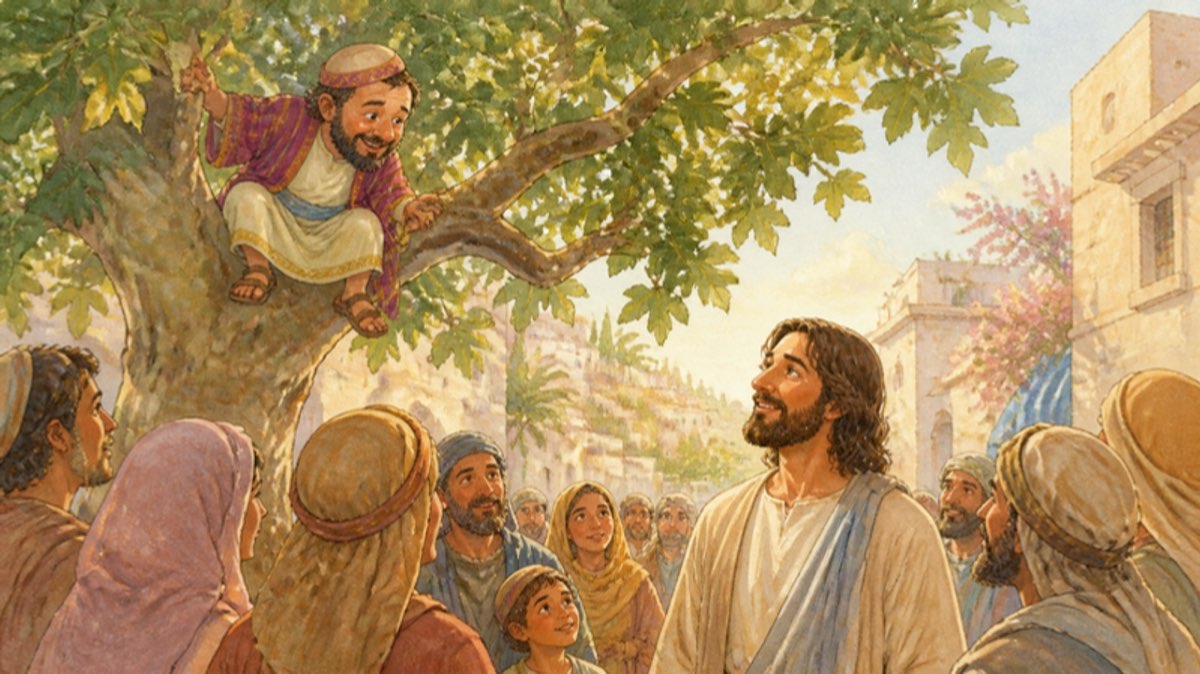
Zacchaeus appears only in Luke 19:1–10. A rich chief tax collector in Jericho, despised for working for the Roman occupiers, climbs a sycamore-fig to see Jesus. Jesus calls him by name and invites himself to his house. Zacchaeus gives half his possessions to the poor and repays anyone he cheated four times over, and Jesus says he came to seek and save the lost.
“Jesus entered Jericho and was passing through” (Luke 19:1, NIV). Passing through. He was on his way to Jerusalem for the last week of his life, and Jericho was a stop on the road, not a destination. Then he stopped under a tree. Most kids already know the song about the “wee little man”; this is the story under the song. Luke 19:1–10 is on BibleGateway (NIV); about five minutes aloud.
Nobody looked at Zacchaeus
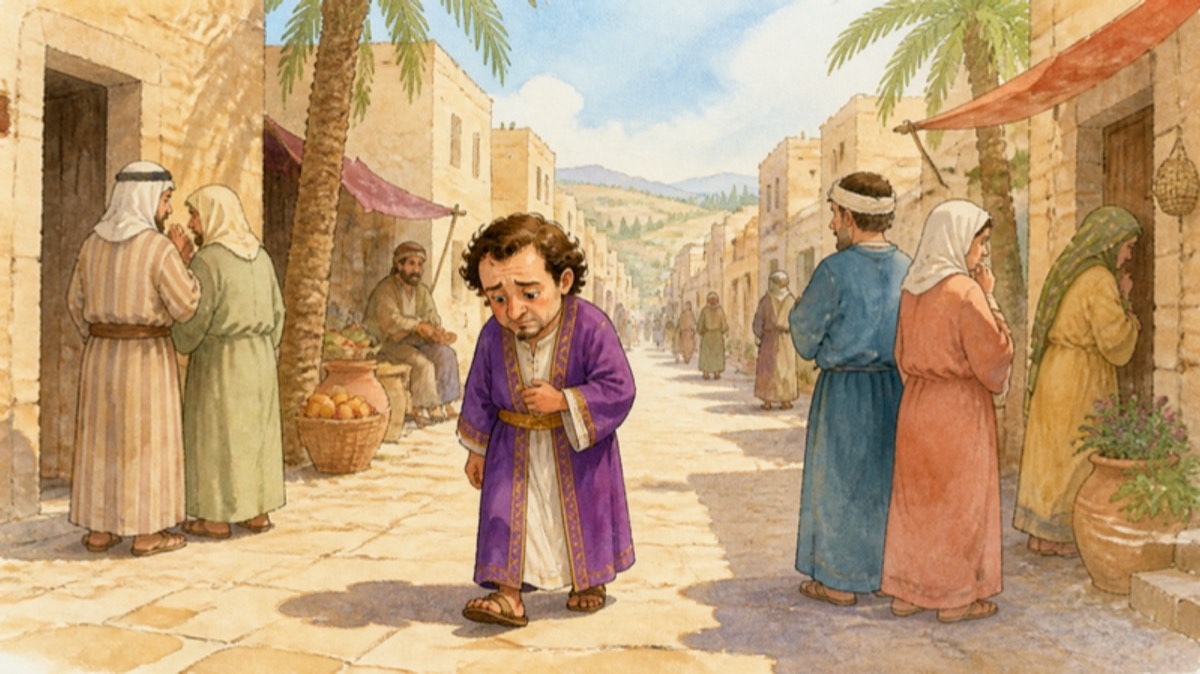
In the town of Jericho there lived a man named Zacchaeus, and nobody looked at him.
Oh, they saw him. He was hard to miss — he wore fine clothes, and he lived in one of the biggest houses in town. But when Zacchaeus walked down the street, people looked at the ground, or at the sky, or at the wall. Nobody said good morning. Nobody waved.
Here’s why. Zacchaeus was a tax collector — the boss of all the tax collectors in Jericho. His job was to collect money from his neighbors and hand it over to the Romans, who ruled the land. And Zacchaeus had a habit of collecting a little extra. And a little more. And keeping it. That’s how he got the big house. Everyone knew it.
Two more things about Zacchaeus: he was very rich, and he was very short.
One morning Jericho was buzzing. “Jesus is coming through! Today! Down the main road!” Everybody had heard about Jesus — the teacher who made blind people see, who told stories you couldn’t forget, who was kind to people nobody else was kind to. The whole town poured out to line the road.
Zacchaeus wanted to see him too. He really, really wanted to see what this Jesus was like. So he hurried down to the road.
But the crowd was already five people deep, and every one of them was taller than Zacchaeus. He stood on his toes. He jumped. He tried to wriggle between two elbows and got a sharp look. Nobody was moving aside for the tax collector. All he could see was backs.
So Zacchaeus did something a rich grown-up in fine clothes was never, ever supposed to do.
He ran. He ran ahead of the crowd, down the road, to a big sycamore-fig tree with wide low branches. He hitched up his robe, grabbed a branch, and climbed — up, and up — until he was sitting in the leaves, high above the road, with the best view in Jericho.
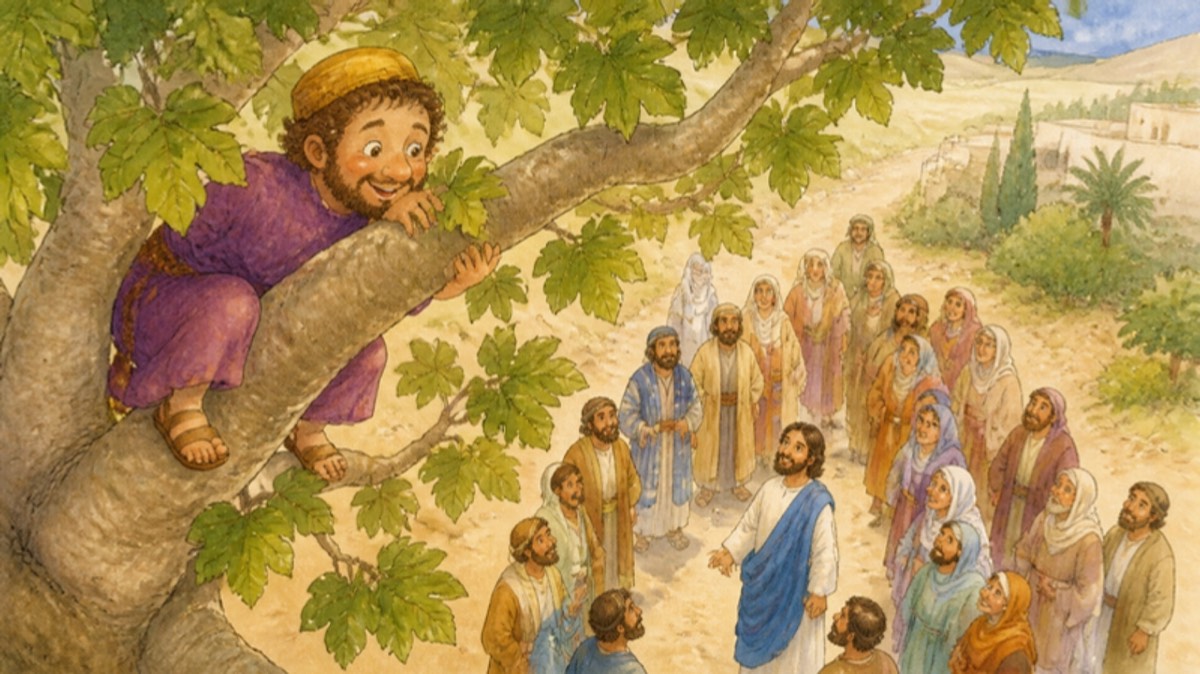
The crowd came closer. The noise got louder. And there, in the middle of it all, was Jesus. Zacchaeus held his breath and looked down.
Jesus walked right under the tree —
— and stopped.
And he looked up.
Right into the branches. Right at Zacchaeus. And he said his name. “Zacchaeus! Come down. Quickly. I have to stay at your house today.”
Zacchaeus nearly fell out of the tree. He scrambled down so fast he scraped his hands, and he stood in front of Jesus with leaves in his hair and his mouth open. My house?
Now the crowd was looking at Zacchaeus — all of them, at once — and they did not look happy. “Did he say Zacchaeus?” they muttered. “He’s going to eat with that man? Doesn’t he know who that is?”
But Jesus didn’t change his mind. He walked home with Zacchaeus, and Zacchaeus was so happy he could hardly walk straight.
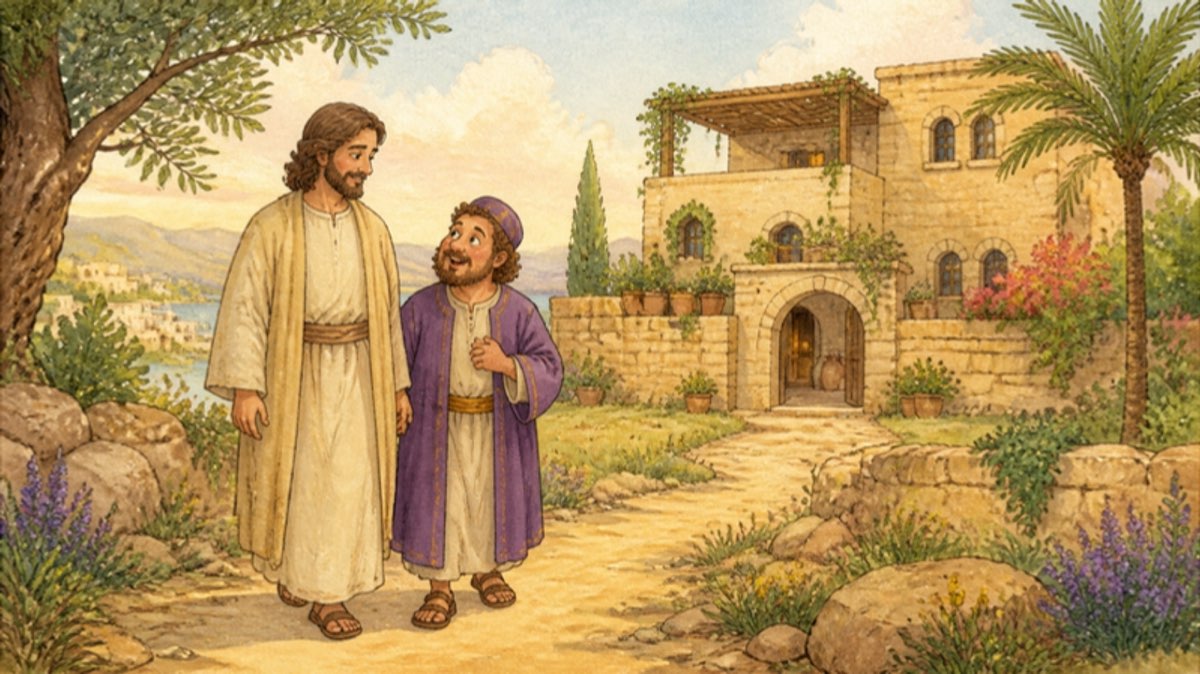
And somewhere between the tree and the front door, something in Zacchaeus turned around.
At the house, in front of everyone, he stood up and said, “Look, Lord! Right now, today — half of everything I own, I’m giving to the poor. And anyone I’ve cheated, I’ll pay back four times what I took.”
Four times! People in the crowd started doing the math. That was a lot of money. But Zacchaeus didn’t look like a man losing money. He looked like a man who’d just been let out of a very small room.
And Jesus said, “Today, rescue has come to this house. This man belongs to God’s family too.” Then he said the sentence that explains the whole day — why he stopped, why he looked up, why he was in Jericho at all:
“The Son of Man came to look for the lost, and to save them.”
What should kids talk about after the Zacchaeus story?
- Zacchaeus climbed a tree even though important grown-ups didn’t do that. What’s something you’d happily look silly doing if it meant you got to see something amazing?
- Jesus didn’t say, “May I come over?” He said, “I must stay at your house today.” Why do you think he invited himself? How would you feel if someone you really admired said that at our front door?
- Zacchaeus paid back four times what he took. If you took two cookies from your sister, what would “four times” look like? Why do you think he gave back more than he took?
Why does Luke place Zacchaeus at the end of the road to Jerusalem?
Only Luke tells it, and he places it at the end of Jesus’ long journey south; a few verses later Jesus is riding into Jerusalem. The story just before it is a blind beggar outside Jericho who shouts for Jesus until Jesus stops (Luke 18:35–43). Then a rich man up a tree. Luke likes putting opposites next to each other.
“I must.” “When Jesus reached the spot, he looked up and said to him, ‘Zacchaeus, come down immediately. I must stay at your house today’” (Luke 19:5, NIV). Enduring Word’s commentary on Luke 19 notes that Jesus knew him by name, and that he didn’t merely want to preach to Zacchaeus from a distance — he went to his house and ate there. Enduring Word also explains why the climbing mattered: a grown, wealthy man up a tree was doing “something that many thought was beneath the dignity” of a person like him. The title “chief tax collector,” Enduring Word adds (citing the scholar Leon Morris), isn’t found anywhere else, so its exact meaning isn’t known, though it seems to mean the head of the local tax office. Tax collectors worked for the Roman occupiers, which is why “He has gone to be the guest of a sinner” (Luke 19:7, NIV) was the crowd’s instant verdict.
Four times. “Look, Lord! Here and now I give half of my possessions to the poor, and if I have cheated anybody out of anything, I will pay back four times the amount” (Luke 19:8, NIV). That number isn’t random. The law of Moses required a thief who stole a sheep to pay back “four sheep for the sheep” (Exodus 22:1, NIV), the steepest penalty for ordinary theft. Zacchaeus volunteered the maximum. Enduring Word reads it simply: after a little time with Jesus, “Zacchaeus knew he had to repent and make restitution.” GotQuestions’ article on Zacchaeus draws the same line — the change showed up first in his money.
The sentence Luke has been building to. “Jesus said to him, ‘Today salvation has come to this house, because this man, too, is a son of Abraham. For the Son of Man came to seek and to save the lost’” (Luke 19:9–10, NIV). Earlier in the Gospel Jesus had said, “I have not come to call the righteous, but sinners to repentance” (Luke 5:32, NIV); Zacchaeus is the last worked example before Jerusalem. Christians read verse 10 as the thesis statement of Luke’s whole book, and this story as the proof: the man nobody would look at, looked at, by name.
The muttering in Luke 19:7 is the same complaint that sets up the lost sheep and the prodigal son four chapters earlier; “the lost” is a Luke word. Where Jesus was headed when he stopped under the tree is the Easter story. And if your child wants to pray something after this one and doesn’t know what, many Christian families start with a simple generated prayer and change the words to their own.
Sources
Luke 19:1–10. Only Luke has it. The blind beggar is Luke 18:35–43 and the entry into Jerusalem is Luke 19:28–40.
- BibleGateway — Luke 19:1–10 (NIV)
- Enduring Word — Luke 19 commentary
- GotQuestions — Who was Zacchaeus in the Bible?
- Blue Letter Bible — Luke 19 with study tools
Questions moms ask
Where is Zacchaeus in the Bible?
What was a chief tax collector?
Why did Zacchaeus pay back four times what he took?
What kind of tree did Zacchaeus climb?
Scripture references in this article
Each reference opens the full passage on BibleGateway (NIV).
Moses and the Burning Bush: The Bible Story for Kids (With Questions to Talk About)
Joseph: The Whole Story, for Grown-ups (From the Pit to Pharaoh's Palace)

The Creation Story: The Bible Story for Kids (With Questions to Talk About)
Jonah and the Big Fish: The Bible Story for Kids (With Questions to Talk About)
Little helps for everyday faith
Start with a few quiet minutes.

Behind the notes
Hi, I'm Vega.
I'm a curious mom in Taiwan reading the Bible and writing down what I learn. I'm not a Christian — I grew up in a Taoist family — but after watching my aunt and the moms around me lean on these words through hard years, I wanted to understand why they carry so much weight. Every verse is quoted from the ESV or NIV and every interpretation links to a public commentary. I'm still learning; if you spot an error, tell me.
A little more about me