Jonah and the Big Fish: The Bible Story for Kids (With Questions to Talk About)
God said east and Jonah sailed west: Jonah retold for ages 3–8, storm to fish to Nineveh to worm, with three questions and why the book ends on a question.
By Vega Lin··Updated October 26, 2026·10 min read-aloud
Quick answer
Jonah's story fills the four short chapters of the book of Jonah, between Obadiah and Micah. God sends Jonah to Nineveh, Jonah sails the other way, a storm hits, and a huge fish swallows him for three days and nights before he finally goes. When the city turns from its wrongs, God spares it, showing mercy even to Israel's enemies.
God said east. Jonah went west. Nineveh lay far to the northeast of Israel, across the desert; Tarshish, where Jonah bought a ticket, was — Enduring Word says — on the coast of what is now Spain, past Gibraltar, about as far the other way as a ship could take you. That’s the first joke in a book that has several, and it ends with a question nobody answers. Jonah 1–4 is on BibleGateway (NIV); about six minutes aloud.
Down, down, down — and then up
God had a job for a man named Jonah.
“Jonah, get up. Go to Nineveh, the great city, and tell the people there that I have seen the terrible things they do.”
Nineveh was a long way to the east. And Jonah did get up. But he went west.
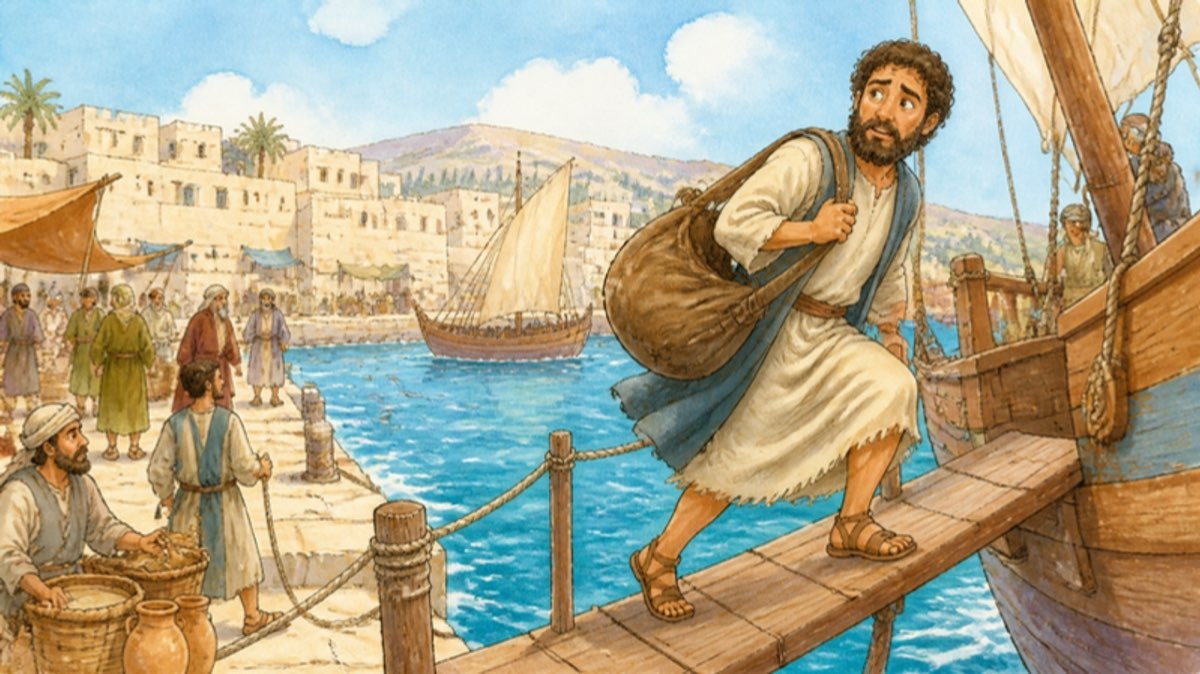
He went down the road to the harbor town of Joppa. He went down to the docks and found a ship sailing to Tarshish — a place so far in the other direction that it was almost off the edge of the map. He paid his money. He went down into the ship. He went down below the deck, lay down, and went to sleep.
As if a boat could take you somewhere God wasn’t.
Out at sea, God sent a wind. The wind made a storm, and the storm grew until the ship groaned and creaked as if it would snap in half. The sailors were tough men who had seen plenty of weather, and they were frightened. They threw the cargo overboard. They each prayed to their own gods. Nothing helped.
And Jonah slept through all of it.
The captain found him. “How can you sleep? Get up! Pray to your God — maybe he’ll notice us!”
Up on deck, the sailors were drawing lots to find out whose fault the storm was. The lot fell on Jonah. “Who are you?” they shouted. “Where are you from? What have you done?”
“I’m a Hebrew,” Jonah said. “I worship the God who made the sea and the land. And I’m running away from him.”
The sailors’ faces went white. “Then what should we do with you?”
Jonah looked at the waves. “Throw me in,” he said. “This storm is because of me.”
But they didn’t want to. They were decent men. They grabbed the oars and rowed for the shore with everything they had — and the sea only got wilder. At last, begging God not to blame them, they picked Jonah up and dropped him over the side.
The sea went flat.
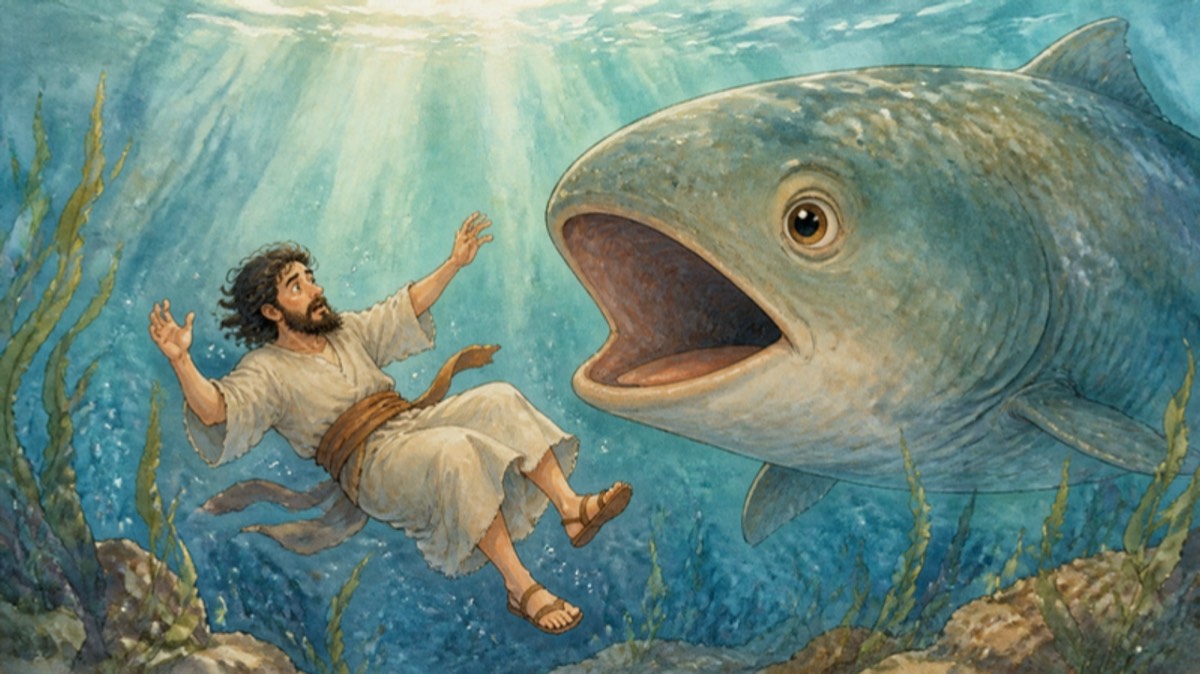
And Jonah went down. Down through the green water, down past the seaweed, down into the dark —
— and God sent a fish. A huge fish, the biggest you can imagine. It opened its mouth and swallowed Jonah whole.
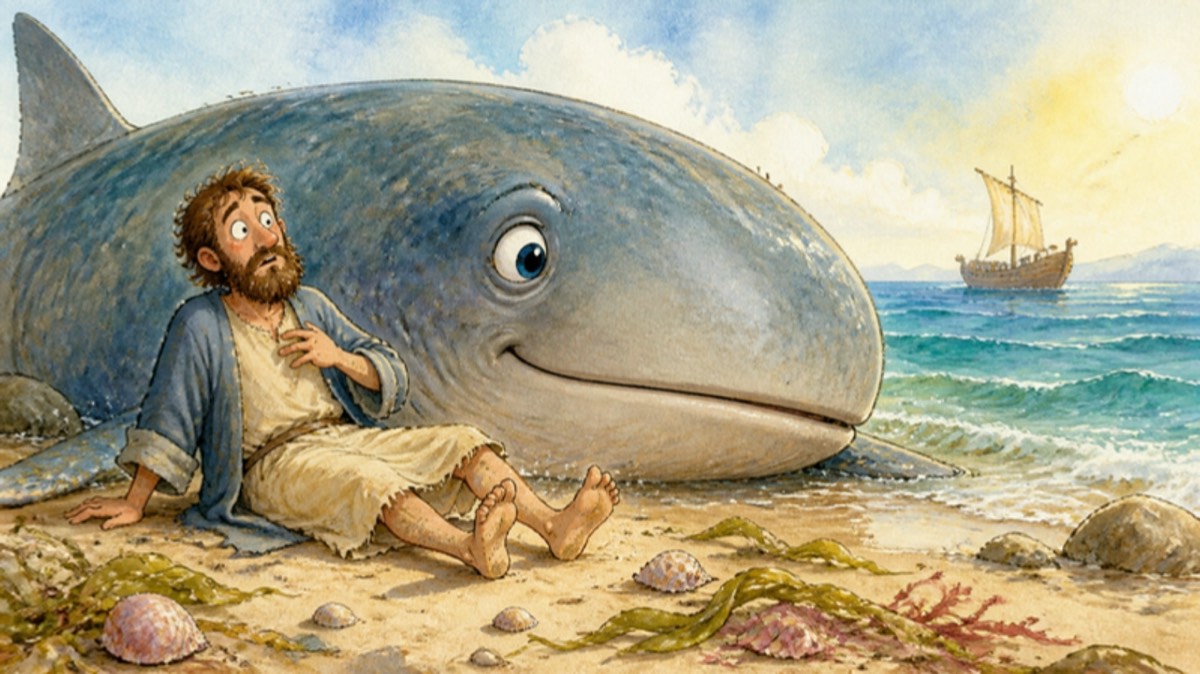
Inside the fish it was dark, and wet, and it smelled exactly the way you think. Jonah was in there for three days and three nights. And in there, at the very bottom of everything, Jonah finally prayed. He said thank you. He said, “Rescue comes from God.” And God spoke to the fish, and the fish swam to the beach and — blaaargh — spat Jonah out onto the sand.
Then God said it again, the same words as before. “Get up. Go to Nineveh.”
This time Jonah went.
Nineveh was so big it took three days to walk across. Jonah walked in and shouted the only message he had: “Forty more days and Nineveh will be knocked down!” And something nobody expected happened. The people listened. They stopped what they were doing. They put on rough, scratchy clothes to show they were sorry. Even the king climbed down off his throne, took off his robe, and sat in the dust. “Everyone, stop doing wrong,” he said. “Maybe God will change his mind.”
And God saw it, and God did not knock Nineveh down.
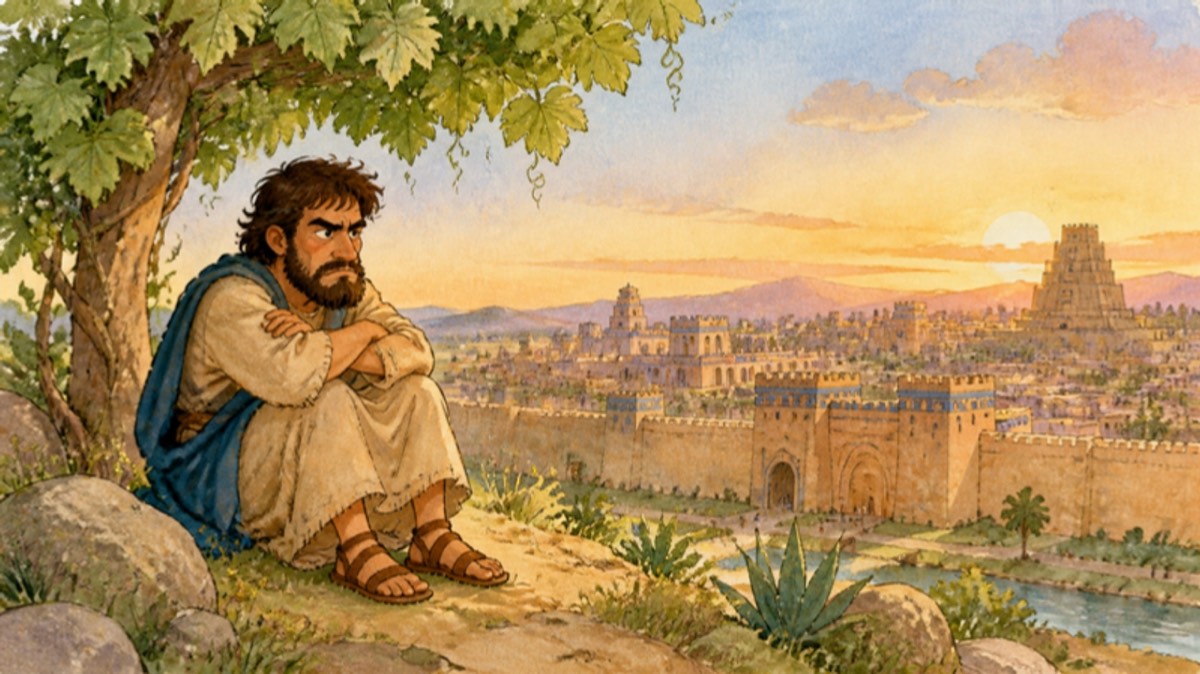
Was Jonah glad? Jonah was furious. “I knew it!” he said to God. “I knew this would happen. That’s why I ran away! I knew you were kind and slow to get angry and full of love, and I knew you’d forgive them!” He stomped out of the city, built himself a little shelter on a hill, and sat down to sulk.
God made a leafy plant grow up over Jonah’s head for shade, and Jonah loved that plant. The next morning God sent a worm, and the worm chewed the plant, and it wilted. Then God sent a hot east wind, and the sun beat down on Jonah’s head, and Jonah said, “I’d rather be dead.”
And God asked him a question.
“You feel sorry for a plant. You didn’t plant it. You didn’t water it. It came up in one night and died in one night. And you don’t think I should feel sorry for a whole city — more than a hundred and twenty thousand people who don’t know their right hand from their left — and all their animals too?”
That’s the last line of the book. Jonah doesn’t answer. The page just ends.
What questions can you ask kids about Jonah?
Jonah bought a ticket going the exact opposite way. If you could get on a boat to get out of doing one thing, what would it be? Where would you sail?
The sailors didn’t want to throw Jonah in — they rowed hard first. Who were the kind people in this story? Were they the ones you expected to be kind?
God asks Jonah a question, and the book just stops. Why do you think the writer didn’t tell us what Jonah said? What would you say to God, sitting on that hill?
What does the story of Jonah teach?
Jonah is four short chapters, and the fish is in three verses of it. The rest is about a prophet who knew exactly what God was like and ran because of it.
Jonah’s confession is the key. When he finally explains himself, he quotes the kind of description of God that shows up all through the Old Testament: “I knew that you are a gracious and compassionate God, slow to anger and abounding in love, a God who relents from sending calamity” (Jonah 4:2, NIV). He isn’t doubting. He’s objecting. Nineveh was the capital of Assyria — GotQuestions describes the Assyrians as “notorious for their cruelty” and a longtime enemy of Israel — and Jonah did not want them forgiven. Enduring Word’s commentary on Jonah 4 hangs the whole chapter on God’s question in verse 4, “Is it right for you to be angry?”, and observes that God “likes to ask us questions because they reveal our hearts.”
God “provided” four things. The NIV uses the same verb each time: “the Lord provided a huge fish” (Jonah 1:17), “the Lord God provided a leafy plant” (Jonah 4:6), “God provided a worm” (Jonah 4:7), and “God provided a scorching east wind” (Jonah 4:8). Enduring Word notes that the repeated phrase shows God’s patience with Jonah “involved deliberate, personal acts designed to reshape the prophet’s understanding of mercy.” The fish, in other words, is the first of four lessons, not the point of the story.
Jesus pointed at it. “For as Jonah was three days and three nights in the belly of a huge fish, so the Son of Man will be three days and three nights in the heart of the earth” (Matthew 12:40, NIV). Christians read that as Jesus using Jonah as a preview of his own death and resurrection, which is why this story shows up in Easter lessons. On whether the fish was literal: GotQuestions takes the plain historical reading, and other Christian traditions treat the book as a pointed teaching story. Either way, God’s last question lands the same.
For kids who want the Easter connection, the Easter story is the other three-days story. The other Bible scene with a man asleep below deck in a storm is Jesus calming the storm, and the contrast is worth a conversation. The Bible timeline shows the kings-and-prophets era Jonah belongs to, when Assyria was the superpower next door.
Sources
The whole book of Jonah: four chapters between Obadiah and Micah. Chapter 1 is the ship, 2 the prayer inside the fish, 3 Nineveh, 4 the plant.
For a hard day
These are one curious mom's study notes, not pastoral counsel or medical advice. If today is heavier than a verse can carry, please reach out to your pastor, a licensed counselor, or your doctor — and if you're in crisis in the US, call or text 988.
Questions moms ask
Where is Jonah in the Bible?
The book of Jonah — four short chapters in the Old Testament, between Obadiah and Micah. Chapter 1 is the ship and the fish, chapter 2 is Jonah's prayer from inside the fish, chapter 3 is Nineveh, and chapter 4 is the plant and God's final question.
Was it a whale?
The Bible never says whale. Jonah 1:17 says "the Lord provided a huge fish" (NIV), and Jesus uses the same words in Matthew 12:40. "Whale" comes from older English translations and picture books; this retelling says "big fish" to match the text.
Why didn't Jonah want to go to Nineveh?
Nineveh was the capital of Assyria, a cruel empire and a longtime enemy of Israel. Jonah says why himself in Jonah 4:2: he knew God was "gracious and compassionate" (NIV) and he didn't want those people forgiven. He wasn't afraid of the city; he was afraid God would be kind to it.
How does the book of Jonah end?
With a question. God asks Jonah whether he shouldn't care about a city of more than 120,000 people, "and also many animals" (Jonah 4:11, NIV) — and the book stops there. Jonah's answer is never recorded.
Scripture references in this article
Each reference opens the full passage on BibleGateway (NIV).
I'm a curious mom in Taiwan reading the Bible and writing down what I learn. I'm not a Christian — I grew up in a Taoist family — but after watching my aunt and the moms around me lean on these words through hard years, I wanted to understand why they carry so much weight. Every verse is quoted from the ESV or NIV and every interpretation links to a public commentary. I'm still learning; if you spot an error, tell me.