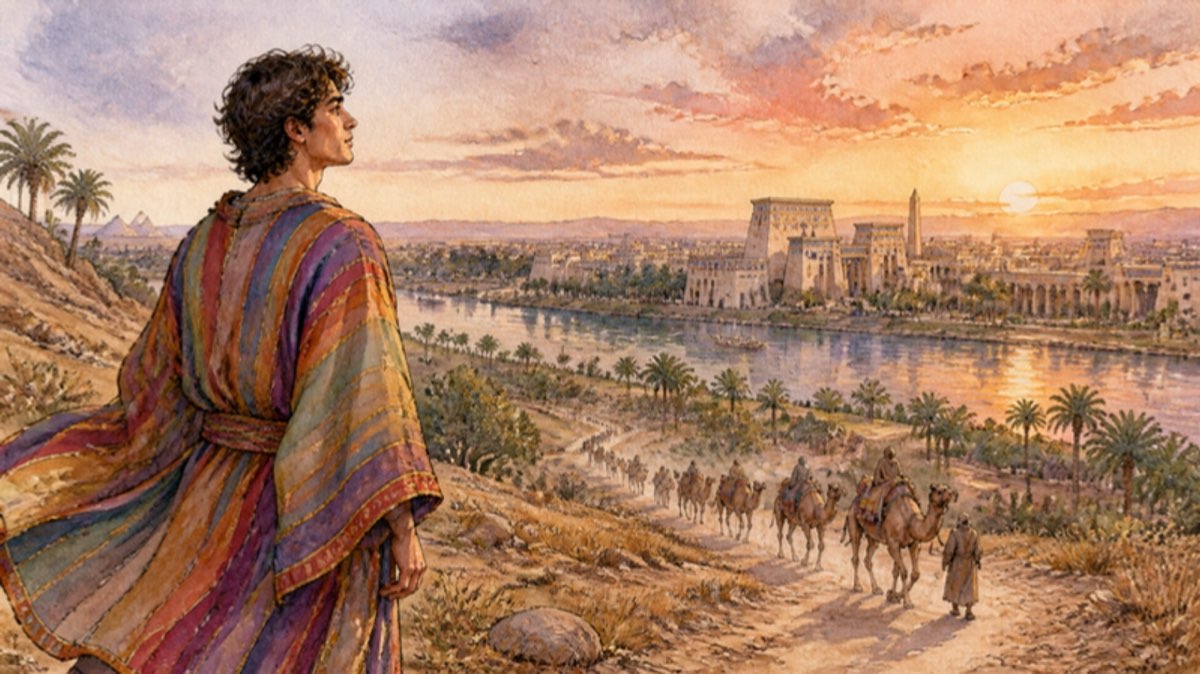
Joseph's story runs through Genesis 37–50. Sold into slavery by jealous brothers, Joseph rises from Potiphar's house and an Egyptian prison to become Pharaoh's second-in-command, storing grain before a seven-year famine. When his brothers come to Egypt to buy food, he tests them and then forgives them, saying God meant their harm for good and the saving of many lives.
This is the longest continuous story in Genesis, chapters 37 through 50. Reading it straight through on BibleGateway (NIV) takes about forty-five minutes.
The favorite son and the robe
Jacob had twelve sons by four women, and he loved Joseph, the first son of his favorite wife Rachel, more than the rest. He made no secret of it; he gave the seventeen-year-old a special robe. Joseph made things worse. He brought his father bad reports about his brothers, and he told them his dreams: sheaves of grain bowing to his sheaf, and then the sun, moon, and eleven stars bowing to him. Even Jacob rebuked him for that one. His brothers hated him.
One day Jacob sent Joseph to check on his brothers, who were grazing the flocks far from home. They saw him coming — the robe gave him away — and decided to kill him. Reuben, the eldest, talked them down to throwing him into a dry cistern, meaning to rescue him later. They stripped off the robe and threw him in. While they ate, a caravan of Ishmaelite traders came by on the road to Egypt, and Judah proposed selling Joseph instead of killing him. Twenty shekels of silver changed hands. The brothers dipped the robe in goat’s blood and brought it to their father, who concluded that a wild animal had torn his son apart. Jacob tore his clothes and refused to be comforted.
From the cistern to Pharaoh’s court
In Egypt, Joseph was sold to Potiphar, an officer of Pharaoh. The text says simply, “The Lord was with Joseph so that he prospered, and he lived in the house of his Egyptian master” (Genesis 39:2, NIV). Potiphar noticed, and put Joseph in charge of everything he owned. Then Potiphar’s wife noticed Joseph too, and pressed him day after day to sleep with her. He refused: “How then could I do such a wicked thing and sin against God?” (Genesis 39:9, NIV). One day, with no one else in the house, she grabbed his cloak; he ran, leaving it in her hand. She used it as evidence, told her husband the Hebrew slave had tried to assault her, and Joseph was thrown into the king’s prison.
In prison the same pattern repeated: the warden put Joseph in charge. Two of Pharaoh’s officials — the cupbearer and the baker — landed in the same prison and each had a troubling dream. Joseph interpreted them: the cupbearer would be restored in three days, the baker executed. Both came true. Joseph asked the cupbearer to mention him to Pharaoh. The cupbearer forgot. Two more years passed.
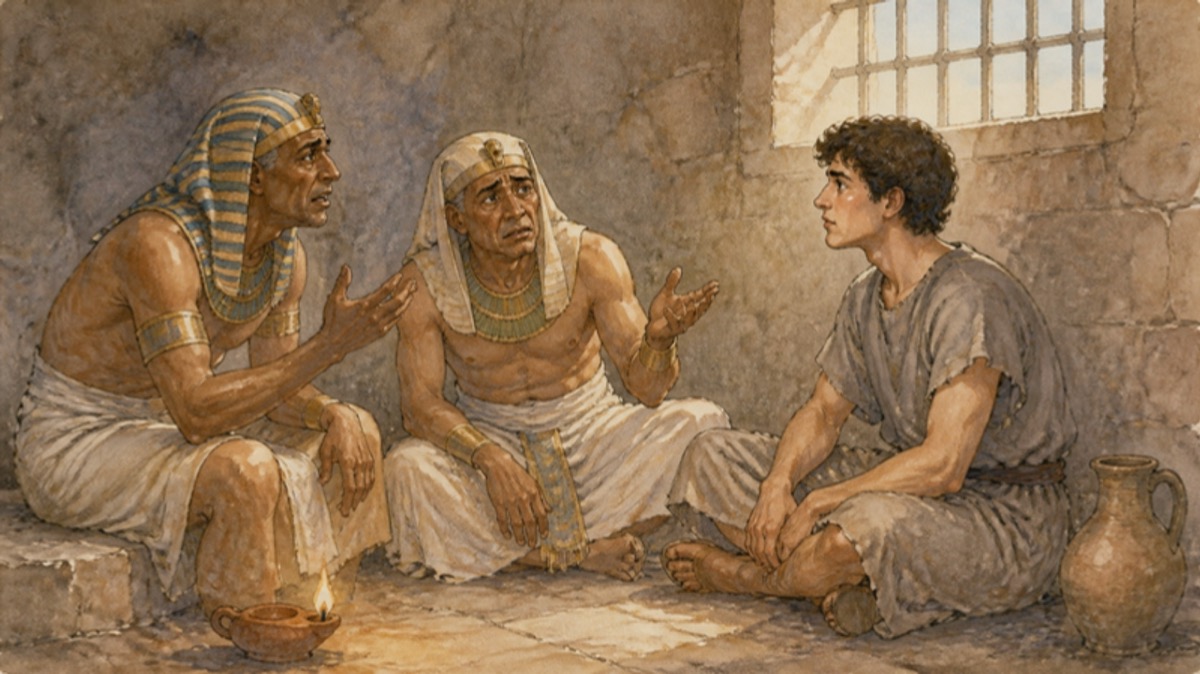
Then Pharaoh dreamed — seven fat cows swallowed by seven gaunt ones, seven full heads of grain swallowed by seven withered ones — and none of his magicians could explain it. The cupbearer finally remembered the Hebrew in prison. Joseph was shaved, dressed, and brought before Pharaoh, and said at once that the interpretation was not his but God’s. The dreams were one message: seven years of abundance, then seven years of famine so severe the good years would be forgotten. He advised Pharaoh to appoint a wise administrator and store a fifth of each harvest.
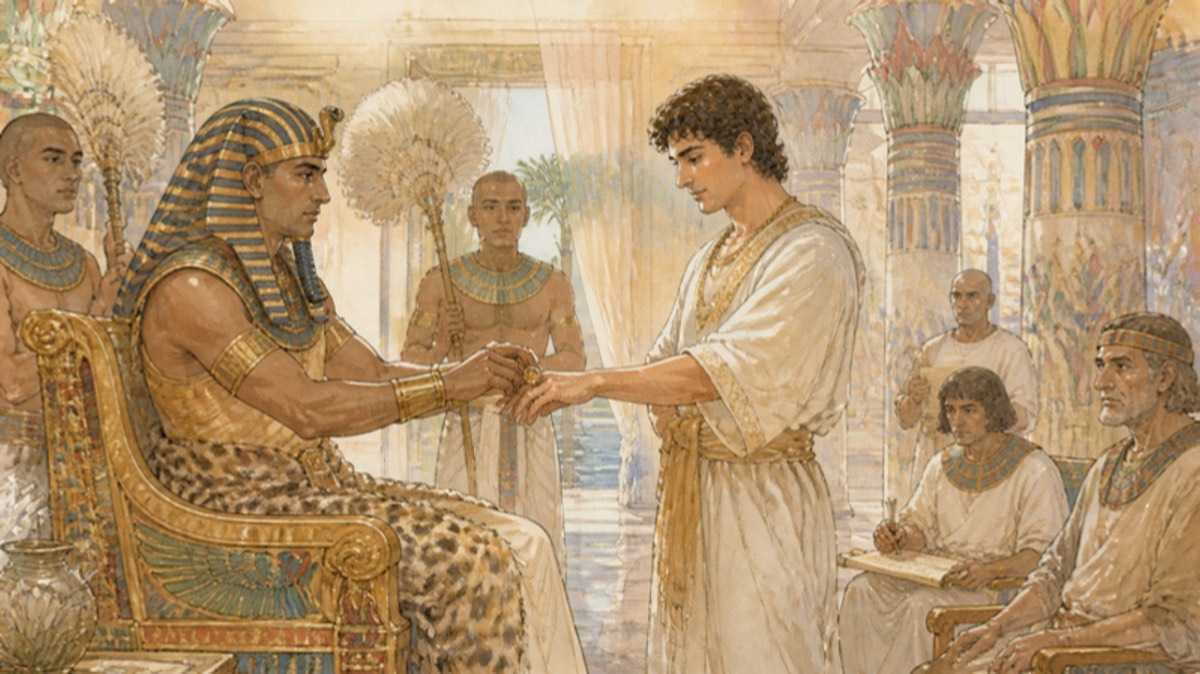
Pharaoh appointed Joseph. At thirty, the slave from the cistern was second in command of Egypt, with Pharaoh’s signet ring, fine linen, a gold chain, a chariot, an Egyptian name, and an Egyptian wife, Asenath, who bore him two sons. He named them Manasseh — “God has made me forget all my trouble” — and Ephraim — “God has made me fruitful in the land of my suffering” (Genesis 41:51–52, NIV). For seven years he stored grain beyond counting.
The brothers bow without knowing
The famine came, and it reached Canaan. Jacob sent ten of his sons to Egypt to buy grain, keeping back Benjamin, Rachel’s other son. The brothers bowed before the Egyptian governor without recognizing him. Joseph recognized them. He spoke harshly through an interpreter, accused them of spying, jailed them for three days, then kept Simeon as a hostage and sent the rest home with grain — and with their silver secretly returned in their sacks — demanding they bring their youngest brother back. In the hearing of a brother they thought couldn’t understand them, they said to each other that this was punishment for what they had done to Joseph. Joseph turned away and wept.
Jacob refused to send Benjamin until the grain ran out. Judah finally pledged his own life for the boy, and the brothers returned. Joseph received them at his house, asked about their father, saw Benjamin, and had to leave the room to weep again. He seated them in birth order, which unsettled them, and served Benjamin five times as much as the others. Then he set the trap: his silver cup was hidden in Benjamin’s sack. The brothers were stopped on the road, the cup found, and they were hauled back. Joseph said only the guilty one would stay as his slave; the rest could go home.
“I am Joseph”
This was the test, and Judah passed it. He stepped forward and gave a long, raw speech — about their father’s grief, about the boy whose loss would kill the old man, about his own pledge — and ended by asking to stay as a slave in Benjamin’s place. It was the opposite of what Judah had done twenty-two years earlier. Joseph could not hold it in any longer. He sent every Egyptian out of the room and told his brothers, weeping so loudly the household heard, “I am Joseph! Is my father still living?” They were speechless with terror. He called them closer. “Do not be distressed and do not be angry with yourselves for selling me here, because it was to save lives that God sent me ahead of you” (Genesis 45:5, NIV). Five more years of famine remained; they should bring their father and settle in Egypt.
Jacob, when told, didn’t believe it until he saw the Egyptian carts. He traveled to Egypt with his whole household — seventy people — and God spoke to him on the way, promising to go with him. Joseph met his father in Goshen and wept on his neck a long time. Pharaoh gave the family the best of the land. Jacob lived seventeen more years, blessed Joseph’s sons and his own, and died asking to be buried in Canaan.
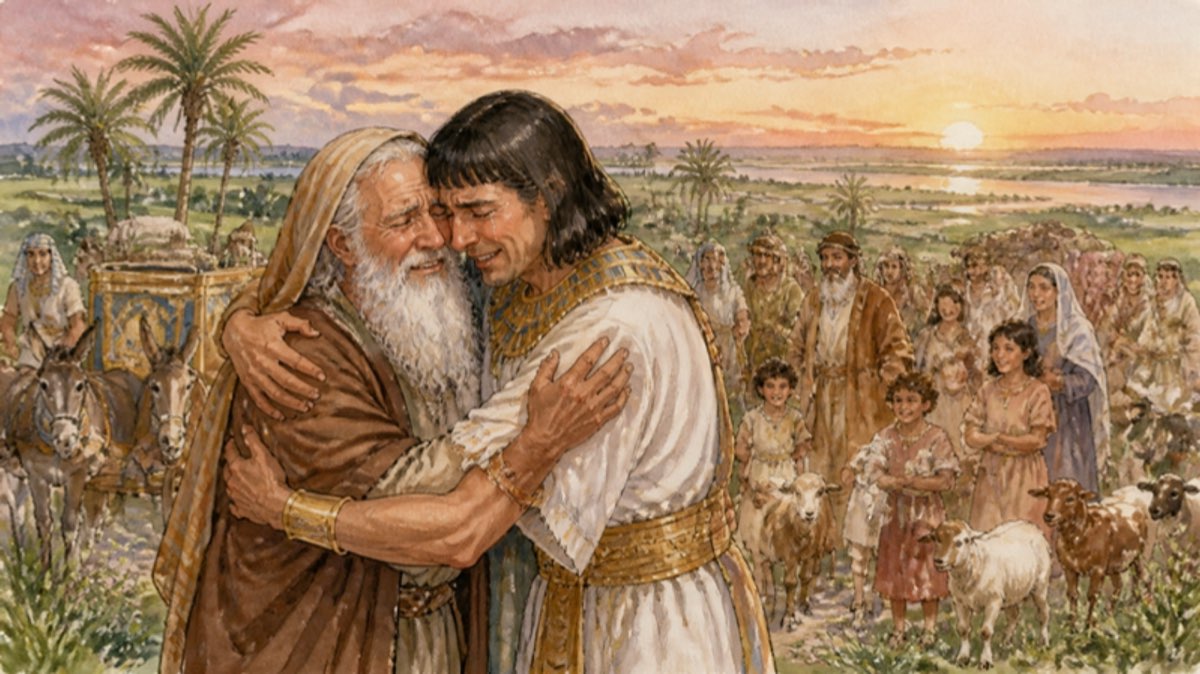
After the funeral the brothers panicked: with their father gone, would Joseph finally take revenge? They sent a message and then came and threw themselves down before him. Joseph wept again. “You intended to harm me, but God intended it for good to accomplish what is now being done, the saving of many lives” (Genesis 50:20, NIV). He promised to provide for them and their children. He lived to a hundred and ten, saw his great-grandchildren, and made his family swear that when God brought them back to the promised land, they would carry his bones with them. Genesis ends with Joseph in a coffin in Egypt, waiting.
What is the historical background of Joseph’s story?
Who these people are. Joseph is Jacob’s eleventh son; Jacob is the grandson of Abraham, renamed Israel (Genesis 32:28). The twelve sons become the twelve tribes, which is why the story matters to the rest of the Bible: it explains how Abraham’s family ended up in Egypt, setting up the Exodus.
Favoritism and polygamy. Jacob had two wives, Leah and Rachel, and their two servants as secondary wives (Genesis 29–30). He loved Rachel; Leah was the one he was tricked into marrying. The sons knew where they stood. Enduring Word’s commentary on Genesis 37 (below) notes that the robe and the dreams land in a family already fractured by the father’s choices.
Egypt. Dream interpretation was a recognized profession at Egyptian courts, grain was stored in state granaries, and Egyptians embalmed their dead — all details Genesis 41 and 50 reflect. The traditional dating places Joseph in the Middle Kingdom or Second Intermediate Period (roughly 1900–1600 BC); scholars debate the chronology and no Egyptian text names him. Genesis 46:34 says shepherds were “detestable to the Egyptians,” which is why Goshen, on the eastern delta, suited the family.
Twenty shekels. The price in Genesis 37:28 is the going rate for a slave in Old Babylonian law codes from roughly that era, a detail commentators cite when discussing the story’s setting.
The dreams. Three pairs of dreams structure the story — Joseph’s two, the officials’ two, Pharaoh’s two — and each pair comes true. In Genesis 41:32 Joseph says the doubling means “the matter has been firmly decided by God.” The pattern is the narrator’s way of saying that events the characters experience as chaos are, underneath, ordered.
What does the story of Joseph mean?
It is the Bible’s clearest statement that God works through human wrong without excusing it. Joseph says it twice: “it was to save lives that God sent me ahead of you” (Genesis 45:5, NIV) and “You intended to harm me, but God intended it for good” (Genesis 50:20, NIV). The brothers’ sin is still sin — Joseph never says otherwise — and yet God’s purpose runs through it. Christians connect this directly to Paul’s line that “in all things God works for the good of those who love him” (Romans 8:28, NIV). How exactly God’s sovereignty and human responsibility fit together is one of the oldest debates in Christian theology; Calvinist and Arminian traditions explain the mechanism differently, but both read Genesis 50:20 as foundational.
It is a story about forgiveness that costs something. Joseph doesn’t forgive cheaply. He tests his brothers over two visits and only reveals himself when Judah offers his own life for Benjamin — proof that the man who sold him has changed. Commentators read the testing not as cruelty but as Joseph discerning whether reconciliation is real. Then he provides for the people who tried to destroy him, for the rest of his life.
It sets up the Exodus and, for Christians, previews Jesus. Genesis ends with Israel in Egypt and Joseph’s unburied bones; Exodus opens with a new king “to whom Joseph meant nothing” (Exodus 1:8, NIV). Many Christians also read Joseph as a “type” of Christ — the beloved son rejected by his brothers, sold for silver, suffering unjustly, and raised up to save the very people who betrayed him. The New Testament doesn’t make that comparison explicitly (Stephen’s speech in Acts 7:9–14 simply retells the history), so it is a traditional interpretation rather than a stated one; the sources below include both the historical and the typological readings.
Who gets to say “God meant it for good”
Genesis turns out to contain a novel: a trap with a silver cup, a brother's raw speech, a governor who keeps leaving the room to cry. It's the longest story I've read in the Bible so far, and the one that moved me most.
What got me was the waiting. Thirteen years from the cistern to the palace, two of them in prison because a man forgot to mention him. The story doesn't speed that up or explain it. As a mom who likes to fix things fast, I noticed how often the text just says "the Lord was with Joseph" and then moves on, as if that were the whole answer to a terrible year.
This is the part I'd pass on: the famous line — "you intended to harm me, but God intended it for good" — is said by the person who was harmed, twenty years later, to the people who did it. It isn't something you say to someone else about their pain. That seems important.
Sources and further reading
- BibleGateway — Genesis 37–50 (NIV)
- Enduring Word — Genesis 37 commentary, Genesis 39, Genesis 45, Genesis 50
- GotQuestions — Who was Joseph in the Old Testament?
- Blue Letter Bible — Genesis 37 with study tools
Questions moms ask
Where is the story of Joseph in the Bible?
Was Joseph's coat really 'of many colors'?
Is the story of Joseph historical?
Scripture references in this article
Each reference opens the full passage on BibleGateway (NIV).
Moses and the Burning Bush: The Bible Story for Kids (With Questions to Talk About)

The Creation Story: The Bible Story for Kids (With Questions to Talk About)

Jonah and the Big Fish: The Bible Story for Kids (With Questions to Talk About)
Ruth: The Whole Story, for Grown-ups (Loyalty, Loss, and a Kinsman-Redeemer)
Little helps for everyday faith
Start with a few quiet minutes.

Behind the notes
Hi, I'm Vega.
I'm a curious mom in Taiwan reading the Bible and writing down what I learn. I'm not a Christian — I grew up in a Taoist family — but after watching my aunt and the moms around me lean on these words through hard years, I wanted to understand why they carry so much weight. Every verse is quoted from the ESV or NIV and every interpretation links to a public commentary. I'm still learning; if you spot an error, tell me.
A little more about me