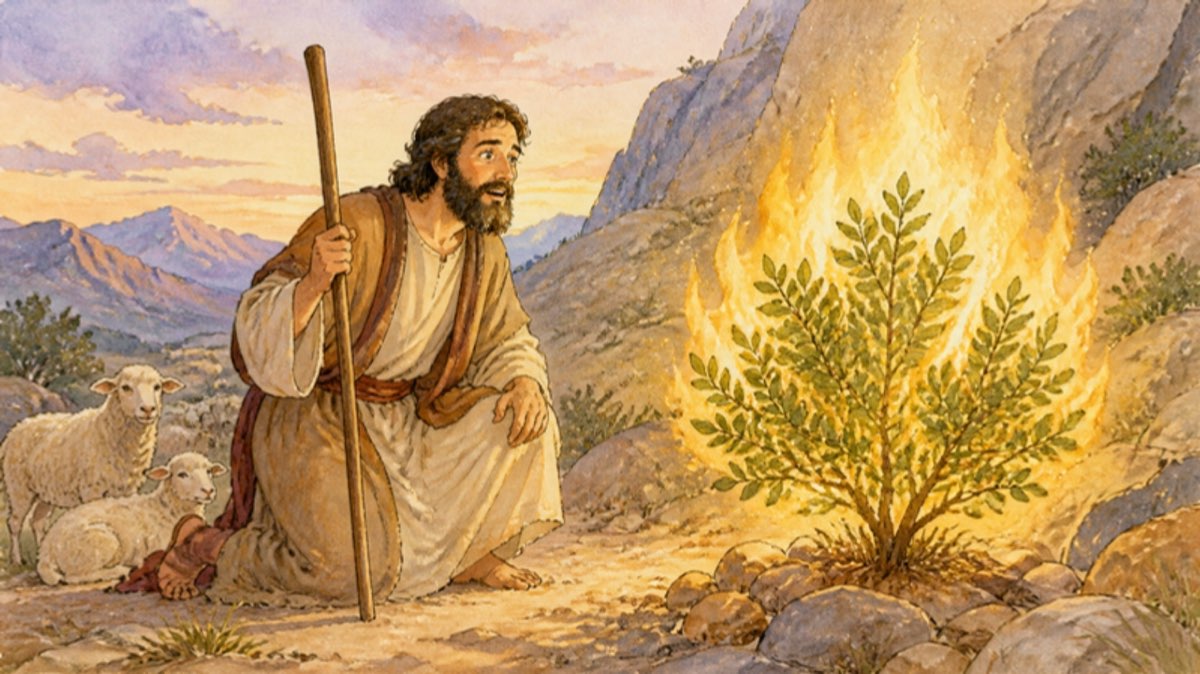
The burning bush story is in Exodus 3:1–4:17. Moses, an eighty-year-old shepherd in Midian, sees a bush that burns without burning up. God tells him to take off his sandals, gives his name as I AM WHO I AM, and sends him to bring the Israelites out of Egypt. Moses objects five times, and God answers that he will be with him.
Forty years after the basket in the river, Moses is an eighty-year-old shepherd with a stick — Exodus 7:7 gives his age — and the first thing God says to him, after his name, is to take off his shoes. That’s usually the first thing a child asks about, too. The passage is Exodus 3:1–4:17, on BibleGateway (NIV); about six minutes aloud. If your child doesn’t know how Moses ended up in the desert, baby Moses in the basket is the chapter before.
Five “buts”
Moses says “but” five times in this story. Hold up a finger each time you hear one.
Moses used to be a prince in Egypt. But he had run away — far across the desert to a land called Midian — and there he’d married, and settled down, and become a shepherd. For forty years. Forty years of walking sheep to grass and walking sheep to water and counting sheep at night. His hair had gone gray. He had a wooden staff he leaned on. Egypt was a long time ago.
Back in Egypt, though, Moses’ own people, the Israelites, were slaves. They worked from dark to dark for a cruel king, and they cried out, and it seemed as if nobody heard.
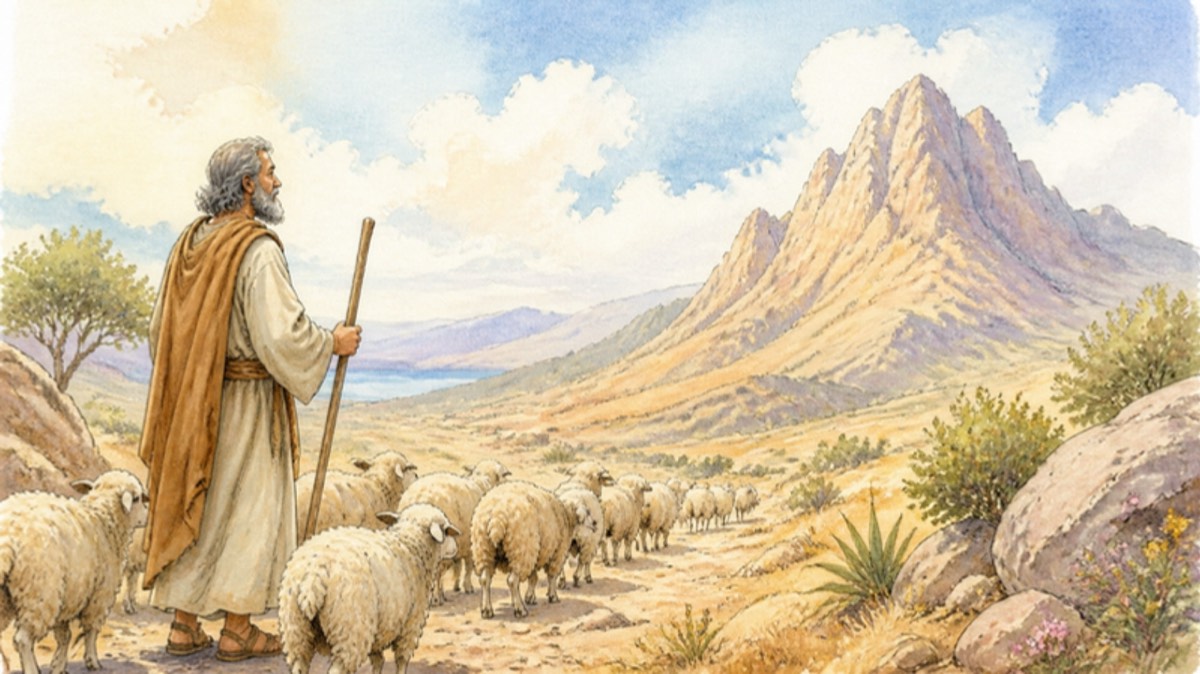
One day Moses led the sheep far out to the edge of the desert, to a mountain called Horeb. And he saw a bush on fire.
Bushes caught fire sometimes, out there in the heat. That wasn’t the strange part. The strange part was that it kept burning. The flames danced, and the leaves stayed green. The branches didn’t turn black. Nothing crumbled. Moses watched, and watched, and the bush did not burn up.
“I’ve got to go and look at that,” he said.
And when he got close, a voice came out of the bush. “Moses! Moses!”
“Here I am,” said Moses.
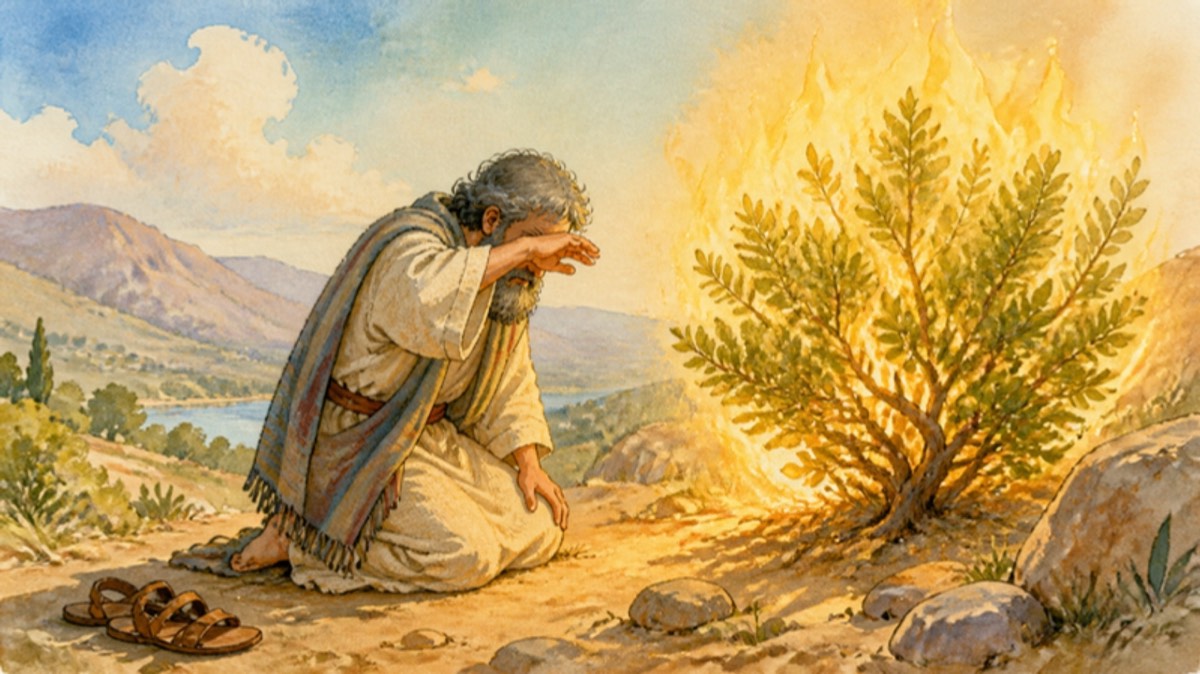
“Don’t come any closer. Take off your sandals. The ground you’re standing on is holy ground. I am the God of your father — the God of Abraham, of Isaac, and of Jacob.”
Moses slipped off his sandals and stood barefoot on the warm rock. Then he put his arm over his face, because he was afraid to look.
“I have seen my people suffering in Egypt,” God said. “I have heard them crying. I know how much it hurts. And I have come down to rescue them and bring them to a good, wide land. So — go. I’m sending you to the king of Egypt. You will bring my people out.”
But. (That’s one.) Moses peeked out from behind his arm. “Me? Who am I, to go to the king? I’m a shepherd.”
“I will be with you,” God said.
But. (Two.) “What if I go to the Israelites and tell them your God sent me, and they say, ‘Oh really? What’s his name?’ What do I tell them?”
And God told Moses his name. “I AM WHO I AM. Tell them: I AM has sent you.”
But. (Three.) “What if they don’t believe me?”
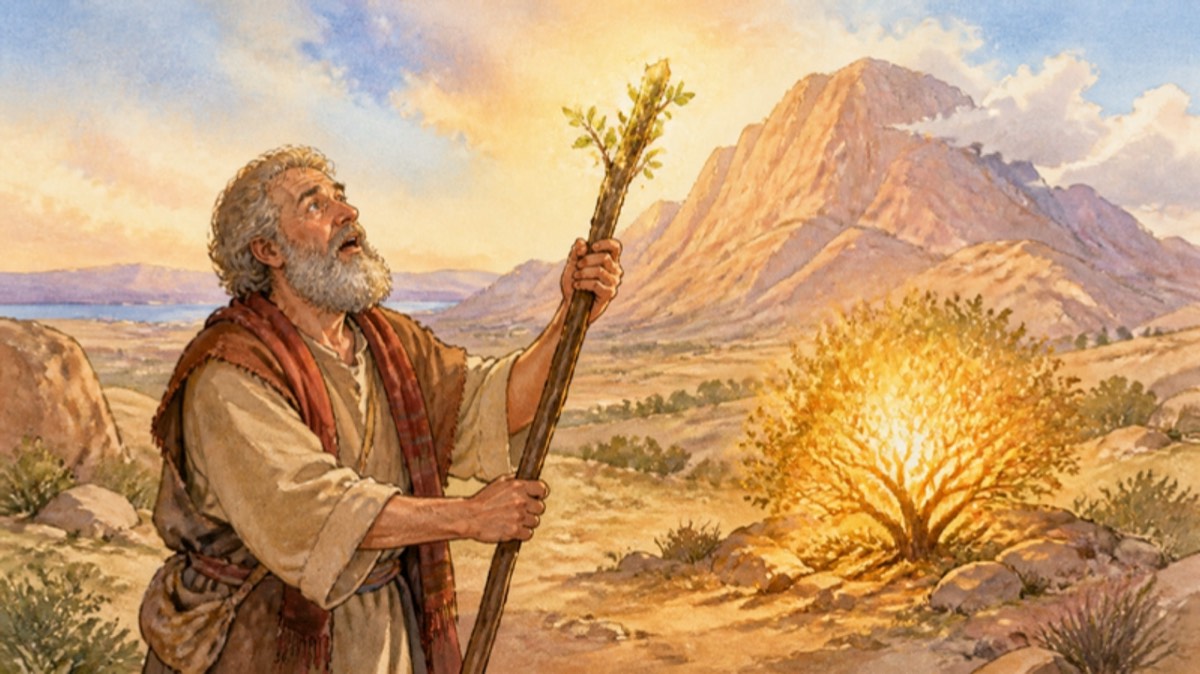
“What’s that in your hand?” God asked.
Moses looked down. “My staff.” His plain old walking stick.
“Throw it on the ground.” Moses threw it down — and it was a snake. Moses jumped back. “Pick it up. By the tail.” Moses reached out, very carefully… and the snake was a stick again, resting in his hand. “Show them that,” God said, “and they’ll believe you.”
But. (Four.) “Lord, I’m not a good talker. I never have been. The words get stuck.”
“Who made your mouth?” God said. “Go. I’ll help you speak. I’ll teach you what to say.”
But. (Five — and this is the one where Moses runs out of reasons.) “Please. Just send somebody else.”
God did not send somebody else. But he did send help. “Your brother Aaron talks well,” God said. “He’s already walking out here to meet you. You tell him what I tell you, and he can do the speaking. And take your staff. You’re going to need it.”
So Moses put his sandals back on. He picked up his stick. And he walked back down the mountain to his sheep — to get ready for the biggest job anyone had ever been given.
What should you ask kids about the burning bush?
- Moses hid his face. When something is very, very big — fireworks, a huge wave, a thunderstorm — do you want to look, or look away? Why do you think Moses looked away?
- Five “buts.” Which of Moses’ worries sounds most like you: “Who am I?”, “What if they don’t believe me?”, “I’m not a good talker,” or “Please send someone else”? What did God say back to that one?
- God asked, “What’s that in your hand?” What’s in your hand right now — what do you already have, or already know how to do, that could help somebody?
What does the burning bush story mean?
Exodus 3 is where the Bible’s biggest rescue story starts, and it starts with God talking to a man who would rather not be involved.
The first time anything is called holy. “‘Do not come any closer,’ God said. ‘Take off your sandals, for the place where you are standing is holy ground’” (Exodus 3:5, NIV). GotQuestions points out that this is the first time the Bible uses the word “holy” with reference to God. Enduring Word reads the bare feet as humility: the poorest people had no shoes, and servants went barefoot. GotQuestions also reads the fire that didn’t consume the bush as a picture of what God intended — not to destroy his people but to save them.
God moves first. Before any job is mentioned: “I have indeed seen the misery of my people in Egypt. I have heard them crying out because of their slave drivers, and I am concerned about their suffering. So I have come down to rescue them” (Exodus 3:7–8, NIV). Seen, heard, come down — and only then, “So now, go. I am sending you to Pharaoh to bring my people the Israelites out of Egypt” (Exodus 3:10, NIV). Christians read all of Exodus in this order: God notices, God comes, God sends somebody.
The name. Moses asks what to say if the people want a name, and God answers: “I am who I am. This is what you are to say to the Israelites: ‘I am has sent me to you’” (Exodus 3:14, NIV). Enduring Word takes the name to reveal God’s “complete independence, eternity, and unchanging nature,” and adds that it also means God “becomes whatever we need in our time of need.” GotQuestions’ article on the verse connects it to the name Yahweh, printed as “the Lord” in English Bibles, and to Jesus’ “before Abraham was born, I am!” in John 8:58. Jewish and Christian readers weigh the Hebrew differently; I’ve linked the pages I actually read rather than guess.
Five buts and a stick. The objections are Exodus 3:11, 3:13, 4:1, 4:10 and 4:13. God’s answer to the first is the one the rest lean on: “I will be with you” (Exodus 3:12, NIV). To the third he asks, “What is that in your hand?” (Exodus 4:2, NIV); Enduring Word’s summary is that God “uses what we already have in hand.” The fourth gets “Who gave human beings their mouths? … Now go; I will help you speak and will teach you what to say” (Exodus 4:11–12, NIV). The fifth — “Pardon your servant, Lord. Please send someone else” (Exodus 4:13, NIV) — is the only one that makes God angry, and even then the answer is a brother, Aaron, who “is already on his way to meet you” (Exodus 4:14, NIV). Enduring Word, for what it’s worth, thinks Aaron turned out to be more trouble than help and reads him as a concession rather than approval; not every commentary agrees.
The boy who answers “Here I am” in the night is in Samuel hears God, and it makes a good pair with this one. If the forty quiet years before the bush are the part that gets you — they get me — when God feels silent is the grown-up post. “I will be with you” is short enough for a scripture memory card.
Sources
Exodus 3:1–4:17. Moses’ escape to Midian is Exodus 2:11–25; his age at this point comes from Exodus 7:7.
- BibleGateway — Exodus 3:1–4:17 (NIV)
- Enduring Word — Exodus 3 commentary
- Enduring Word — Exodus 4 commentary
- GotQuestions — What is the meaning of the burning bush?
- GotQuestions — What does “I AM WHO I AM” mean in Exodus 3:14?
- Blue Letter Bible — Exodus 3 with study tools
Questions moms ask
Where is the burning bush in the Bible?
Why did Moses have to take off his sandals?
Why did the bush burn without burning up?
What does "I AM WHO I AM" mean?
Scripture references in this article
Each reference opens the full passage on BibleGateway (NIV).
Joseph: The Whole Story, for Grown-ups (From the Pit to Pharaoh's Palace)
The Creation Story: The Bible Story for Kids (With Questions to Talk About)
Jonah and the Big Fish: The Bible Story for Kids (With Questions to Talk About)
Ruth: The Whole Story, for Grown-ups (Loyalty, Loss, and a Kinsman-Redeemer)
Little helps for everyday faith
Start with a few quiet minutes.

Behind the notes
Hi, I'm Vega.
I'm a curious mom in Taiwan reading the Bible and writing down what I learn. I'm not a Christian — I grew up in a Taoist family — but after watching my aunt and the moms around me lean on these words through hard years, I wanted to understand why they carry so much weight. Every verse is quoted from the ESV or NIV and every interpretation links to a public commentary. I'm still learning; if you spot an error, tell me.
A little more about me