The Creation Story: The Bible Story for Kids (With Questions to Talk About)
Genesis 1 retold for ages 3–8 as a counting game, six times "it was good" then "very good," with the seventh-day rest, three questions and what page one claims.
By Vega Lin··Updated October 26, 2026·9 min read-aloud
Quick answer
The creation story is on the Bible's first page, Genesis 1:1–2:3. Over six days God speaks order out of chaos, first making spaces and then filling them, and calls his work good six times, then very good after making people in his image. On the seventh day he rests, which sets the one-day-in-seven pattern that became the Sabbath.
Count the word “good” in Genesis 1. It comes six times — light, land and sea, plants, sun and moon, fish and birds, land animals — and then on the sixth day, after people, it changes to “very good.” Seven in all. (Day two, the sky, is the one day that doesn’t get it; a good puzzle for an older kid.) That count is the retelling below: every time your child hears “it was good,” they shout it back. Genesis 1:1–2:3 is on BibleGateway (NIV); about five minutes, or longer with the shouting.
Seven “goods” (your job is to shout them)
Before we start: every time I say “it was good,” you say “GOOD!” as loud as you’re allowed to at bedtime. Ready?
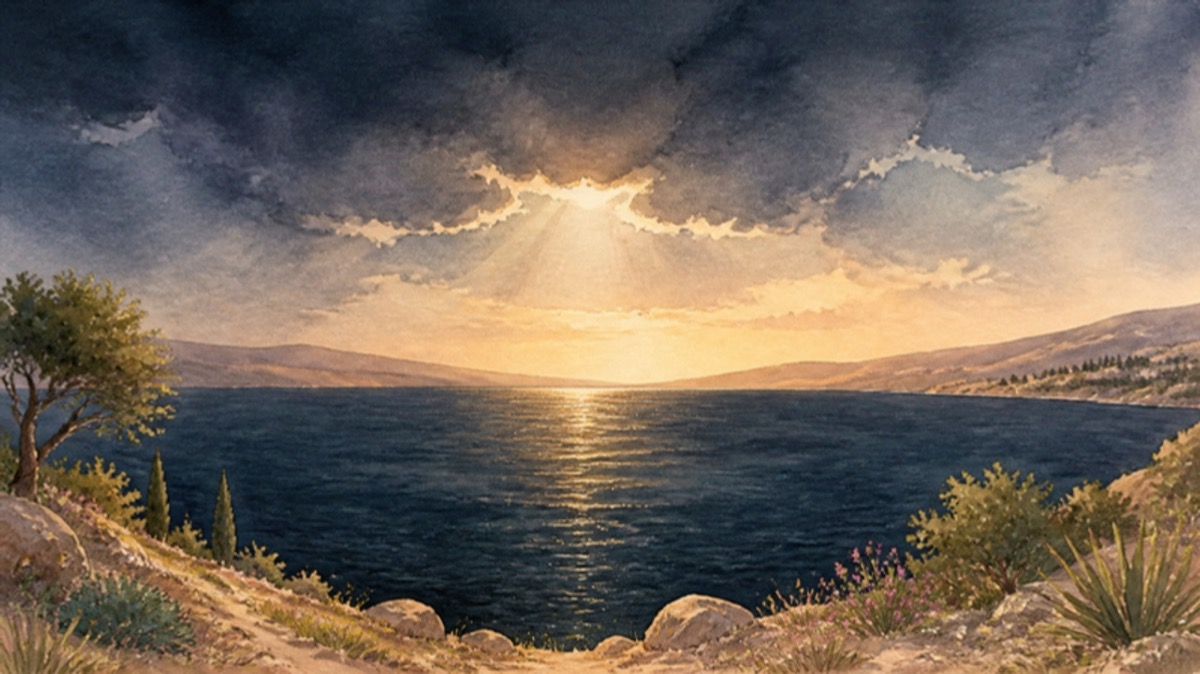
In the beginning — before there was a sun, before there was a sky, before there were trees or fish or dogs or you — there was God. And there was dark, and there was deep water, and God’s Spirit moved over the water like a bird hovering over its nest.
Then God spoke.
“Let there be light.” And there was light — the very first light anybody ever saw. God looked at it, and it was good. (GOOD!) He called the light Day and the dark Night. Evening came, and morning came. Day one.
God spoke again. “Let there be a sky.” And a big wide sky opened up between the water below and the clouds above. Evening came, morning came. Day two. (No shouting on this one — listen carefully, there’s no “good” on day two. Nobody’s quite sure why.)
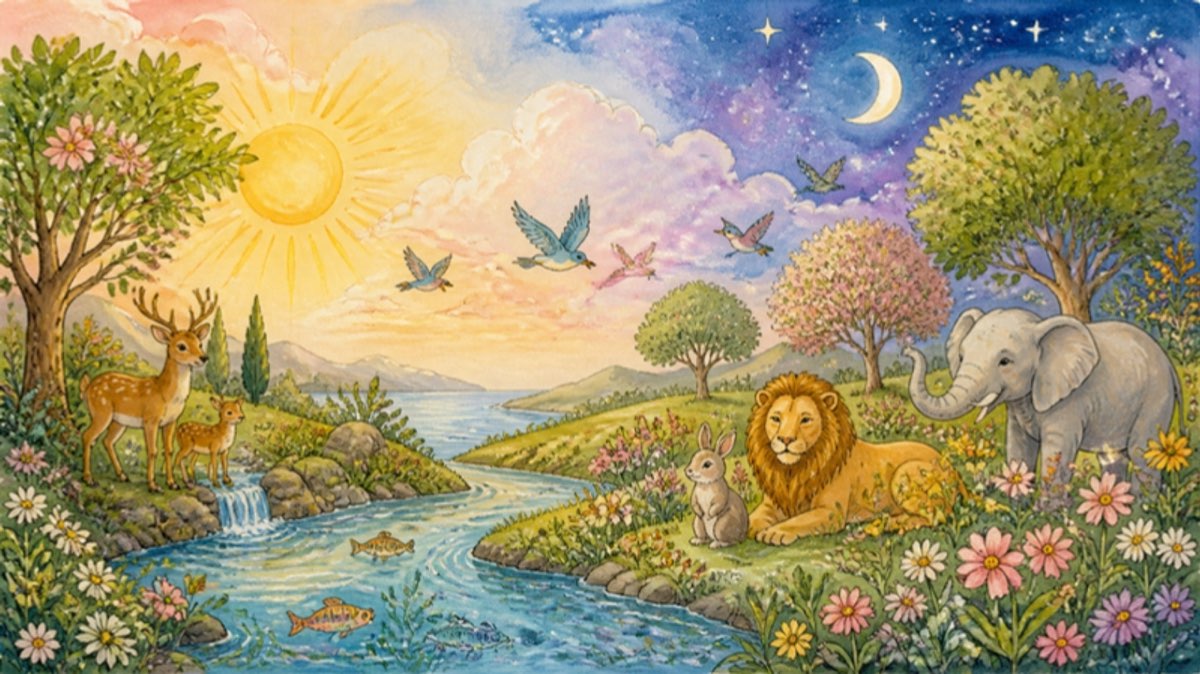
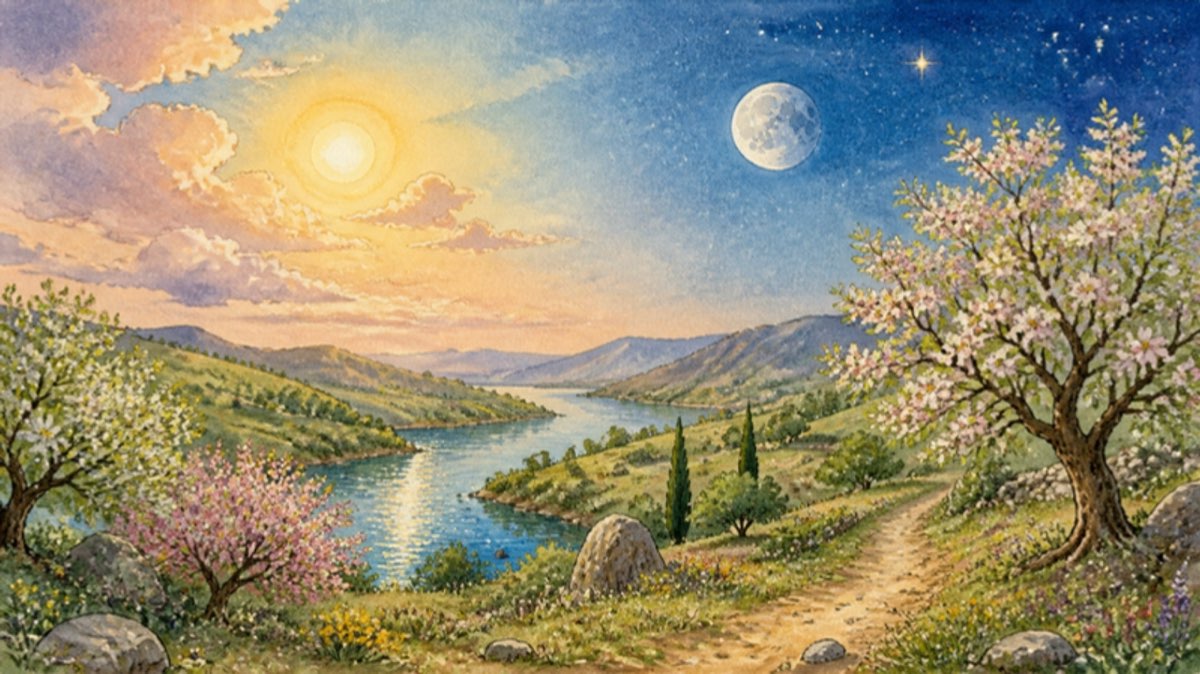
Day three. “Let the water pull back and let dry land show.” And the water rolled back, and up came land — hills and beaches and flat places and mountains. God called the dry part Land and the wet part Seas, and it was good. (GOOD!) Then God said, “Let the land grow things.” And up came grass, and flowers, and bushes, and tall trees heavy with fruit, every one with seeds inside so it could make more. And it was good. (GOOD!)
Day four. “Let there be lights in the sky.” God made the big bright sun for the daytime and the soft silver moon for the night, and he threw the stars across the dark — so many nobody could count them. It was good. (GOOD!)
Day five. “Let the water be full of living things, and let birds fly across the sky!” And the seas began to flash and splash — little silver fish, huge gray whales, crabs walking sideways, jellyfish drifting. And the air filled up with wings — sparrows, ducks, owls, hummingbirds no bigger than your thumb. God blessed them and told them to fill up the seas and the sky. It was good. (GOOD!)
Day six. “Let the land be full of animals!” Cows and lions, rabbits and bears, horses and mice and tiny beetles and great big elephants. It was good. (GOOD!)
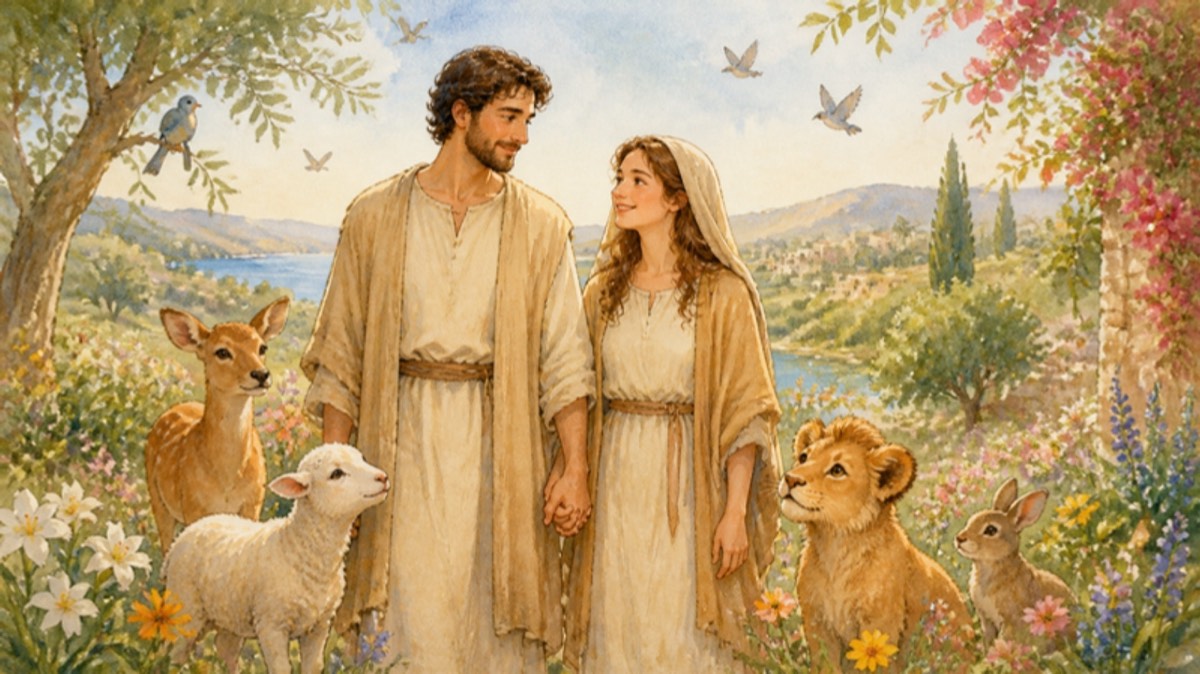
And then God did something different. He didn’t just say “let there be.” He said, “Let us make people — in our image, to be like us. Let them look after the fish and the birds and the animals and the whole earth.” And God made people, a man and a woman, and he blessed them. “Have children,” he said. “Fill the earth. Take care of it all.”
Then God looked at everything — the light, the sky, the land, the sun and moon and stars, the fish and birds, the animals, and the people. And this time he didn’t just say good. He said it was very good. (VERY GOOD!) That was day six.
And on day seven, God stopped. He rested. Not because he was tired — God doesn’t get tired — but because the work was done and it was time to stop and enjoy it. God blessed the seventh day and made it special: a day for stopping. That’s seven. (Did you count? Six goods and one very good.)
And that is how the Bible says the world began.
What should you ask a child after the creation story?
We said “good” seven times. Which thing God made is your favorite? If you were making a world, what would you make first?
God made people “in his image” — a bit like a picture of him. What does a photo of someone show you about them? What do you think people show about God?
On day seven, God stopped. What’s the hardest part about stopping when you’re in the middle of something? What should a stopping day look like in our family?
What does the creation story teach?
Genesis 1 is not trying to be a science chapter, and arguing about whether it is one tends to drown out what it actually says.
Order out of chaos, by speaking. “In the beginning God created the heavens and the earth. Now the earth was formless and empty, darkness was over the surface of the deep, and the Spirit of God was hovering over the waters” (Genesis 1:1–2, NIV). Enduring Word describes the starting point as “formless, empty, out of order, and in confusion,” and the chapter as God putting it in order. Line the days up and you can see the pattern yourself: days one to three make the spaces — light and dark, sky and sea, land — and days four to six fill them — sun and moon, birds and fish, animals and people. Christians disagree, sometimes sharply, about whether the days are twenty-four hours, long ages, or a literary frame; GotQuestions’ overview walks through the positions. Everyone agrees on what the chapter is for: the world was made on purpose, by a God who speaks, and it was good.
People are the only thing made “in his image.” “So God created mankind in his own image, in the image of God he created them; male and female he created them” (Genesis 1:27, NIV). Enduring Word says this is where human dignity comes from — “personality, morality, and spirituality” — and that it makes a human life valuable “apart from any circumstances.” GotQuestions’ article on the image of God covers the main ways Christians have understood the phrase. The psalmist looks at the same sky and asks the obvious question: “what is mankind that you are mindful of them, human beings that you care for them?” (Psalm 8:4, NIV).
The story ends with rest, not with people. “Then God blessed the seventh day and made it holy, because on it he rested from all the work of creating that he had done” (Genesis 2:3, NIV). GotQuestions is careful here: the rest “does not suggest that God was tired”; it is “simply a cessation of work,” and it sets the one-day-in-seven pattern that became the Sabbath. The first thing the Bible calls holy is not a place or a person. It’s a day off. I think about that one more than I expected to.
The story that follows this one, a few chapters on, is Noah’s ark — the same good world, gone wrong. If you’re reading the Bible from page one with a child (or for yourself), how to read the Bible as a beginner is the post I wish I’d had, and the Bible timeline starts right here.
Sources
Genesis 1:1–2:3. Genesis 2:4 starts the second, close-up telling — the garden, Adam and Eve — which is a different story for a different night.
For a hard day
These are one curious mom's study notes, not pastoral counsel or medical advice. If today is heavier than a verse can carry, please reach out to your pastor, a licensed counselor, or your doctor — and if you're in crisis in the US, call or text 988.
Questions moms ask
Where is the creation story in the Bible?
Genesis 1:1–2:3, the very first page. Genesis 2:4 onward tells it again from a closer angle — the garden, the first man and woman — which is a separate story for a separate night.
How many times does Genesis 1 say "it was good"?
Six times — after light (1:4), land and sea (1:10), plants (1:12), sun and moon (1:18), fish and birds (1:21) and land animals (1:25) — and then, after people, "very good" (1:31). Seven in all. Day two, the sky, is the one day without it.
Did creation really take seven days?
Christians answer this differently. Some read the days as ordinary 24-hour days; others as long ages; others as a literary frame that teaches who made the world rather than how long it took. GotQuestions' overview (in the sources) lays out the views. This retelling follows the seven-day shape of the text and leaves the debate to the grown-ups.
What does "made in God's image" mean for a child?
It's the Bible's way of saying people are different from everything else God made — made to know him, to love, to think, and to look after the world. For a small child: you were made on purpose, and you're a bit like a picture of the one who made you.
Scripture references in this article
Each reference opens the full passage on BibleGateway (NIV).
I'm a curious mom in Taiwan reading the Bible and writing down what I learn. I'm not a Christian — I grew up in a Taoist family — but after watching my aunt and the moms around me lean on these words through hard years, I wanted to understand why they carry so much weight. Every verse is quoted from the ESV or NIV and every interpretation links to a public commentary. I'm still learning; if you spot an error, tell me.