Ruth: The Whole Story, for Grown-ups (Loyalty, Loss, and a Kinsman-Redeemer)
The book of Ruth retold for adults — famine, three widows, a foreign daughter-in-law who refuses to leave, a harvest field, a midnight request, and a kinsman-redeemer. The background, what the story means in the Bible, and what one curious mom took from it.
Ruth is a four-chapter Old Testament book set in the time of the judges. A widowed Moabite, Ruth, refuses to leave her mother-in-law Naomi, gleans in the field of a relative named Boaz, and asks him to act as kinsman-redeemer. Boaz marries her, and their son Obed becomes King David's grandfather. Christians read it as a story of hesed, loyal love beyond duty, and quiet providence.
Ruth is one of the shortest books in the Old Testament — four chapters, about fifteen minutes on BibleGateway (NIV).
Three widows on the road from Moab
It begins with a famine. In the days when judges ruled Israel — a rough, lawless stretch of history — a man named Elimelek left Bethlehem with his wife Naomi and their two sons and crossed into Moab, the neighboring country east of the Dead Sea, looking for food. Moab was not a comfortable place for an Israelite family to settle; the two nations had a long, bitter history. But hunger makes people move.
In Moab, Elimelek died. The two sons married Moabite women, Orpah and Ruth. Ten years passed. Then both sons died too, and there were no children. Three widows were left in a foreign country with no husbands, no sons, and no land — in that world, no way to survive.
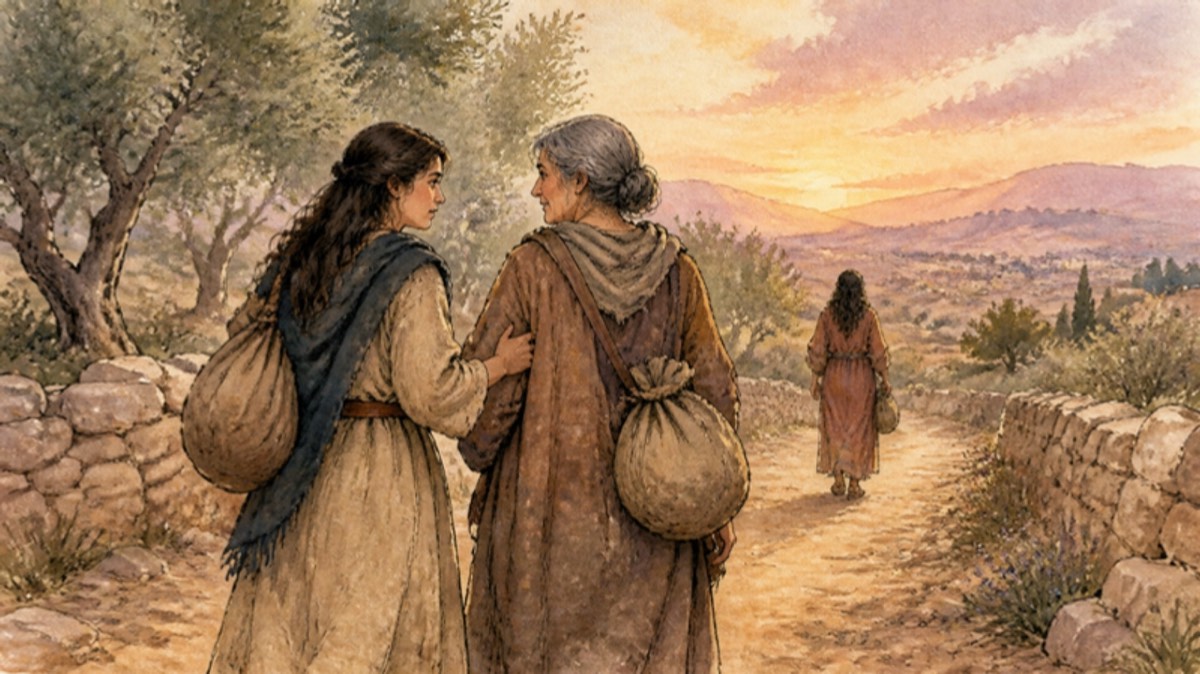
Naomi heard that the famine back home had ended, so she set out on the road to Bethlehem with her daughters-in-law. Part way along she stopped and told them to go back. Go home to your mothers, she said; may the Lord show you the kindness you have shown me; may you each find rest in a new husband’s house. She kissed them, and they all wept. Orpah, after some pleading, turned back. Ruth did not.
What Ruth said next is the most quoted line in the book: “Don’t urge me to leave you or to turn back from you. Where you go I will go, and where you stay I will stay. Your people will be my people and your God my God” (Ruth 1:16, NIV). She added that only death would separate them. Naomi stopped arguing. The two women walked on together.
Empty, then a field of barley
When they reached Bethlehem the whole town stirred. “Can this be Naomi?” the women asked. Naomi answered that they should call her Mara — “bitter” — instead: “I went away full, but the Lord has brought me back empty” (Ruth 1:21, NIV). It was the beginning of the barley harvest.
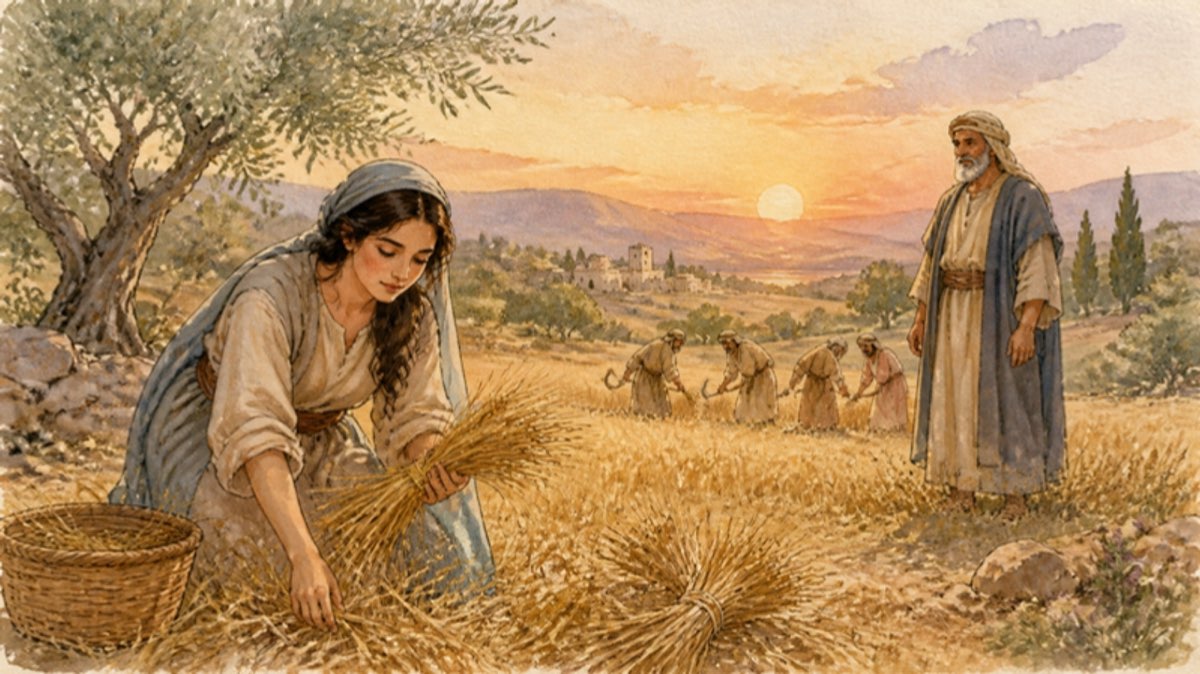
Ruth did what poor people did at harvest: she went out to glean, picking up the stalks the reapers dropped. Israelite law required landowners to leave the edges and the leftovers of their fields for the poor and the foreigner. The field Ruth happened to enter belonged to a man named Boaz — a relative of Naomi’s dead husband, and, the text says, a man of standing.
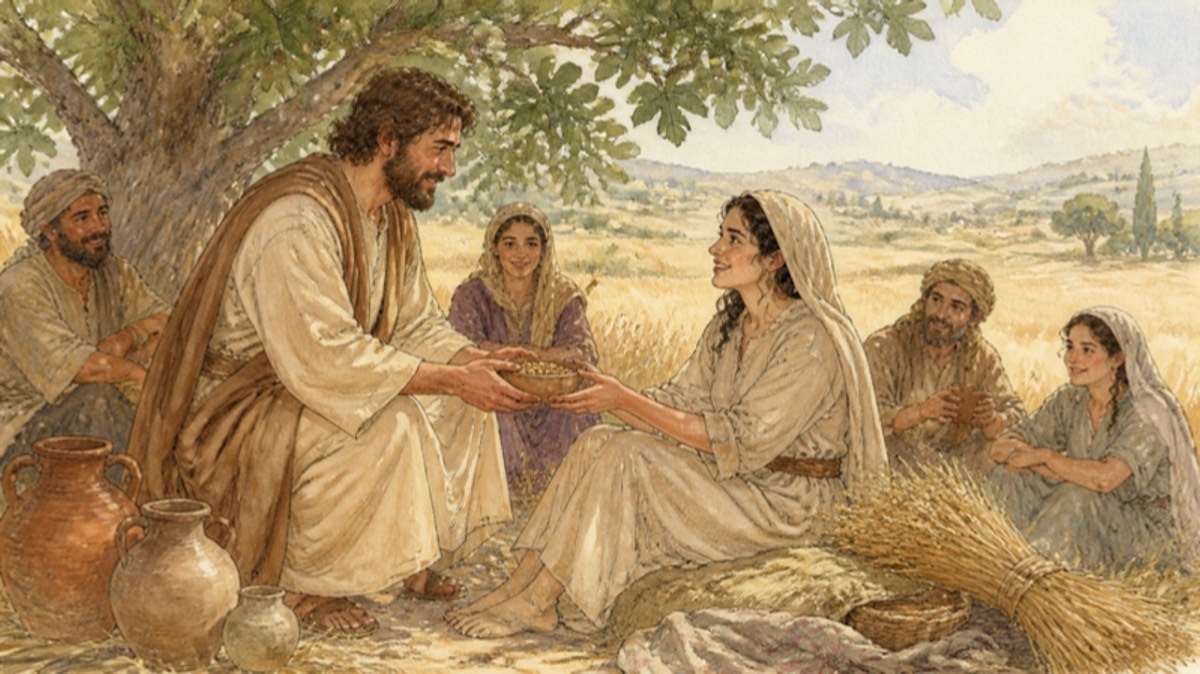
Boaz noticed her. He asked his foreman who she was and learned she was the Moabite who had come back with Naomi and had been working since early morning. Boaz went to Ruth and told her to stay in his field, to keep close to his women workers, to drink from his water jars; he had ordered the men not to touch her. Ruth asked why a foreigner should get such favor. Because, Boaz said, he had heard everything she had done for her mother-in-law since her husband’s death — leaving her parents and homeland for a people she didn’t know. “May the Lord repay you for what you have done. May you be richly rewarded by the Lord, the God of Israel, under whose wings you have come to take refuge” (Ruth 2:12, NIV).
At the meal he handed her roasted grain until she was full. He quietly told his workers to pull stalks out of the bundles on purpose and leave them for her. Ruth went home that evening with an enormous amount of barley — far more than a gleaner should have gathered. When Naomi heard whose field it was, something woke up in her. “That man is our close relative,” she said; “he is one of our guardian-redeemers” (Ruth 2:20, NIV). Ruth kept gleaning in Boaz’s fields through the barley and wheat harvests.
The threshing floor and the town gate
When the harvests were over, Naomi made a plan. The threshing floor was where grain was winnowed, and the landowner would sleep there overnight to guard it. Naomi told Ruth to wash, put on perfume and her best clothes, go to the threshing floor after Boaz had eaten and lain down, and then uncover his feet and lie down — and he would tell her what to do. It was a bold, risky request, and both women knew it.
Ruth did it. In the middle of the night Boaz woke, startled, and found a woman at his feet. “Who are you?” he asked. “I am your servant Ruth,” she said. “Spread the corner of your garment over me, since you are a guardian-redeemer of our family” (Ruth 3:9, NIV). She was asking him to marry her and take responsibility for Naomi’s family line.
Boaz’s answer was not what she might have feared. He blessed her, called her a woman of noble character, and said he would gladly do it — but there was a problem. Another man was a closer relative than Boaz and had the first right to redeem. Boaz promised to settle it in the morning. Before dawn, so no one would see her, he sent her home with six measures of barley for Naomi. “Wait, my daughter,” Naomi told Ruth, “until you find out what happens. For the man will not rest until the matter is settled today” (Ruth 3:18, NIV).
Boaz went to the town gate, where legal business was done, and waited until the closer relative came by. In front of ten elders he laid out the case: Naomi was selling the piece of land that had belonged to Elimelek; the nearer relative had the first right to buy it. The man said he would. Then Boaz added the condition: whoever bought the land also acquired Ruth the Moabite, the dead man’s widow, to carry on the dead man’s name. At that the relative backed out — it would endanger his own estate — and, following the custom of the day, took off his sandal and handed it over to seal the transfer.
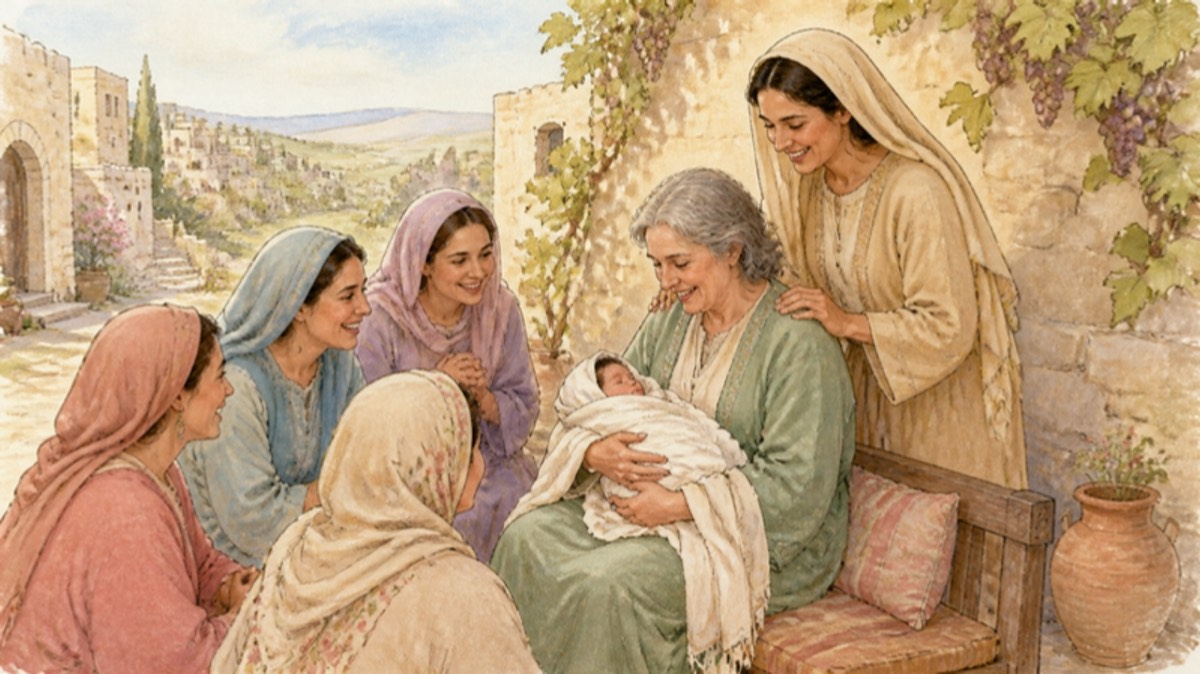
Boaz announced to the elders and everyone present that he had bought all that belonged to Elimelek and his sons, and had taken Ruth as his wife. The people blessed them. Boaz and Ruth married, and she bore a son. The women of the town said to Naomi that this child would renew her life and sustain her in old age, because her daughter-in-law, who loved her, was better to her than seven sons. Naomi took the baby in her arms.
“The women living there said, ‘Naomi has a son!’ And they named him Obed. He was the father of Jesse, the father of David” (Ruth 4:17, NIV). The woman who came home empty is holding, at the end, the grandfather of Israel’s greatest king.
What is the historical background of the book of Ruth?
The time of the judges. Ruth 1:1 dates the story to the period described in the book of Judges — roughly the twelfth and eleventh centuries BC, before Israel had a king. Judges ends with the line “everyone did as they saw fit” (Judges 21:25, NIV). Ruth is a small, decent story set inside a chaotic era, which is part of why readers love it.
Moab. Moab lay east of the Dead Sea. Moabites descended from Lot (Genesis 19:37), and the two nations clashed repeatedly; Deuteronomy 23:3 bars Moabites from Israel’s assembly. An Israelite family moving there, and a Moabite woman marrying in, would both have raised eyebrows. Enduring Word’s commentary on Ruth 1 (linked below) discusses how the book pushes against that prejudice.
Gleaning. Leviticus 19:9–10 and Deuteronomy 24:19–21 required farmers to leave the edges of their fields and the dropped grain for the poor, the foreigner, the orphan, and the widow. Ruth was all of those except the orphan. Gleaning was legal but exposed; Boaz’s instructions to his men (Ruth 2:9) show the real danger a lone foreign woman faced.
The kinsman-redeemer. The Hebrew word is go’el. Leviticus 25:25 gives a close relative the right to buy back family land a poor man had sold, so that property stayed in the family. Deuteronomy 25:5–10 describes levirate marriage, where a brother marries his dead brother’s widow to produce an heir, and the sandal ceremony for a man who refuses. Ruth 4 combines these customs — the land and the widow go together — and the sandal in Ruth 4:7–8 is a formal legal act, not an insult. GotQuestions’ explanation of the kinsman-redeemer (below) walks through the legal details.
The threshing floor. Threshing floors were open-air spaces where grain was winnowed in the evening breeze; owners slept there during harvest to guard the crop. Ruth 3 is deliberately ambiguous in its language, and commentators disagree about how much risk Naomi’s plan carried, but the text itself stresses that Boaz behaved honorably and that Ruth’s reputation was known in town (Ruth 3:11).
What does the story of Ruth mean?
Hesed — loyal love that goes beyond duty — drives every chapter. The Hebrew word hesed runs through the book: Naomi prays for it (1:8), Boaz praises Ruth’s (3:10), and the whole plot turns on people doing more than the law required. Ruth did not have to stay with Naomi; Boaz did not have to over-provide for a gleaner. Christians read this as a picture of the kind of love God shows and asks for — and many commentators note that the book, which never records a miracle, shows God working through ordinary human kindness.
God provides when the plot looks finished. Naomi’s complaint in chapter 1 — “I went away full, but the Lord has brought me back empty” (Ruth 1:21, NIV) — is answered, scene by scene, by a harvest, a field, a redeemer, and a child. Ruth “happened” to enter Boaz’s field (2:3); the narrator uses that wording with a wink. Christians across traditions read Ruth as a book about providence: God’s unseen hand in events that look like luck. Some Reformed commentators press this more strongly than others, but the reading is nearly universal.
It points forward to David — and, for Christians, to Jesus. The book ends with a genealogy to King David (Ruth 4:18–22), and Matthew’s Gospel repeats it: “Boaz the father of Obed, whose mother was Ruth, Obed the father of Jesse” (Matthew 1:5, NIV). A foreign widow is in the line of the Messiah. Many Christians also see Boaz, the redeemer who pays to rescue a family with no hope, as a foreshadowing of Christ as redeemer; that is an interpretation the New Testament doesn’t state directly, and Jewish readers and some Christian scholars read the book without it. The sources below give both the devotional and the historical readings.
The love story between two widows
Notes in the margin
The central love story in this book is between a mother-in-law and a daughter-in-law. Boaz arrives in chapter 2 mostly as the answer to a food problem, and the famous promise in 1:16 is made by one widow to another on the road out of Moab.
What surprised me most was how practical the kindness is. Nobody prays for a miracle. Ruth goes to work. Boaz tells his men to drop extra grain. Naomi makes a plan that is frankly a little scary. The "God provides" of this book looks like people being decent to each other on purpose. If a Christian friend told me God was working in her life, this is the book that would help me understand what she might mean.
And I keep thinking about Naomi's bitterness in chapter 1. The Bible lets her say it out loud, and nobody corrects her. That felt honest.
For a hard day
These are one curious mom's study notes, not pastoral counsel or medical advice. If today is heavier than a verse can carry, please reach out to your pastor, a licensed counselor, or your doctor — and if you're in crisis in the US, call or text 988.
Questions moms ask
Where is the book of Ruth in the Bible?
Ruth is a short Old Testament book — four chapters — placed after Judges and before 1 Samuel in Christian Bibles. The opening line sets it 'in the days when the judges ruled' (Ruth 1:1, NIV).
What is a kinsman-redeemer?
In Old Testament law a close relative (Hebrew go'el) had the right and duty to buy back family land that had been sold, and in some cases to marry a relative's widow so the dead man's name and property would continue (Leviticus 25:25; Deuteronomy 25:5–10). Boaz acts as this redeemer for Naomi's family.
Why does the Bible include a story about a Moabite woman?
Ruth was a foreigner from Moab, a nation often at odds with Israel, yet the book ends by naming her as the great-grandmother of King David (Ruth 4:17), and the New Testament lists her in the ancestry of Jesus (Matthew 1:5). Commentators see the book as a deliberate statement that God's family welcomes the outsider who comes in faith.
Scripture references in this article
Each reference opens the full passage on BibleGateway (NIV).
I'm a curious mom in Taiwan reading the Bible and writing down what I learn. I'm not a Christian — I grew up in a Taoist family — but after watching my aunt and the moms around me lean on these words through hard years, I wanted to understand why they carry so much weight. Every verse is quoted from the ESV or NIV and every interpretation links to a public commentary. I'm still learning; if you spot an error, tell me.