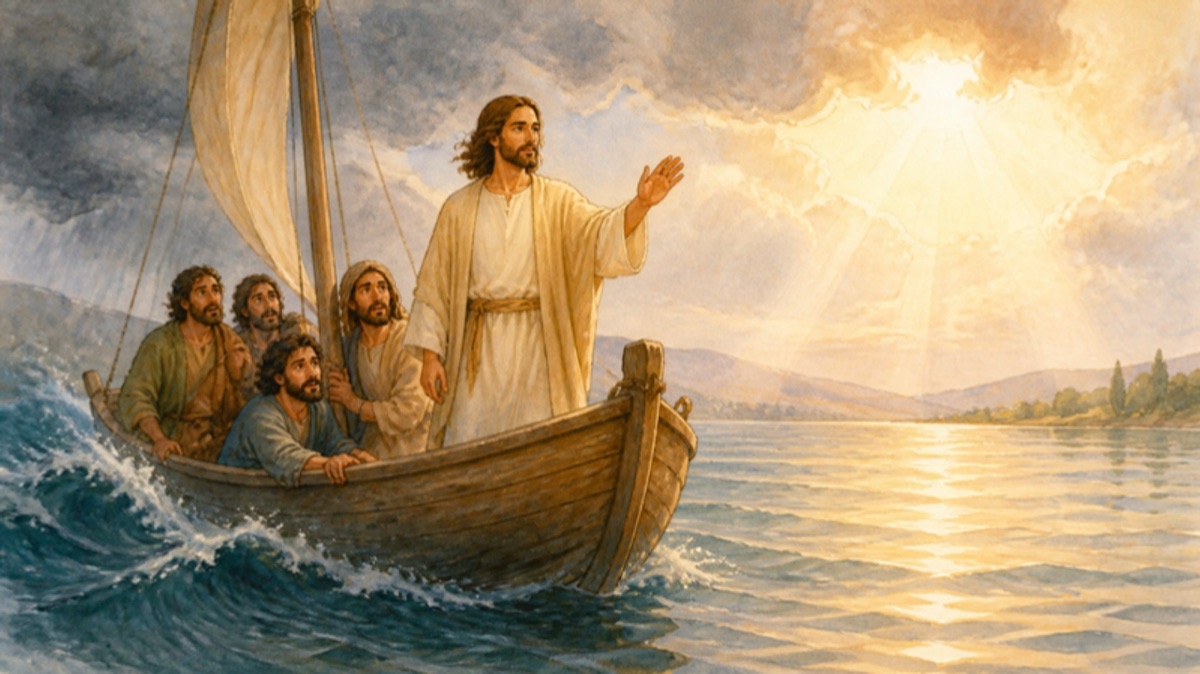
Where it is in the Bible: Mark 4:35–41 (also Matthew 8:23–27 and Luke 8:22–25). Read it on BibleGateway (NIV).
Age range for this retelling: about 3–8. About four minutes aloud — a good one for bedtime, or for a night when the wind is loud outside.
The story (for ages 3–8)
Jesus had been teaching people all day long, by the edge of a big lake. So many people came that he had to climb into a boat and talk to them from the water. By the time the sun started to go down, he was very, very tired.
“Let’s cross over to the other side of the lake,” Jesus said to his friends. His friends were called disciples, and some of them were fishermen who had been sailing on this lake their whole lives. So they pushed the boat out, and off they went.
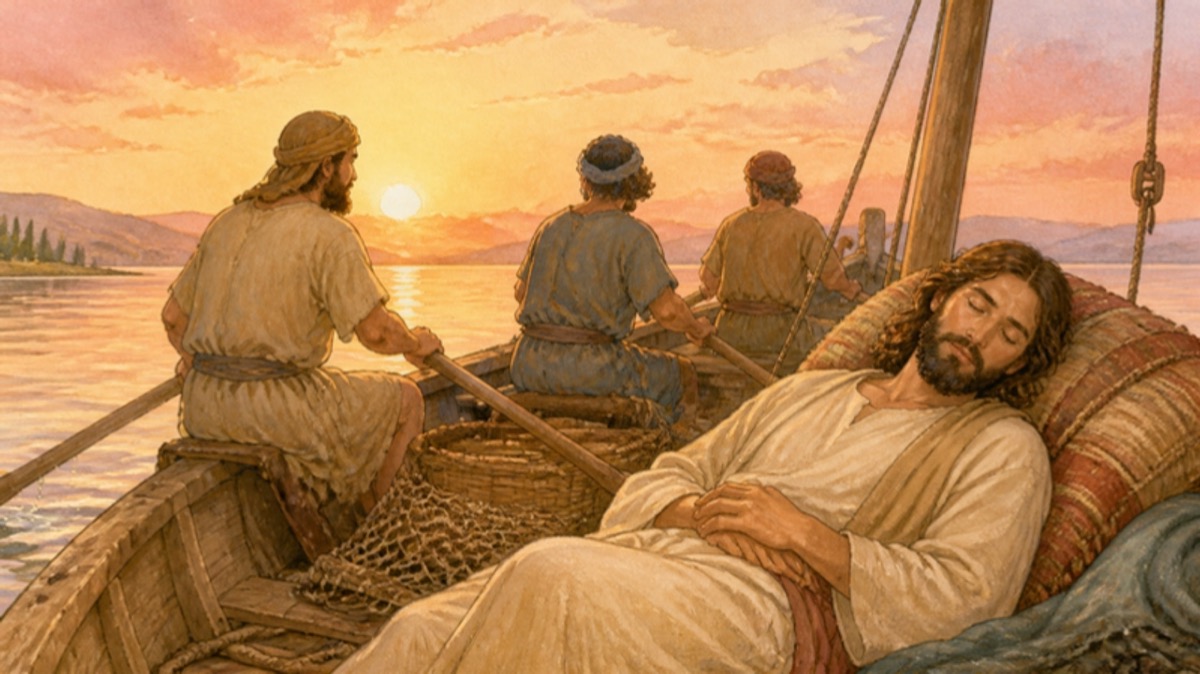
Jesus found a cushion in the back of the boat, lay down, and fell fast asleep.
At first the water was calm. The sky was pink and gold. The oars went splash, splash, and the little boat rocked gently, the way a cradle rocks. Some of the disciples talked quietly. Some of them watched the shore slide away behind them.
Now, this lake was a tricky lake. It sat low down between tall hills, and sometimes — with no warning at all — the wind would come rushing down from the hills and turn the water wild. The fishermen knew this. They kept one eye on the sky.
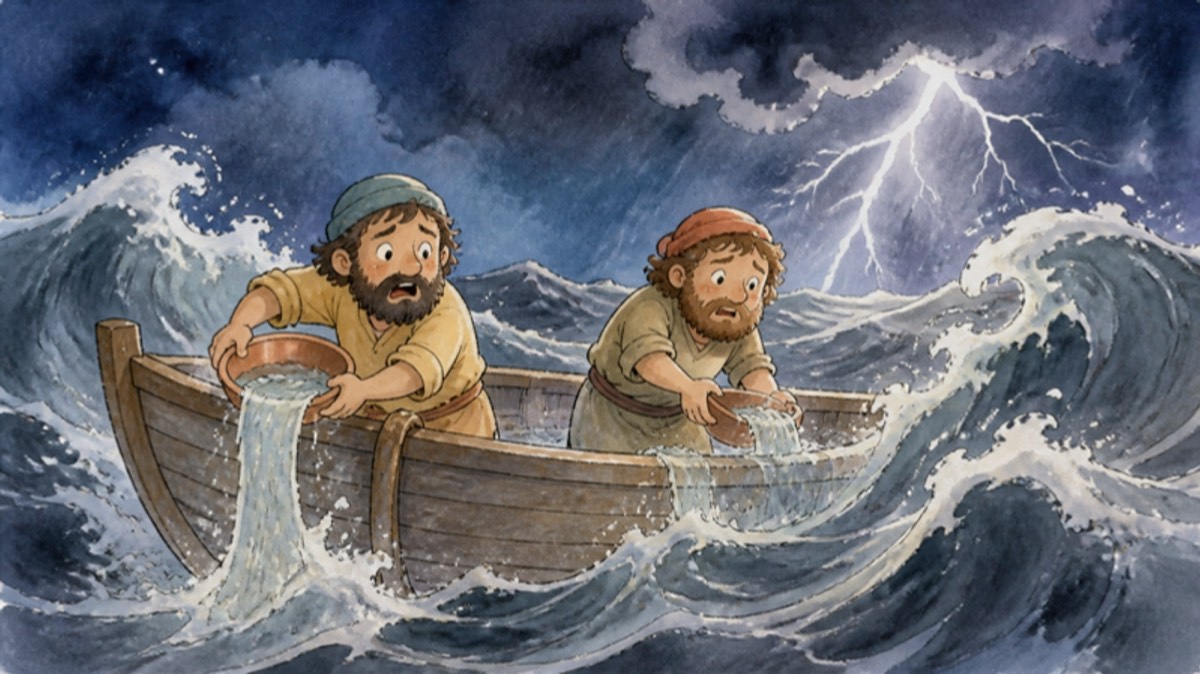
And then it happened. The wind picked up. The sky turned dark gray, then black. The waves grew bigger — and bigger — and BIGGER. This was no little rain shower. This was a huge storm! The wind howled like a wolf. The boat pitched up to the top of one wave and slammed down into the next. Cold water crashed over the sides, and more water, and more, until it was sloshing around the disciples’ ankles.
“Bail!” someone shouted. The disciples grabbed buckets and bowls and scooped water out as fast as they could, but for every bowl they threw out, two waves came in. Peter, who had fished this lake since he was a boy, had never seen anything like it. Even the fishermen were terrified. They were sure the boat was going to sink, and all of them with it.
And Jesus? Jesus was still asleep on his cushion.
The disciples shook him awake. “Teacher!” they shouted over the wind. “Don’t you care that we’re about to drown?”
Jesus stood up in the rocking boat. He looked at the wind and the waves, and he spoke to them the way you might speak to a noisy puppy.
“Quiet,” he said. “Be still.”
And the wind stopped. Just like that. The waves lay down flat. The water went smooth as glass, and the only sound was the drip, drip of water off the oars.
The disciples stared. Their mouths hung open. Their hearts were still pounding, but now it wasn’t the storm they were amazed at.
Jesus turned to them. “Why were you so afraid?” he asked. “Don’t you trust me yet?”
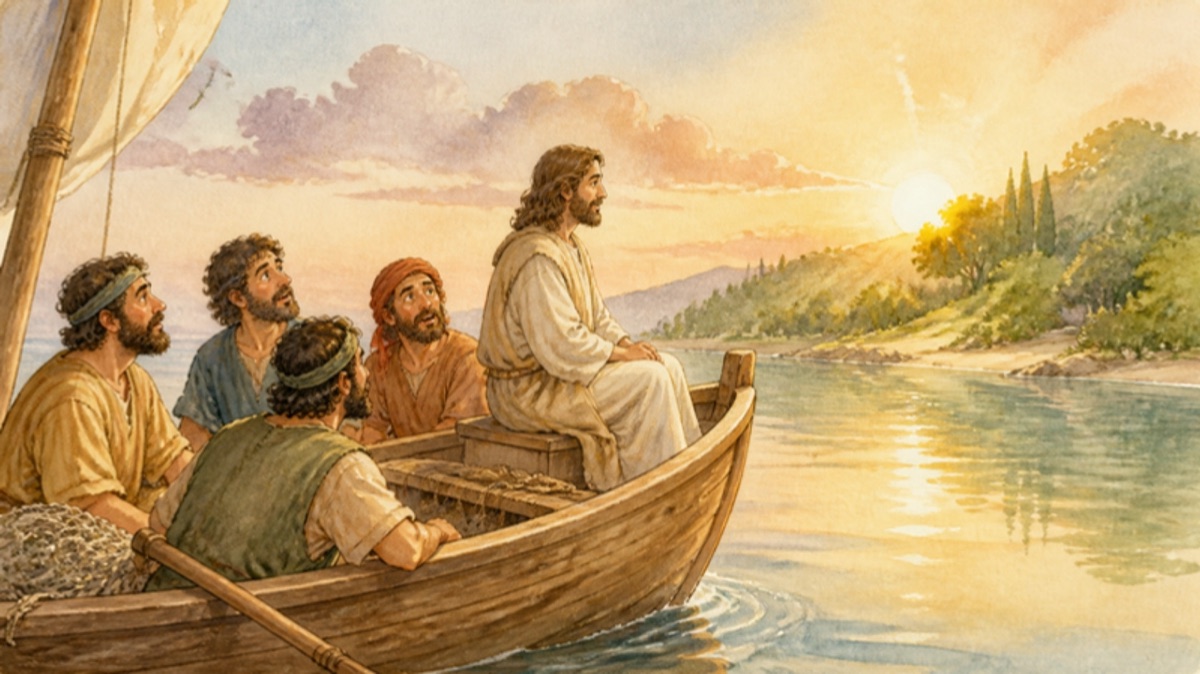
The disciples looked at each other. “Who is this?” they whispered. “Even the wind and the waves do what he says!”
And the boat glided quietly on to the other side.
Three questions to talk about
- The disciples were scared even though Jesus was right there in the boat. When you’re scared — of the dark, of a storm, of a big day — what helps you remember you’re not alone?
- Jesus asked, “Why were you so afraid?” Do you think it’s bad to be afraid? What’s the difference between feeling afraid and staying afraid?
- The disciples asked, “Who is this?” If you had been in the boat, what would you have thought when the wind stopped?
What this story means in the Bible
This short story is told in three of the four Gospels, which tells you how important the early church thought it was. In the Bible it answers one question above all: who is Jesus?
Only God commands the sea. In the Old Testament, calming the sea is something God alone does — “You rule over the surging sea; when its waves mount up, you still them” (Psalm 89:9, NIV; see also Psalm 107:28–29). Enduring Word’s commentary on Mark 4 notes that the disciples’ final question, “Who is this?”, is the point of the whole account: a man who does what only God does. For Christians, this is one of the clearest early signs in the Gospels of Jesus’ divinity.
Fear and faith are set side by side. Jesus doesn’t scold them for being in a storm; he asks why they were afraid and whether they had faith (Mark 4:40). GotQuestions’ discussion of the passage reads it as a lesson that Jesus’ presence doesn’t mean no storms, but that his presence changes what the storm means. That’s the application most Christian parents draw for their kids: you can be scared and still trust.
The sleeping Jesus matters too. Mark includes the detail of the cushion (Mark 4:38) — Jesus was exhausted from teaching. Commentators see both his real humanity and his real calm in that one detail.
Christians from different traditions read the miracle stories with different emphases — some stress the literal event, others its symbolic meaning for the church “in the boat” — but the sources below agree on the central claim: this is a story about who Jesus is.
Sources and further reading
- BibleGateway — Mark 4:35–41 (NIV) · Matthew 8:23–27 · Luke 8:22–25
- Enduring Word — Mark 4 commentary
- Enduring Word — Matthew 8 commentary
- Blue Letter Bible — Mark 4:35 with study tools
Questions moms ask
Where is Jesus calming the storm in the Bible?
Why was Jesus asleep in the storm?
What is the lake in the story?
Scripture references in this article
Each reference opens the full passage on BibleGateway (NIV).
David and Goliath: The Bible Story for Kids (With Questions to Talk About)
The Good Samaritan: The Bible Story for Kids (With Questions to Talk About)
Noah's Ark: The Bible Story for Kids (With Questions to Talk About)
The Prodigal Son: The Bible Story for Kids (With Questions to Talk About)
Little helps for everyday faith
Start with a few quiet minutes.

Behind the notes
Hi, I'm Vega.
I'm a curious mom in Taiwan reading the Bible and writing down what I learn. I'm not a Christian — I grew up Buddhist — but after watching my aunt and the moms around me lean on these words through hard years, I wanted to understand why they carry so much weight. Every verse is quoted from the ESV or NIV and every interpretation links to a public commentary. I'm still learning; if you spot an error, tell me.
A little more about me