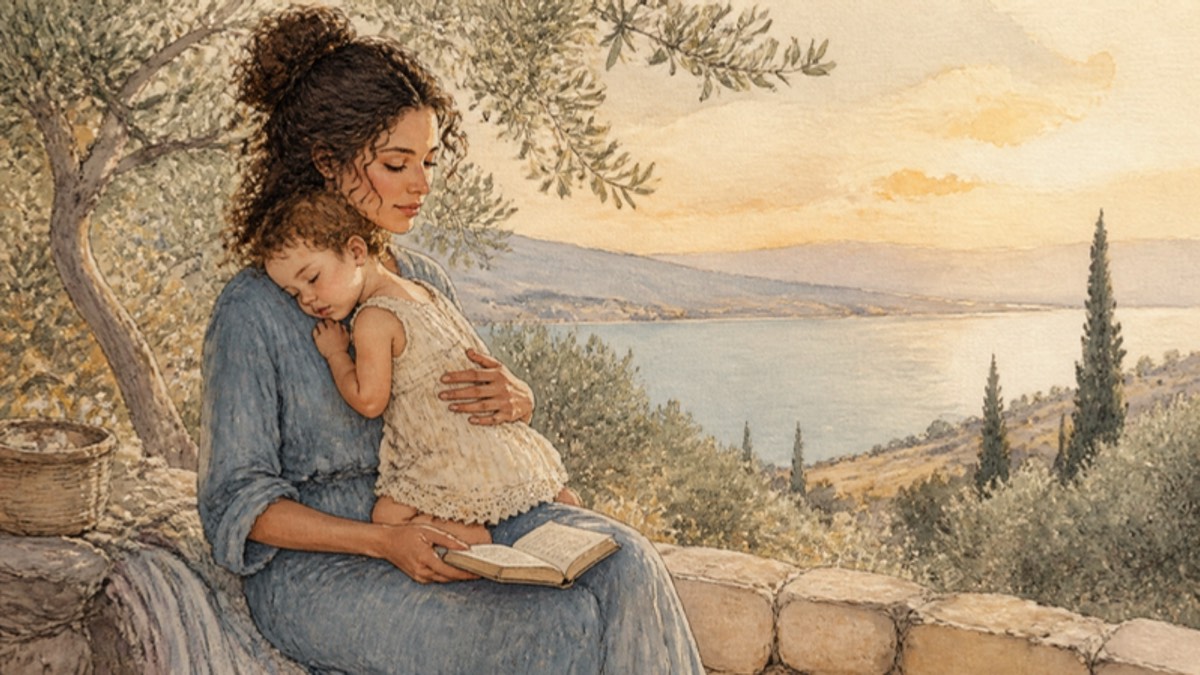
The Bible rarely tells mothers what to do. It lets mothers speak, such as Lemuel's mother in Proverbs 31, Deborah, and Sarah; it tells their stories, from Jochebed and Hannah to Mary; it tells children to honor their mothers; and it compares God's care to a mother's in Isaiah 66:13 and 49:15. Proverbs 31 is a mother's teaching, not a job description.
The most quoted passage about women in the whole Bible was, according to its own first line, a mother’s teaching to her son. Proverbs 31 opens: “The sayings of King Lemuel—an inspired utterance his mother taught him.” I had seen the famous part (“she is clothed with strength and dignity”) on Mother’s Day cards long before I noticed that the chapter is a woman talking, a queen mother coaching a young king on alcohol, justice, and what kind of wife to look for. That reframed the whole topic for me.
I’m not a Christian; I grew up Taoist and read the Bible out of curiosity. These are my notes on thirty verses that touch motherhood, in the NIV, grouped by what kind of passage they are: mothers speaking in their own voice, God described in a mother’s terms, the actual mothers in the stories, the instructions given to children, and a handful for the weeks when there is nothing left.
When does a mother get to speak for herself in the Bible?
1. Proverbs 31:1
The sayings of King Lemuel—an inspired utterance his mother taught him. — Proverbs 31:1 (NIV)
Lemuel is never mentioned outside this chapter, and neither is his mother, so the Bible’s longest portrait of a good woman was framed by a woman. Who Lemuel might have been, and why the old Solomon-and-Bathsheba guess has little behind it, is covered in the Proverbs 31 woman explained.
2. Proverbs 31:25-26
She is clothed with strength and dignity; she can laugh at the days to come. She speaks with wisdom, and faithful instruction is on her tongue. — Proverbs 31:25-26 (NIV)
Part of the queen mother’s poem, an A-to-Z acrostic in Hebrew. The verse-by-verse reading (the warrior vocabulary, the acrostic, why it was never a checklist) lives in the Proverbs 31 post. For this list, the point is simpler: the poem’s ideal woman is described by her strength and her speech, and that a mother chose those two.
3. Proverbs 1:8
Listen, my son, to your father’s instruction and do not forsake your mother’s teaching. — Proverbs 1:8 (NIV)
The first instruction in the book, after the preface. Father and mother are named as a pair, and the mother’s part is called “teaching,” not nagging or comfort. Proverbs assumed that mothers taught, and that a son’s job was to remember what she said.
4. Judges 5:7
Villagers in Israel would not fight; they held back until I, Deborah, arose, until I arose, a mother in Israel. — Judges 5:7 (NIV)
Deborah’s own song after the battle against Sisera’s army, and she gives herself the title “a mother in Israel.” She was a judge and a prophet (4:4), and the Bible mentions no children of hers; the title is about protecting a whole people when the men “held back.” Her full story is in Deborah for grown-ups.
5. Genesis 21:6
Sarah said, “God has brought me laughter, and everyone who hears about this will laugh with me.” — Genesis 21:6 (NIV)
Sarah, after Isaac is born, when she was ninety (Genesis 17:17). A year earlier she had laughed in disbelief at the promise (18:12-14); now the laughter is joy, and the boy’s name, Isaac, means “he laughs,” per Blue Letter Bible’s lexicon. It is one of the few lines in Genesis where a mother speaks about her own child.
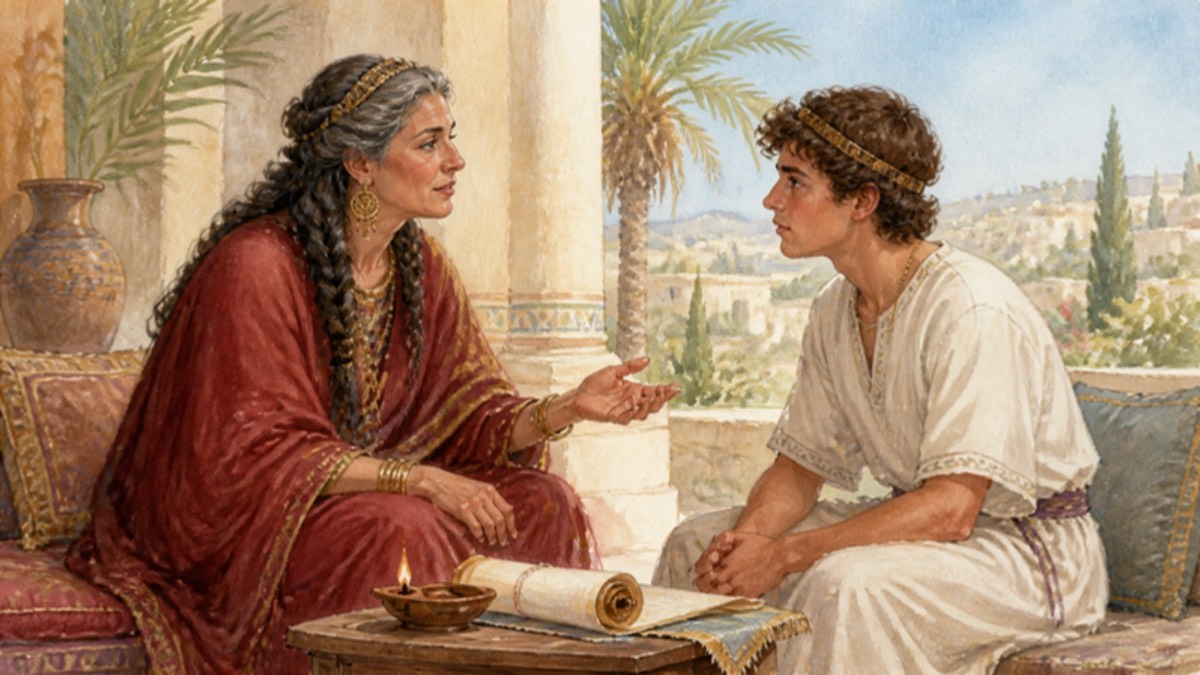
Where does the Bible compare God to a mother?
6. Isaiah 66:13
As a mother comforts her child, so will I comfort you; and you will be comforted over Jerusalem.” — Isaiah 66:13 (NIV)
Isaiah ends his book looking ahead to exiles who will come home to a ruined city. The verse before it pictures Jerusalem nursing and carrying its children; then God steps into the mother’s role himself. Enduring Word’s comment is short: “No one can comfort like a mother, and God will bring that kind of comfort to His people.”
7. Isaiah 49:15
“Can a mother forget the baby at her breast and have no compassion on the child she has borne? Though she may forget, I will not forget you! — Isaiah 49:15 (NIV)
The verse answers a complaint one line earlier: “The Lord has forsaken me, the Lord has forgotten me” (Isaiah 49:14, NIV). God’s reply reaches for the most reliable loyalty anyone can think of, a nursing mother, and then says his own is stronger. The honesty of “though she may forget” is striking. The text admits that even that bond can fail; the promise is anchored somewhere steadier.
8. Isaiah 46:3-4
“Listen to me, you descendants of Jacob, all the remnant of the people of Israel, you whom I have upheld since your birth, and have carried since you were born. Even to your old age and gray hairs I am he, I am he who will sustain you. I have made you and I will carry you; I will sustain you and I will rescue you. — Isaiah 46:3-4 (NIV)
The chapter opens with Babylon’s gods, Bel and Nebo, being loaded onto animals and hauled away (46:1-2). The contrast is the point: those gods have to be carried; this God does the carrying, from birth to gray hair. Anyone who has carried a sleeping child upstairs knows the image is work, not sentiment.
9. Matthew 23:37
“Jerusalem, Jerusalem, you who kill the prophets and stone those sent to you, how often I have longed to gather your children together, as a hen gathers her chicks under her wings, and you were not willing. — Matthew 23:37 (NIV)
Jesus, in Jerusalem a few days before his death, reaching for a farmyard picture of a mother: a hen spreading her wings over her chicks. The image is of protection offered and refused, and the sorrow in “how often I have longed” is a parent’s.
10. Psalm 131:2
But I have calmed and quieted myself, I am like a weaned child with its mother; like a weaned child I am content. — Psalm 131:2 (NIV)
A three-verse psalm attributed to David. Enduring Word draws out the detail of “weaned”: a nursing child reaches for its mother wanting milk; a weaned child climbs into her lap wanting her. David says his soul has reached the second stage. Written by a man, but only someone who had watched a toddler settle against its mother would have chosen the picture.
11. Psalm 22:9-10
Yet you brought me out of the womb; you made me trust in you, even at my mother’s breast. From birth I was cast on you; from my mother’s womb you have been my God. — Psalm 22:9-10 (NIV)
From the psalm whose first line Jesus quotes on the cross (Matthew 27:46). In the middle of feeling abandoned, the writer reaches back to his earliest memory of trust, which is at his mother’s breast, and says God was there before that.
Which mothers appear in Bible stories?
12. Genesis 3:20
Adam named his wife Eve, because she would become the mother of all the living. — Genesis 3:20 (NIV)
This comes directly after the consequences of the fall and just before the two are sent out of the garden. On the worst day in the story, Adam names his wife for the life that will come through her.
13. Exodus 2:9
Pharaoh’s daughter said to her, “Take this baby and nurse him for me, and I will pay you.” So the woman took the baby and nursed him. — Exodus 2:9 (NIV)
The ending nobody expects. Moses’ sister has offered to find a Hebrew nurse for the baby Pharaoh’s daughter pulled from the river, and fetches their own mother (2:7-8). So the woman who hid her son to save him is paid to nurse him in the open.
14. Hebrews 11:23
By faith Moses’ parents hid him for three months after he was born, because they saw he was no ordinary child, and they were not afraid of the king’s edict. — Hebrews 11:23 (NIV)
Exodus 2 tells the story: a mother hides her baby, then waterproofs a basket and sets him among the reeds. The New Testament lists it among the great acts of faith. If you want to read it with a child, our Baby Moses story for kids follows Exodus 2:1-10, where nearly everyone who saves Moses is a woman or a girl.
15. 1 Samuel 1:27-28
I prayed for this child, and the Lord has granted me what I asked of him. So now I give him to the Lord. For his whole life he will be given over to the Lord.” And he worshiped the Lord there. — 1 Samuel 1:27-28 (NIV)
Hannah says this to Eli, the priest who a few years earlier watched her pray silently and assumed she was drunk (1 Samuel 1:13-14). She named the boy Samuel “Because I asked the Lord for him” (1:20, NIV), and here she keeps the vow she made, leaving him at the sanctuary at Shiloh. Enduring Word notes how rare a lifelong Nazirite dedication from birth was. We have a longer Hannah story for grown-ups if her chapter gets under your skin the way it did mine.
16. 1 Kings 3:26
The woman whose son was alive was deeply moved out of love for her son and said to the king, “Please, my lord, give her the living baby! Don’t kill him!” But the other said, “Neither I nor you shall have him. Cut him in two!” — 1 Kings 3:26 (NIV)
Solomon’s famous judgment. Two women, one living baby, a sword. The Hebrew behind “deeply moved out of love” is the word racham, which Blue Letter Bible’s lexicon lists as “compassion” and, by extension, “the womb.” The real mother’s body gives her away. Solomon was counting on exactly that.
17. Ruth 1:16
But Ruth replied, “Don’t urge me to leave you or to turn back from you. Where you go I will go, and where you stay I will stay. Your people will be my people and your God my God. — Ruth 1:16 (NIV)
This line gets read at weddings, but Ruth said it to her mother-in-law. Naomi, widowed and childless in Moab, is trying to send her daughters-in-law home; Ruth refuses, on a road, with nothing promised. It is the clearest picture in the Bible of a daughter choosing a mother. The full Ruth story is on the site if you want the rest.
18. Luke 1:46-48
And Mary said: “My soul glorifies the Lord and my spirit rejoices in God my Savior, for he has been mindful of the humble state of his servant. From now on all generations will call me blessed, — Luke 1:46-48 (NIV)
A pregnant teenager, visiting her older cousin, breaks into the song churches call the Magnificat. Enduring Word notes that it echoes Hannah’s song in 1 Samuel 2 and carries at least a dozen other Old Testament allusions, which tells you Mary knew her Scriptures. “All generations will call me blessed” is nearly the wording of Proverbs 31:28.
19. Luke 2:34-35
Then Simeon blessed them and said to Mary, his mother: “This child is destined to cause the falling and rising of many in Israel, and to be a sign that will be spoken against, so that the thoughts of many hearts will be revealed. And a sword will pierce your own soul too.” — Luke 2:34-35 (NIV)
Simeon, an old man in the temple, meets the family when they bring the baby for the purification rites (2:22), blesses them, and then turns to Mary alone. The last sentence is addressed to her, not to Joseph. Luke is the only Gospel writer to record it, and John later places her at the foot of the cross (John 19:25).
20. Luke 2:51
Then he went down to Nazareth with them and was obedient to them. But his mother treasured all these things in her heart. — Luke 2:51 (NIV)
This follows the three days Mary and Joseph spent searching Jerusalem for a twelve-year-old who had stayed behind in the temple (2:41-50). Her first words when she found him were a parent’s: “Son, why have you treated us like this?” (2:48, NIV). Then, after an answer she didn’t understand, she went home and treasured it, as Luke says she had done after the shepherds left (2:19).
21. John 19:26-27
When Jesus saw his mother there, and the disciple whom he loved standing nearby, he said to her, “Woman, here is your son,” and to the disciple, “Here is your mother.” From that time on, this disciple took her into his home. — John 19:26-27 (NIV)
Said from the cross. Of the handful of things Jesus is recorded saying while he was dying, one was arranging who would look after his mother.
22. 2 Timothy 1:5
I am reminded of your sincere faith, which first lived in your grandmother Lois and in your mother Eunice and, I am persuaded, now lives in you also. — 2 Timothy 1:5 (NIV)
Paul, in what is probably his last surviving letter, traces Timothy’s faith back two generations through the women. Acts 16:1 adds that Timothy’s father was Greek, which means the faith in the house came from his mother’s side. Enduring Word even floats the comparison when discussing Lemuel: a boy taught by his mother.
What the Bible asks of children (and churches) where mothers are concerned
23. Exodus 20:12
“Honor your father and your mother, so that you may live long in the land the Lord your God is giving you. — Exodus 20:12 (NIV)
The fifth of the Ten Commandments, given at Sinai, and the first one with a reason attached; Paul later calls it “the first commandment with a promise” (Ephesians 6:2, NIV). Mother and father are honored equally, which was not a given in the ancient world.
24. Psalm 113:9
He settles the childless woman in her home as a happy mother of children. Praise the Lord. — Psalm 113:9 (NIV)
Psalm 113 starts with God enthroned above the heavens and ends in a kitchen. The verses before this one describe him lifting the poor from the dust and the ash heap (113:7); the childless woman is listed alongside them. This is Hannah’s story in one line.
25. 3 John 1:4
I have no greater joy than to hear that my children are walking in the truth. — 3 John 1:4 (NIV)
John is writing to a man named Gaius, and “my children” means the people he taught. Christian parents quote it anyway: the news you most want about your kids is about who they are becoming.
26. 1 Thessalonians 2:7-8
Instead, we were like young children among you. Just as a nursing mother cares for her children, so we cared for you. Because we loved you so much, we were delighted to share with you not only the gospel of God but our lives as well. — 1 Thessalonians 2:7-8 (NIV)
Paul, describing how he and his coworkers behaved in Thessalonica, picks a nursing mother as his model: no demands, total availability, giving not just information but “our lives as well.”
For the week when nothing is left
27. Isaiah 40:29
He gives strength to the weary and increases the power of the weak. — Isaiah 40:29 (NIV)
From Isaiah 40, the chapter that opens “Comfort, comfort my people.” The verse after it admits, “Even youths grow tired and weary” (40:30, NIV). Enduring Word’s note is that this strength is “reserved for those who know they are weak.” Our longer list of Bible verses about strength sits mostly in this chapter.
28. Galatians 6:9
Let us not become weary in doing good, for at the proper time we will reap a harvest if we do not give up. — Galatians 6:9 (NIV)
A farming image from Paul to churches in what is now Turkey. The harvest comes “at the proper time,” which is never the week you planted. It fits any stretch of parenting — potty training, a teenager — whose results are months away.
29. Lamentations 3:22-23
Because of the Lord’s great love we are not consumed, for his compassions never fail. They are new every morning; great is your faithfulness. — Lamentations 3:22-23 (NIV)
Written in the ruins of Jerusalem after the Babylonians burned it, in the middle of a poem that begins with twenty verses of complaint. Enduring Word quotes the scholar Ellison on the vocabulary: “great love” is hesed, covenant loyalty, and “compassions” is rahamim, a word “derived from reḥem (‘womb’).” So the mercies that arrive fresh each morning are, in the Hebrew, mother-mercies. I did not expect to find that in a book of laments.
30. Matthew 11:28
“Come to me, all you who are weary and burdened, and I will give you rest. — Matthew 11:28 (NIV)
Jesus to crowds weighed down by religious rules. There is no condition about having done the day well. And in the two verses that follow he offers a different yoke rather than no yoke at all — a trade, not an exemption.
What these thirty have in common
The Bible almost never gives mothers instructions. It shows mothers (Hannah, Mary, Jochebed, Naomi and Ruth, the woman before Solomon), lets a few speak (Lemuel’s mother, Deborah, Sarah), tells children how to treat theirs, and borrows motherhood as its picture of how God treats people. The pressure a modern mom feels from Proverbs 31 comes from reading a mother’s praise-poem as a job description, which Enduring Word says is the one thing it was not.
This page is about what the Bible says on motherhood; if you are picking a line to write in a card, the Mother’s Day card verses are sorted by who is writing, and the newborn weeks have their own list in Bible verses for new moms. For one of these a day rather than thirty at once, the verse of the day tool draws from a checked list; on the days when the right verse is “I am weary,” the anxiety list may be more useful than this one.
Sources
- Proverbs 31 (NIV) on BibleGateway
- Enduring Word — Proverbs 31 commentary
- GotQuestions — Who was King Lemuel in Proverbs 31?
- Enduring Word — Isaiah 49 commentary
- Enduring Word — Isaiah 66 commentary
- Enduring Word — Isaiah 40 commentary
- Enduring Word — Psalm 131 commentary
- Enduring Word — 1 Samuel 1 commentary
- Enduring Word — Luke 1 commentary
- Enduring Word — Luke 2 commentary
- Enduring Word — Lamentations 3 commentary
- Blue Letter Bible — Strong’s H7356 racham
- Blue Letter Bible — Strong’s H3327 Yitschaq (Isaac)
- Enduring Word — Judges 5 commentary
Questions moms ask
What is the most famous Bible verse about mothers?
Does the Bible describe God as a mother?
Who is called a mother in Israel?
Does the Bible give mothers instructions on how to parent?
Scripture references in this article
Each reference opens the full passage on BibleGateway (NIV).
- Proverbs 31:1
- Proverbs 31:25-26
- Proverbs 1:8
- Judges 5:7
- Genesis 21:6
- Genesis 17:17
- Isaiah 66:13
- Isaiah 49:15
- Isaiah 49:14
- Isaiah 46:3-4
- Matthew 23:37
- Psalm 131:2
- Psalm 22:9-10
- Matthew 27:46
- Genesis 3:20
- Exodus 2:9
- Hebrews 11:23
- Exodus 2:1-10
- 1 Samuel 1:27-28
- 1 Samuel 1:13-14
- 1 Kings 3:26
- Ruth 1:16
- Luke 1:46-48
- Proverbs 31:28
- Luke 2:34-35
- John 19:25
- Luke 2:51
- John 19:26-27
- 2 Timothy 1:5
- Acts 16:1
- Exodus 20:12
- Ephesians 6:2
- Psalm 113:9
- 3 John 1:4
- 1 Thessalonians 2:7-8
- Isaiah 40:29
- Galatians 6:9
- Lamentations 3:22-23
- Matthew 11:28



Little helps for everyday faith
Start with a few quiet minutes.

Behind the notes
Hi, I'm Vega.
I'm a curious mom in Taiwan reading the Bible and writing down what I learn. I'm not a Christian — I grew up in a Taoist family — but after watching my aunt and the moms around me lean on these words through hard years, I wanted to understand why they carry so much weight. Every verse is quoted from the ESV or NIV and every interpretation links to a public commentary. I'm still learning; if you spot an error, tell me.
A little more about me