
I started this one because a Christian friend told me, in the same breath, that her faith had carried her through postpartum depression and that she’d felt guilty the whole time for being depressed at all. I wanted to know whether the Bible gives anyone a reason to feel that guilt. As far as I can tell, it doesn’t. What it has instead is some of the most unguarded writing about despair I’ve read anywhere.
The Bible never uses the word “depression.” But it has a prophet asking to die, a psalm that ends in darkness, a man cursing his own birthday, and an apostle who “despaired of life itself.” None of them is told their faith is weak.
Elijah: “I have had enough, Lord”
The most detailed picture is 1 Kings 19. In the previous chapter Elijah has just won the showdown on Mount Carmel — fire from heaven, the prophets of Baal defeated. Then Queen Jezebel sends a death threat, and he runs:
while he himself went a day’s journey into the wilderness. He came to a broom bush, sat down under it and prayed that he might die. “I have had enough, Lord,” he said. “Take my life; I am no better than my ancestors.” — 1 Kings 19:4 (NIV)
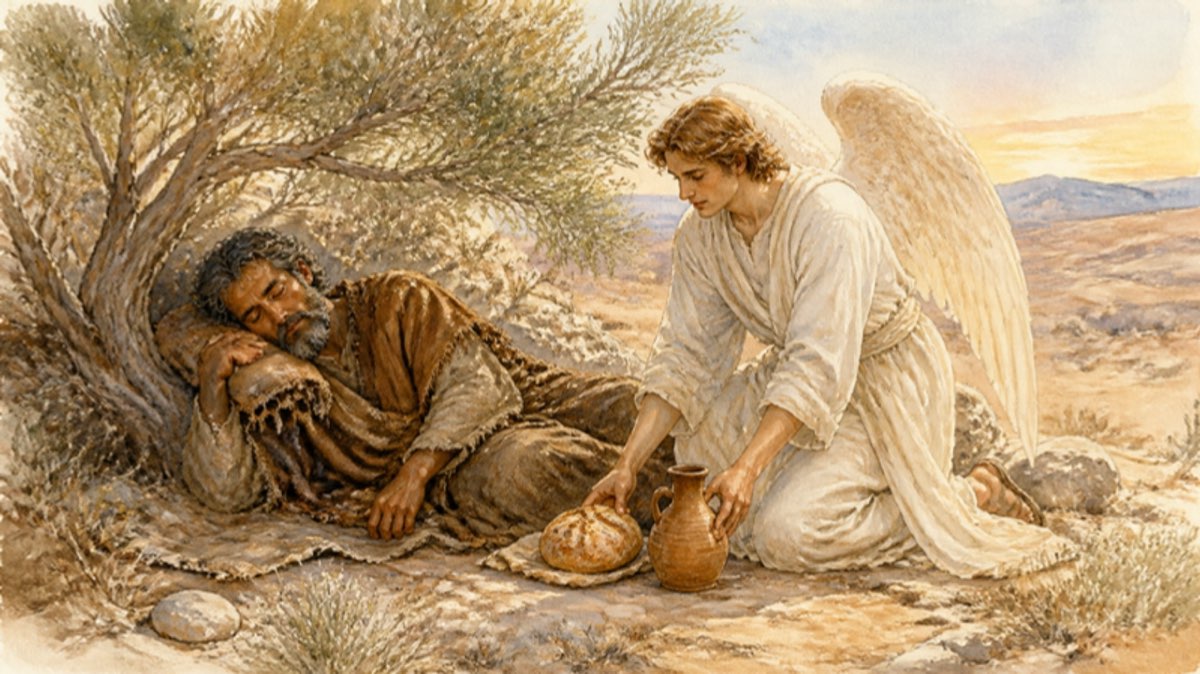
What happens next is the part the commentaries draw attention to:
Then he lay down under the bush and fell asleep. All at once an angel touched him and said, “Get up and eat.” He looked around, and there by his head was some bread baked over hot coals, and a jar of water. He ate and drank and then lay down again. The angel of the Lord came back a second time and touched him and said, “Get up and eat, for the journey is too much for you.” — 1 Kings 19:5-7 (NIV)
No lecture. Sleep, bread, water, more sleep, more bread. Enduring Word’s commentary on the chapter notes that God dealt with Elijah’s physical exhaustion first and only later, at the mountain, with his thinking (Elijah believes he’s the only faithful person left; God tells him there are seven thousand). The crash after a huge effort, the wish to die, the distorted “I’m the only one” — a modern reader recognizes all of it.
The psalms that don’t pretend
Psalm 42 is the one most Christians reach for, and it’s a dialogue the writer has with himself:
Why, my soul, are you downcast? Why so disturbed within me? Put your hope in God, for I will yet praise him, my Savior and my God. — Psalm 42:5 (NIV)
He says it twice (verse 5 and verse 11), which tells you the first time didn’t fix it. Enduring Word reads the repetition as the psalmist “preaching to himself” — not denying the feeling, but refusing to let it have the last word.
Psalm 88 is darker. It’s the only psalm with no turn toward hope at the end. It just stops:
You have taken from me friend and neighbor— darkness is my closest friend. — Psalm 88:18 (NIV)
I find it remarkable that this is in a hymnbook. Somebody decided that a prayer with no resolution belonged in the collection people sing from. Psalm 13 is a shorter version of the same thing — four “How long?“s in two verses — and Psalm 6:6 has David flooding his bed with tears all night.
Jeremiah and Paul
Jeremiah, whose job was delivering bad news to a city that didn’t want it, says this in the middle of his book:
Cursed be the day I was born! May the day my mother bore me not be blessed! — Jeremiah 20:14 (NIV)
And four verses later: “Why did I ever come out of the womb to see trouble and sorrow and to end my days in shame?” (Jeremiah 20:18). His despair wasn’t caused by doing something wrong. It came from doing the right thing for a long time with no visible result — which some people reading this will recognize.
Paul, writing to the Corinthians about a crisis in Asia Minor, is just as blunt:
We do not want you to be uninformed, brothers and sisters, about the troubles we experienced in the province of Asia. We were under great pressure, far beyond our ability to endure, so that we despaired of life itself. Indeed, we felt we had received the sentence of death. But this happened that we might not rely on ourselves but on God, who raises the dead. — 2 Corinthians 1:8-9 (NIV)
“Far beyond our ability to endure” is not the language of someone pretending to be fine.
What the Bible says God does about it
Nothing in these passages promises instant relief. What they describe is closer to presence:
The Lord is close to the brokenhearted and saves those who are crushed in spirit. — Psalm 34:18 (NIV)
“Come to me, all you who are weary and burdened, and I will give you rest. — Matthew 11:28 (NIV)
And Lamentations 3 — written, the tradition says, over the ruins of Jerusalem — has the line that a lot of Christian moms seem to hold onto: “Because of the Lord’s great love we are not consumed, for his compassions never fail. They are new every morning” (Lamentations 3:22-23, NIV). Not new every year. Every morning. Small enough to be survivable.

Faith and treatment, as Christians explain it
Since I’m not a Christian, I went looking for how Christians themselves handle the medicine question, and the mainstream answer was more practical than I expected.
GotQuestions’ page on depression says, against “what some in the Christian community believe,” that “clinical depression is not always caused by sin,” that it “is a physical condition that must be diagnosed by a physician,” and that it may need “medication and/or counseling” — “seeing a doctor for depression is no different than seeing a doctor for an injury.” It lists prayer, Scripture, fellowship, confession, gratitude, counseling, exercise, sleep, and nutrition side by side. Its page on mental health uses the Elijah story the way I did above: “God dealt with Elijah’s physical needs first, feeding him and giving him time to sleep.”
The National Institute of Mental Health describes depression as a common, treatable medical condition, and the Christian sources and the medical ones say the same thing about what helps: talk to someone, don’t isolate, treat the body, keep going. Where the Christian sources add something is the insistence that a depressed person is not a failed believer. Elijah under the bush is still Elijah.
What I’m taking from it
As a mom, the thing I keep coming back to is that the Bible lets its heroes say “I have had enough.” It doesn’t edit the line out. If that’s the book, then a faith built on it should have room for a woman sitting in a church parking lot who can’t make herself go in yet. My friend’s guilt, as far as I can see, didn’t come from the text. It came from the quiet around her.
Sources and further reading
- BibleGateway — 1 Kings 19 (NIV), Psalm 42 (NIV), Psalm 88 (NIV)
- Enduring Word — 1 Kings 19 commentary, Psalm 42, Psalm 88, Jeremiah 20
- GotQuestions — What does the Bible say about depression? How can a Christian overcome depression?
- GotQuestions — What does the Bible say about mental health?
- National Institute of Mental Health — Depression
- Blue Letter Bible — 1 Kings 19:4 with study tools
Questions moms ask
Does the Bible say depression is a sin or a lack of faith?
What is the most honest psalm about depression?
Is it okay for a Christian to take medication or see a therapist?
Scripture references in this article
Each reference opens the full passage on BibleGateway (NIV).



Little helps for everyday faith
Start with a few quiet minutes.

Behind the notes
Hi, I'm Vega.
I'm a curious mom in Taiwan reading the Bible and writing down what I learn. I'm not a Christian — I grew up Buddhist — but after watching my aunt and the moms around me lean on these words through hard years, I wanted to understand why they carry so much weight. Every verse is quoted from the ESV or NIV and every interpretation links to a public commentary. I'm still learning; if you spot an error, tell me.
A little more about me