
“Faith” was the word that confused me most when I started reading the Bible, because in everyday English it mostly means believing something without evidence. The biblical writers don’t use it that way. Their word is closer to trust — the kind you place in a person whose track record you know — and the book is full of people whose trust was shaky, partial, or mixed with doubt and still counted.
These 30 verses in the NIV are grouped by what faith is, what to do when it’s small, and what keeps it going. Each note says who wrote the line, to whom, and what was happening around it. Study notes from a curious outsider, not a sermon.
What faith is
1. Hebrews 11:1
Now faith is confidence in what we hope for and assurance about what we do not see. — Hebrews 11:1 (NIV)
The author (unknown) is writing to Jewish Christians tempted to drift back to their old religion, and this verse follows a warning not to “throw away your confidence” (10:35). The two nouns — “confidence” (hypostasis, literally something that stands under) and “assurance” (elenchos, a proof or conviction) — are then illustrated with a chapter of names rather than more abstractions.
2. Hebrews 11:6
And without faith it is impossible to please God, because anyone who comes to him must believe that he exists and that he rewards those who earnestly seek him. — Hebrews 11:6 (NIV)
Two things, the writer says, must be believed to come to God: that he exists, and that he rewards those who seek him. That second half is often left out. Enoch is the example cited just before (11:5).
3. Romans 10:17
Consequently, faith comes from hearing the message, and the message is heard through the word about Christ. — Romans 10:17 (NIV)
Paul is in the middle of a painful section about his own people, Israel. The chain he lays out in 10:14-15 is sending, preaching, hearing, believing — faith here is not something you work up but something that comes in through the ear.
4. 2 Corinthians 5:7
For we live by faith, not by sight. — 2 Corinthians 5:7 (NIV)
Said by a man who, by his own account, had been caught up into heaven and seen things he wasn’t allowed to repeat (12:2-4) — and who still describes ordinary Christian life as walking by faith, not sight.
5. Ephesians 2:8-9
For it is by grace you have been saved, through faith—and this is not from yourselves, it is the gift of God— not by works, so that no one can boast. — Ephesians 2:8-9 (NIV)
A circular letter to churches around Ephesus. The sentence insists three times that this is not your doing: “not from yourselves,” “the gift of God,” “not by works.” The reason given is plain — “so that no one can boast.”
6. Habakkuk 2:4
“See, the enemy is puffed up; his desires are not upright— but the righteous person will live by his faithfulness— — Habakkuk 2:4 (NIV)
The prophet has complained that God is using Babylon, a nation worse than Judah, to punish Judah. God’s answer includes this line. The NIV translates the Hebrew emunah as “faithfulness”; other versions have “faith.” Paul quotes it in Romans 1:17 and Galatians 3:11.
7. Romans 1:17
For in the gospel the righteousness of God is revealed—a righteousness that is by faith from first to last, just as it is written: “The righteous will live by faith.” — Romans 1:17 (NIV)
The thesis sentence of Romans, with Habakkuk 2:4 attached. “By faith from first to last” — the Greek is literally “from faith to faith.” Martin Luther described his understanding of this verse as the moment the gospel opened up to him.
8. James 2:17
In the same way, faith by itself, if it is not accompanied by action, is dead. — James 2:17 (NIV)
James — traditionally the brother of Jesus — writing to scattered Jewish Christians. He is not arguing with Paul; he is arguing with people who say they have faith and do nothing (2:14-16, the person who tells a hungry neighbor to “keep warm and well fed”). His test is whether the faith shows.
9. John 6:29
Jesus answered, “The work of God is this: to believe in the one he has sent.” — John 6:29 (NIV)
A crowd that had been fed the day before asks Jesus what works God requires. His answer collapses the list to one item: believe in the one he sent. Enduring Word’s summary: Jesus “commanded them (and us) not to do, but to trust.”
10. Galatians 2:20
I have been crucified with Christ and I no longer live, but Christ lives in me. The life I now live in the body, I live by faith in the Son of God, who loved me and gave himself for me. — Galatians 2:20 (NIV)
Paul describing his own inner life, in a letter written in anger at people adding rules to the gospel. Faith here has an object with a face: “the Son of God, who loved me and gave himself for me.”
When faith is small or shaky
11. Mark 9:24
Immediately the boy’s father exclaimed, “I do believe; help me overcome my unbelief!” — Mark 9:24 (NIV)
A father has brought his son, who has violent seizures, first to the disciples (who failed) and then to Jesus. His sentence contradicts itself — “I do believe; help me overcome my unbelief!” — and Jesus heals the boy anyway. It’s the most honest prayer in the Gospels.
12. Matthew 17:20
He replied, “Because you have so little faith. Truly I tell you, if you have faith as small as a mustard seed, you can say to this mountain, ‘Move from here to there,’ and it will move. Nothing will be impossible for you.” — Matthew 17:20 (NIV)
Matthew’s version of the same story. The disciples ask why they couldn’t drive the spirit out, and Jesus says their faith was too little — then says faith the size of a mustard seed moves mountains. The lesson is not about quantity of faith but about where it’s pointed.
13. Luke 17:5-6
The apostles said to the Lord, “Increase our faith!” He replied, “If you have faith as small as a mustard seed, you can say to this mulberry tree, ‘Be uprooted and planted in the sea,’ and it will obey you. — Luke 17:5-6 (NIV)
The apostles ask Jesus, “Increase our faith!” He doesn’t. He tells them a mustard seed’s worth is enough to uproot a tree. Enduring Word’s reading: the faith that matters “has more to do with what kind of faith it is than with how much faith there is.”
14. Matthew 14:31
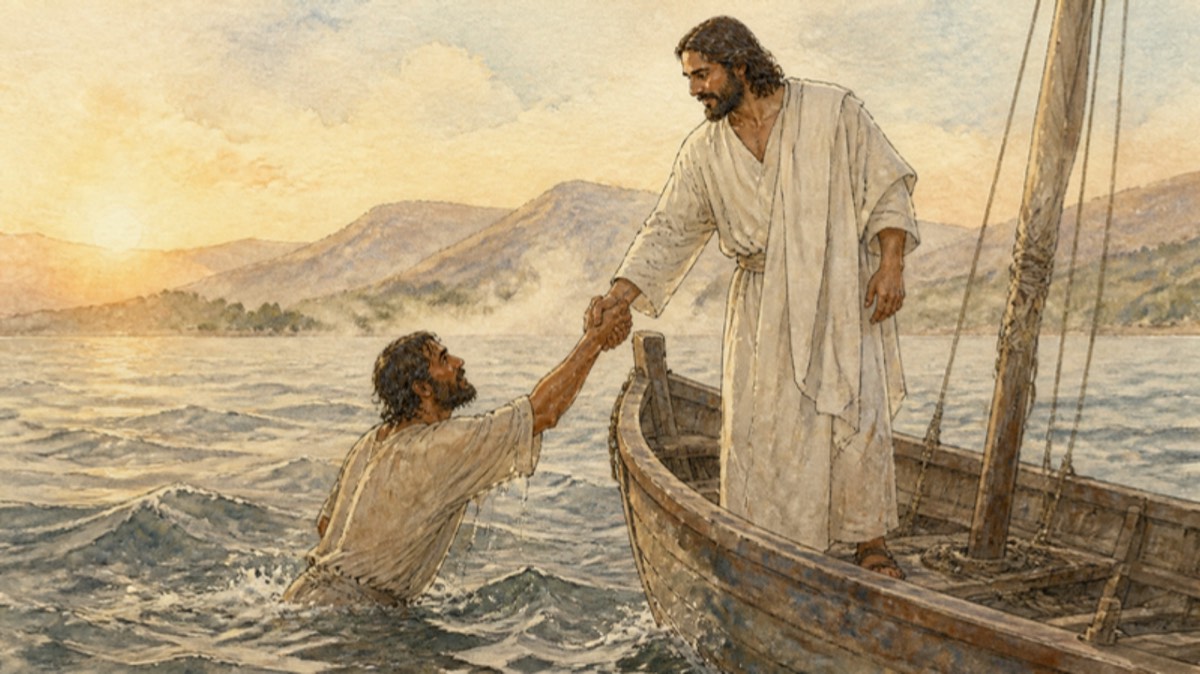
Immediately Jesus reached out his hand and caught him. “You of little faith,” he said, “why did you doubt?” — Matthew 14:31 (NIV)
Peter has walked on water and then started sinking. Note the order in the verse: “Immediately Jesus reached out his hand and caught him” comes before the question “why did you doubt?” The rescue precedes the rebuke, and the rebuke is a question.
15. John 20:29
Then Jesus told him, “Because you have seen me, you have believed; blessed are those who have not seen and yet have believed.” — John 20:29 (NIV)
Thomas said he would not believe without touching the wounds. A week later Jesus offers him exactly that (20:27). The blessing on those who have not seen is spoken after Thomas’s doubt has been met, not instead of meeting it.
16. James 1:6
But when you ask, you must believe and not doubt, because the one who doubts is like a wave of the sea, blown and tossed by the wind. — James 1:6 (NIV)
James has just said God gives wisdom “generously to all without finding fault” (1:5). The doubter he warns about in 1:6-8 is “double-minded,” a wave driven by the wind; Enduring Word reads the doubt as doubting “God’s ability or desire” to give. That is a different thing from asking honest questions.
17. Romans 4:20-21
Yet he did not waver through unbelief regarding the promise of God, but was strengthened in his faith and gave glory to God, being fully persuaded that God had power to do what he had promised. — Romans 4:20-21 (NIV)
Paul’s summary of Abraham: “he did not waver… but was strengthened in his faith.” Genesis itself records Abraham laughing at the promise (Genesis 17:17), so Paul seems to be describing the arc of a life, not every moment in it.
18. John 11:40
Then Jesus said, “Did I not tell you that if you believe, you will see the glory of God?” — John 11:40 (NIV)
Martha has just objected to opening Lazarus’s tomb because of the smell (11:39). Jesus reminds her of what he told her a few verses earlier. Faith here means letting the stone be rolled away when you’d rather not.
19. Hebrews 10:23
Let us hold unswervingly to the hope we profess, for he who promised is faithful. — Hebrews 10:23 (NIV)
The verse right before the “hall of faith” begins. The ground for holding on is not the strength of the believer’s grip but “he who promised is faithful.”
20. Psalm 37:5
Commit your way to the Lord; trust in him and he will do this: — Psalm 37:5 (NIV)
David, writing as an old man (“I was young and now I am old,” 37:25), in a psalm about not fretting over people who do wrong and get away with it. “Commit your way” — the Hebrew verb means to roll something onto someone, like a load.
Faith that keeps going
21. Proverbs 3:5-6
Trust in the Lord with all your heart and lean not on your own understanding; in all your ways submit to him, and he will make your paths straight. — Proverbs 3:5-6 (NIV)
A father’s advice to his son, from the opening chapters of Proverbs. “Lean not” is a picture of putting your weight on something. The promise at the end — “he will make your paths straight” — is about direction, not ease.
22. Hebrews 12:2
fixing our eyes on Jesus, the pioneer and perfecter of faith. For the joy set before him he endured the cross, scorning its shame, and sat down at the right hand of the throne of God. — Hebrews 12:2 (NIV)
After the list of faithful people in chapter 11, the writer tells readers to look at one person: Jesus, “the pioneer and perfecter of faith.” Both words matter — he goes first and he finishes.
23. 1 Peter 1:8-9
Though you have not seen him, you love him; and even though you do not see him now, you believe in him and are filled with an inexpressible and glorious joy, for you are receiving the end result of your faith, the salvation of your souls. — 1 Peter 1:8-9 (NIV)
Peter is writing to people in the middle of “all kinds of trials” (1:6) who had never seen Jesus. “Though you have not seen him, you love him” — faith as a relationship with someone you haven’t met.
24. Romans 5:1-2
Therefore, since we have been justified through faith, we have peace with God through our Lord Jesus Christ, through whom we have gained access by faith into this grace in which we now stand. And we boast in the hope of the glory of God. — Romans 5:1-2 (NIV)
The first result Paul names of being justified by faith is “peace with God.” The second is access — standing “in this grace.” The verbs are settled, not provisional.
25. 1 John 5:4
for everyone born of God overcomes the world. This is the victory that has overcome the world, even our faith. — 1 John 5:4 (NIV)
John’s letter to a church shaken by people who had left it (2:19). “This is the victory that has overcome the world, even our faith” — an odd thing to say to a small, pressured group, which is the point.
26. Colossians 2:6-7
So then, just as you received Christ Jesus as Lord, continue to live your lives in him, rooted and built up in him, strengthened in the faith as you were taught, and overflowing with thankfulness. — Colossians 2:6-7 (NIV)
To a church being pulled toward a mix of philosophy and rule-keeping (2:8, 2:16). Paul’s answer is to be “rooted and built up” — a plant image and a building image side by side — “in the faith as you were taught.”
27. 1 Timothy 6:12
Fight the good fight of the faith. Take hold of the eternal life to which you were called when you made your good confession in the presence of many witnesses. — 1 Timothy 6:12 (NIV)
Paul to Timothy, a young pastor in Ephesus. “Fight the good fight of the faith” — the word is the one used for an athletic contest. It assumes faith takes effort and sometimes opposition.
28. 1 Corinthians 16:13
Be on your guard; stand firm in the faith; be courageous; be strong. — 1 Corinthians 16:13 (NIV)
Four short commands at the end of a long, difficult letter to a divided church: be on guard, stand firm in the faith, be courageous, be strong. “Be courageous” is literally “act like men,” a military phrase.
29. 1 Corinthians 2:5
so that your faith might not rest on human wisdom, but on God’s power. — 1 Corinthians 2:5 (NIV)
Paul reminds the Corinthians that he came to them “in weakness with great fear and trembling” (2:3) and preached without polish on purpose, so their faith “might not rest on human wisdom, but on God’s power.”
30. Romans 15:13
May the God of hope fill you with all joy and peace as you trust in him, so that you may overflow with hope by the power of the Holy Spirit. — Romans 15:13 (NIV)
A blessing near the end of Romans. Joy and peace come “as you trust in him” — in the Greek, “in believing.” The result is to “overflow with hope,” which is faith pointed at the future.
Faith and doubt in the same person
What surprised me most was how much doubt the Bible records in its own heroes without disowning them. Abraham laughs at God’s promise (Genesis 17:17). Moses argues that he can’t speak well (Exodus 4:10). John the Baptist, in prison, sends messengers to ask Jesus whether he is really the one (Matthew 11:3). The father in Mark 9 says believe and unbelief in one breath. Thomas gets a week of doubt and then an invitation to touch.
James’s warning against doubting (1:6) is the verse people use to say doubt is disqualifying, but the person he describes is “double-minded” — asking God for direction while already committed to going their own way. Enduring Word frames the doubt in that passage as doubting “God’s ability or desire” to answer; honest uncertainty that keeps asking is a different posture. In the stories above, that kind of uncertainty that keeps asking is answered, not punished.
Faith and works: Paul and James
Ephesians 2:8-9 says faith is a gift and no one earns it. James 2:17 says faith without works is dead. Read quickly, they contradict; read in context, they answer different questions. Paul is asking how a person gets right with God, and his answer is: not by works. James is asking how you can tell whether someone’s claimed faith is real, and his answer is: look at what it produces. Both use Abraham as their example, and both are in the same Bible on purpose.
Where faith is said to come from
Romans 10:17 says faith comes from hearing the message about Christ — which is why Christian moms I’ve read keep coming back to reading the text out loud, to themselves and to their kids. Deuteronomy 8:2 and Psalm 77:11 add a second source: remembering what God has already done. Many keep a written list of answered prayers for the days when belief feels thin. And Hebrews 11 adds a third: faith grows by being used. Every person on that list is remembered for something they did — leaving, building, crossing, refusing — not something they felt.
Sources
- Hebrews 11 (NIV) on BibleGateway
- Enduring Word — Hebrews 11 commentary
- Enduring Word — Mark 9 commentary
- Enduring Word — James 1 commentary
- Enduring Word — Romans 4 commentary
- Blue Letter Bible — Hebrews 11:1 with lexicon tools
- GotQuestions — What is the definition of faith?
- GotQuestions — What does the Bible say about faith?
Questions moms ask
What is the Bible's definition of faith?
Is doubt the opposite of faith in the Bible?
How do Paul and James fit together on faith and works?
Scripture references in this article
Each reference opens the full passage on BibleGateway (NIV).
- Hebrews 11:1
- Hebrews 11:6
- Romans 10:17
- 2 Corinthians 5:7
- Ephesians 2:8-9
- Habakkuk 2:4
- Romans 1:17
- Galatians 3:11
- James 2:17
- John 6:29
- Galatians 2:20
- Mark 9:24
- Matthew 17:20
- Luke 17:5-6
- Matthew 14:31
- John 20:29
- James 1:6
- Romans 4:20-21
- Genesis 17:17
- John 11:40
- Hebrews 10:23
- Psalm 37:5
- Proverbs 3:5-6
- Hebrews 12:2
- 1 Peter 1:8-9
- Romans 5:1-2
- 1 John 5:4
- Colossians 2:6-7
- 1 Timothy 6:12
- 1 Corinthians 16:13
- 1 Corinthians 2:5
- Romans 15:13
- Exodus 4:10
- Matthew 11:3
- Deuteronomy 8:2
- Psalm 77:11



Little helps for everyday faith
Start with a few quiet minutes.

Behind the notes
Hi, I'm Vega.
I'm a curious mom in Taiwan reading the Bible and writing down what I learn. I'm not a Christian — I grew up Buddhist — but after watching my aunt and the moms around me lean on these words through hard years, I wanted to understand why they carry so much weight. Every verse is quoted from the ESV or NIV and every interpretation links to a public commentary. I'm still learning; if you spot an error, tell me.
A little more about me