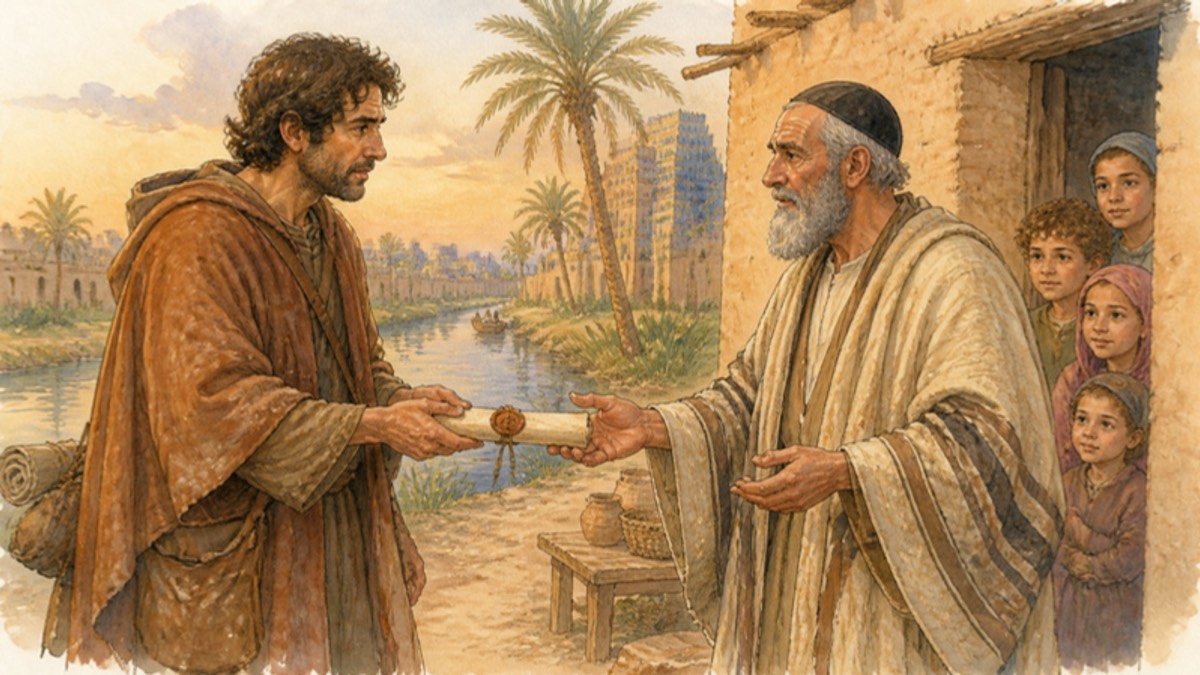
“For I know the plans I have for you, declares the Lord, plans for welfare and not for evil, to give you a future and a hope.”
Jeremiah 29:11 is a line from a letter Jeremiah sent from Jerusalem to Jewish exiles in Babylon around 598 BC. One verse earlier he says the exile will last seventy years, contradicting a prophet who promised two. The word rendered prosper is shalom, meaning welfare and wholeness rather than wealth, so the promise is a hopeful end for a community told to settle in first.
Jeremiah 29:11 has a return address. Most of the places I have seen it (a graduation card, a nursery wall decal, the inside of a planner) treat it as a sentence that fell out of the sky addressed to whoever is reading. It did not. It is one line from a letter, and the letter names its sender, its carriers, its recipients and the year. I come to this as a curious outsider rather than a believer, and my first question with any quoted line is who was talking to whom. For this verse that turned out to be the whole story. (If you want a spread of hope verses rather than one verse in depth, that is a separate page: Bible verses about hope.)
Who sent the letter in Jeremiah 29, and to whom?
This is the text of the letter that the prophet Jeremiah sent from Jerusalem to the surviving elders among the exiles and to the priests, the prophets and all the other people Nebuchadnezzar had carried into exile from Jerusalem to Babylon. — Jeremiah 29:1 (NIV)
So: a letter. Jeremiah is in Jerusalem. The readers are in Babylon, roughly five hundred miles east, having been marched there after Nebuchadnezzar’s second invasion. Enduring Word dates this deportation to 598 BC and notes that Babylon had already invaded twice (605 and 598), with a third and final siege still to come. Jeremiah 29:3 names the two men who carried the letter, Elasah and Gemariah, members of a diplomatic delegation King Zedekiah was sending to Nebuchadnezzar. The commentary quotes Thompson’s observation that correspondence between overlords and vassals was routine in that world, so the prophet’s letter went east in a diplomatic pouch.
That detail reset the verse for me. This is not a private whisper. It is public mail to a displaced community, read aloud to elders by men who had just walked across a desert.
Two prophets, two timelines
The reason Jeremiah wrote at all is that other prophets were already telling the exiles something else. One chapter earlier, a prophet named Hananiah had stood in the temple in Jerusalem and announced:
Within two years I will bring back to this place all the articles of the Lord’s house that Nebuchadnezzar king of Babylon removed from here and took to Babylon. — Jeremiah 28:3 (NIV)
He repeated the number in front of everyone, breaking a wooden yoke off Jeremiah’s neck for effect: “In the same way I will break the yoke of Nebuchadnezzar king of Babylon off the neck of all the nations within two years” (Jeremiah 28:11, NIV). Enduring Word calls it the message the frightened people would love to hear, and quotes Ryken’s dry line: “Whose church would you rather go to?” Hananiah died later that same year (Jeremiah 28:17), two months after the confrontation by the commentary’s count.
Jeremiah’s letter gives a different number, and it comes one verse before the famous one:
This is what the Lord says: “When seventy years are completed for Babylon, I will come to you and fulfill my good promise to bring you back to this place. — Jeremiah 29:10 (NIV)
Seventy years, not two. Enduring Word cites R. K. Harrison counting from the Babylonian victory at Carchemish in 605 BC to the first return in 536 BC, so the number was not a round figure of speech. A prophet in Babylon named Shemaiah was so annoyed by the letter that he complained about it in writing; his summary of Jeremiah’s message survives in the chapter: “It will be a long time. Therefore build houses and settle down; plant gardens and eat what they produce” (Jeremiah 29:28, NIV). That is the context verse 11 lives in. Spurgeon, quoted by Enduring Word, says the prophet had “the double duty of putting down their false hopes, and sustaining their right expectations.”
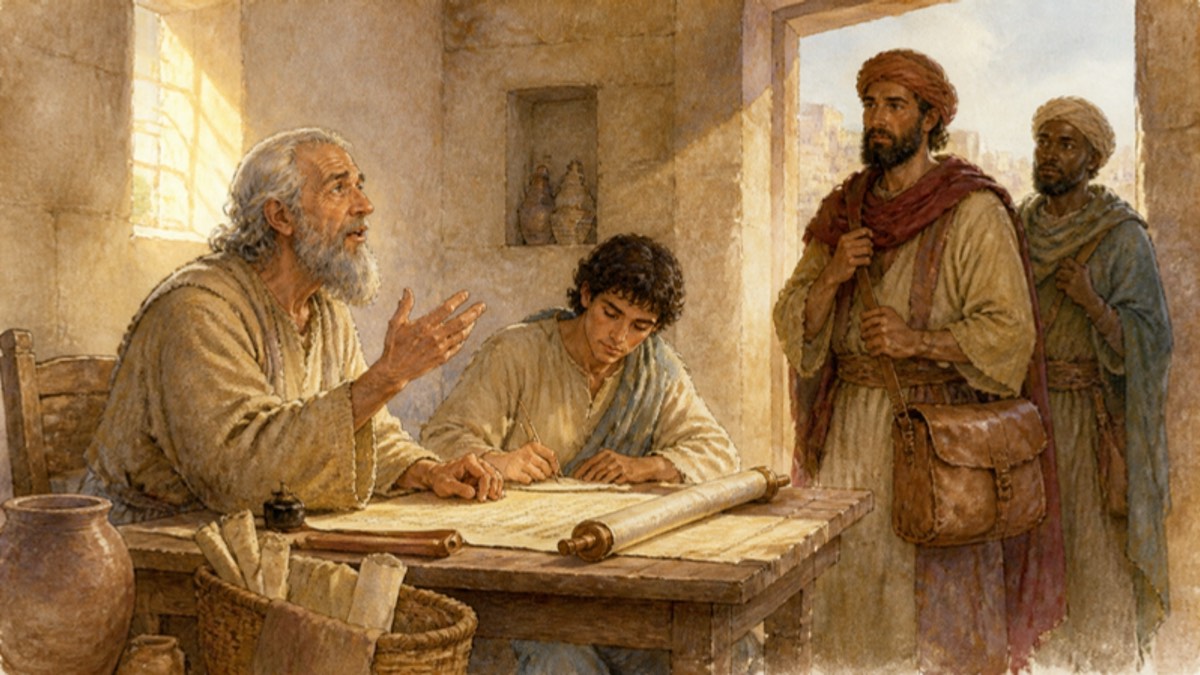
What the letter told them to do first
Before any promise, the letter gives instructions, and they are startlingly domestic:
“Build houses and settle down; plant gardens and eat what they produce. Marry and have sons and daughters; find wives for your sons and give your daughters in marriage, so that they too may have sons and daughters. Increase in number there; do not decrease. Also, seek the peace and prosperity of the city to which I have carried you into exile. Pray to the Lord for it, because if it prospers, you too will prosper.” — Jeremiah 29:5-7 (NIV)
Enduring Word quotes Cundall’s guess about why this needed saying: expecting a short stay, the exiles were probably “wary of acquiring houses, land, and even children, since these would be encumbrances in the event of a return journey.” They were living out of suitcases. The letter tells them to unpack. It also tells them to pray for Babylon, which Feinberg (cited in the same commentary) calls “unique in ancient literature”: a command to pray for your captors.
As a parent, this is the part I keep coming back to. The promise of a good future arrives attached to an order to raise children in the place you did not choose, and to want that place to do well.
What does Jeremiah 29:11 mean, phrase by phrase?
Now the verse itself, read as the next line after “seventy years”:
- “For I know the plans I have for you.” The “For” ties it to verse 10; it is the reason the seventy-year promise can be trusted. Enduring Word points out the contrast: the exiles did not know, or had forgotten, what God intended toward them, so it was put in writing.
- “Plans to prosper you and not to harm you.” The word behind “prosper” is shalom. Strong’s (via BibleHub) defines it as peace, completeness, welfare, well-being, safety, prosperity. The ESV translates the phrase “plans for welfare and not for evil,” which sounds less like a bank balance and more like what the word covers: wholeness. Verse 7 used the same word a few lines earlier for the peace of Babylon.
- “Plans to give you hope and a future.” Enduring Word quotes Feinberg: the Hebrew is literally “an end and a hope,” a hendiadys, two nouns carrying one idea, “a hopeful end.” Not a hopeful next week. An end.
Then the letter keeps going, and the next lines say what the hope consists of: “Then you will call on me and come and pray to me, and I will listen to you. You will seek me and find me when you seek me with all your heart” (Jeremiah 29:12-13, NIV). Enduring Word notes that the exiles could not perform the temple rituals in Babylon, so being heard from there was itself part of the promise. Verse 14 finally names the return home.
Is Jeremiah 29:11 a promise of personal success?
GotQuestions is unusually blunt for a devotional site: “In the primary application, Jeremiah 29:11 has nothing to do with any person living today. This verse applied only to the Jews who were in exile in Babylon during the sixth century BC.” It then allows a secondary application, because the character the verse reveals does not change. Enduring Word lands in the same place: a promise made to ancient Jews that nonetheless shows an “unchanging heart.”
Reading it that way rules out a few popular uses:
- It is not a promise about your particular college, job, or house. The plans in view are national: return, rebuilding, being gathered “from all the nations and places where I have banished you” (Jeremiah 29:14, NIV).
- It is not fast. Seventy years means many of the adults who first heard the letter read aloud would not make the trip home. The hope was for their grandchildren’s generation as much as for them.
- It is not a reward for good behaviour. The chapter is explicit that the exile is judgment (29:4 has God saying he carried them there). The promise comes to people who are, in the letter’s own framing, being disciplined.
- It is not “everything happens for a reason.” That phrase is not in the Bible, as I found when I wrote up Romans 8:28, the other verse people reach for in a hospital corridor.

The graduation-card problem
I don’t think the people printing this verse on mugs are being dishonest. The sentence genuinely is beautiful on its own. The trouble is that read alone it sounds like a quick fix, and read in its letter it is the opposite: a promise that the hard season is real, long, and known in advance by the one making the promise. The honest version is better for anyone who is anxious, because it does not ask you to pretend the wait is short.
Reading it in a season that will not end by bedtime
Most of the hard things in parenting are not emergencies; they are seasons. A child’s speech delay. A year of night terrors. A parent’s long recovery. The temptation in all of them is to live like the exiles before the letter: suitcases packed, refusing to build anything until the season is over.
The letter’s advice to people in a long season is practical to the point of bluntness. Build the house you are in. Plant something that takes months. Raise the kids here, not in the imagined future. Want good things for the place you did not pick. And then, only then, the promise about the end. Read in that order, verse 11 is less a reason to hold your breath than permission to settle into the stretch you are in. If you want to keep the whole paragraph in your head rather than the one line, the scripture memory cards on this site let you drill verses 10–13 together. The site also has a devotional on when God feels silent, which is the exile’s problem from the inside.
Telling a child about a long wait
If a child asks what this verse means, I would not start with “God has a plan for your life,” which is how I first heard it and which raises more questions than it answers for a young child. I would tell the story: some families had to move far away from home and were told they would be there a very long time. A letter came that said two things. First, make a real home where you are: build, plant, have babies, be good neighbours. Second, the ending is good, and the one who wrote the letter already knows it, even though the people reading it would have to wait. Then I would ask the child what they would plant.
Those are my notes on a verse I thought I understood from the greeting card. The letter is twenty-nine verses longer and, read in order, far more useful.
Sources
- Jeremiah 29:1–14 (NIV) — BibleGateway
- Enduring Word — Jeremiah 29 commentary (David Guzik)
- Enduring Word — Jeremiah 28 commentary, Hananiah’s two-year prophecy
- GotQuestions — What is the meaning of “for I know the plans I have for you” in Jeremiah 29:11?
- GotQuestions — What was the Babylonian captivity/exile?
- BibleHub — Strong’s Hebrew 7965 shalom
- Blue Letter Bible — Jeremiah 29:11 with interlinear tools
In different seasons
The passage keeps its original setting, but the questions we bring to it can change. A tired afternoon and a grateful morning may lead us to notice different parts of the same verse.
Choose a season below for a short reflection. These are gentle applications drawn from public commentaries, not additional words from the verse.
When your thoughts won't settle
The verse is often misused as "everything will work out soon." Its honest version is better for anxiety: the end is good, and the wait is real and known.
A question to carry: Am I treating this verse as a promise of a quick fix, or as hope with a long horizon?
Questions moms ask
Who was Jeremiah 29:11 written to?
What does 'plans to prosper you' mean in Hebrew?
Does Jeremiah 29:11 apply to me today?
How long did the exiles actually wait?
Scripture references in this article
Each reference opens the full passage on BibleGateway (NIV).


Little helps for everyday faith
Start with a few quiet minutes.

Behind the notes
Hi, I'm Vega.
I'm a curious mom in Taiwan reading the Bible and writing down what I learn. I'm not a Christian — I grew up in a Taoist family — but after watching my aunt and the moms around me lean on these words through hard years, I wanted to understand why they carry so much weight. Every verse is quoted from the ESV or NIV and every interpretation links to a public commentary. I'm still learning; if you spot an error, tell me.
A little more about me