
“And we know that for those who love God all things work together for good, for those who are called according to his purpose.”
If you have ever sat in a hospital waiting room, you may have heard someone say “well, all things work together for good.” It is one of the most quoted lines in the Bible, and one of the most misquoted. I’m not a Christian; I started reading the Bible because I kept noticing how much it helped the people around me. This verse is a good example of why I wanted to read the whole chapter and not just the mug.
The verse itself
And we know that in all things God works for the good of those who love him, who have been called according to his purpose. — Romans 8:28 (NIV)
Three things jump out before any commentary: it begins with “we know” (a claim of confidence, not a wish), it says God is doing the working, and it ends with a qualifier about who the promise is for. Hold onto all three.
Who wrote it, to whom, and when
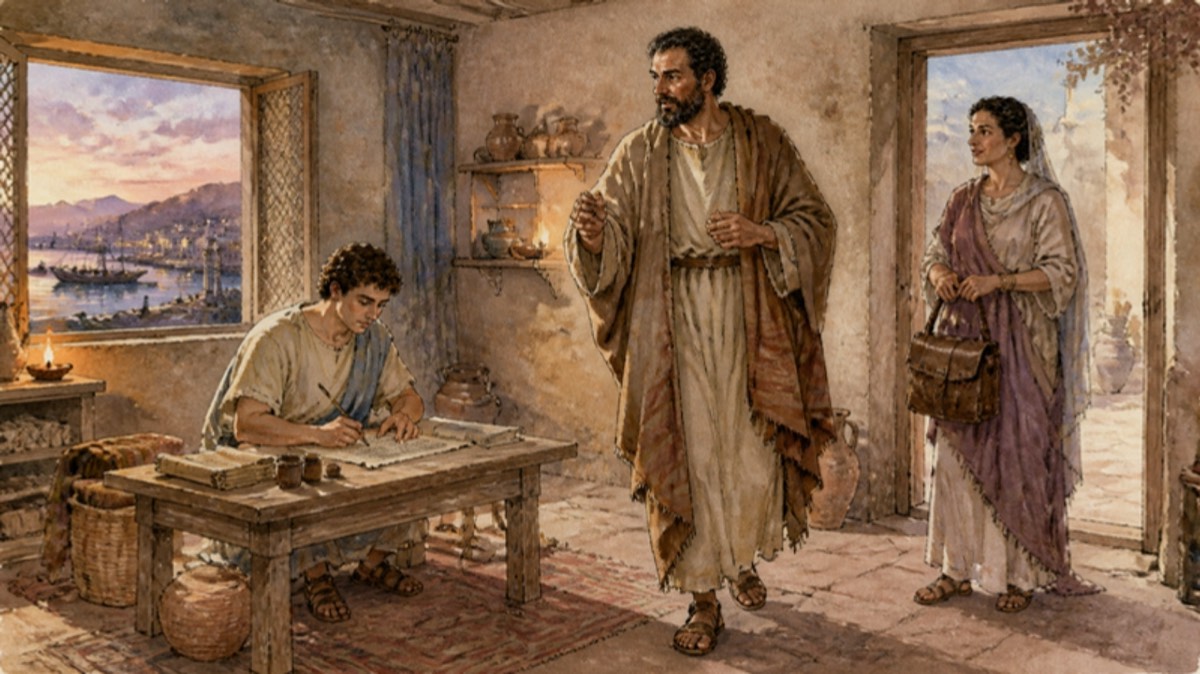
Romans is a letter from Paul to the Christians in Rome, a church he had not founded and had never visited. He opens by addressing “all in Rome who are loved by God and called to be his holy people” (Romans 1:7, NIV). According to Enduring Word’s introduction, it is almost universally agreed that Paul wrote it from Corinth while wintering there on his third missionary journey (the stop described in Acts 20:2–3), with commentators placing the date somewhere between AD 53 and 58. The letter closes with a few human details I found charming: Paul commends “our sister Phoebe, a deacon of the church in Cenchreae” (Romans 16:1, NIV), who most likely carried the letter, and the scribe pops his head up to say, “I, Tertius, who wrote down this letter, greet you in the Lord” (Romans 16:22, NIV).
So the first readers were a mixed group of Jewish and non-Jewish believers in the capital of the empire, reading a long, careful letter from a man they had heard of but never met. Romans 8:28 was not a comforting one-liner texted to a grieving friend. It sits inside the most sustained argument in the letter.
Where the verse sits in Romans 8
This is the part the greeting cards skip, and it changes everything. Chapter 8 moves like this:
- Verse 1 opens with “there is now no condemnation for those who are in Christ Jesus” (NIV).
- Verses 5–17 contrast living by “the flesh” and living by “the Spirit,” and describe believers as adopted children and heirs.
- Verse 18 turns to pain: “I consider that our present sufferings are not worth comparing with the glory that will be revealed in us” (NIV). Notice the word sufferings. Paul is not pretending.
- Verses 22–25 say creation itself “groans,” and so do believers, waiting for bodies to be redeemed.
- Verse 26 admits weakness: “We do not know what we ought to pray for, but the Spirit himself intercedes for us through wordless groans” (NIV).
- Verse 28 is the answer to all that groaning.
- Verse 29 immediately explains what the “good” is: “to be conformed to the image of his Son” (NIV).
- Verses 31–39 build to the famous finish, “If God is for us, who can be against us?” and “neither death nor life … will be able to separate us from the love of God” (NIV).
Read in order, 8:28 is not “cheer up.” It is a man who has just said suffering, groaning, we don’t even know how to pray and then says: and yet, this is what we know. Enduring Word’s commentary puts it plainly: God “is able to make even those sufferings work together for our good and His good.”
The key words
“We know.” The Greek is oidamen, a settled kind of knowing. Paul does not say “we hope” or “we feel.”
“All things.” Greek panta. Enduring Word stresses the word: God works all things, “not some things,” and works them “together, not in isolation.” That second point is the one I had never noticed. No single event is claimed to be good. The claim is about how they combine.
“Works together.” In the ESV and KJV wording (“all things work together for good”), the verb is συνεργέω (synergeō), which Blue Letter Bible’s lexicon defines as “to be a fellow-worker, i.e. co-operate” — to work with, to help with. It is the root of our word synergy. The picture is of pieces cooperating toward one result, like ingredients in a recipe where several of them taste terrible on their own.
“For good.” Greek eis agathon, “toward good.” The direction matters: toward. And verse 29 tells you the destination.
“Those who love him, who have been called according to his purpose.” This is the qualifier, and the commentaries do not soften it. Enduring Word: the promise “is for those who love God in the Biblical understanding of love.” Whatever you make of that theologically, it is honest to say that Paul did not write this as a law of nature that applies to everyone equally.
Four things Romans 8:28 does not promise
It does not say everything is good. Paul uses the words sufferings and groaning ten verses earlier. Enduring Word calls the sufferings real and says God works them for good, which is a different claim from calling them good.
It does not promise comfort, success, or a happy ending in this life. Because verse 29 defines the good as being “conformed to the image of his Son,” the promise is about character, not circumstances. A Christian reading this honestly has to accept that the “good” God is working toward might look like becoming more patient and more compassionate through something she would never have chosen.
It is not a line to hand someone at a funeral. Nothing in the verse tells you to say it out loud to a person in fresh grief. The commentary I read on this chapter spends its time on the groaning of verses 22–26, not on fixing people’s feelings.
It does not say “everything happens for a reason.” That phrase is not in the Bible. Romans 8:28 says God works; it does not say God scripted the car accident so that a lesson could be learned. The commentaries I read are careful not to make God the author of evil while still insisting he is not defeated by it.

The honest question I still have
As an outsider, here is what I keep turning over: if the “good” is Christlikeness, then the verse is far more demanding and far less soothing than the way it gets used. It asks a person to want the right outcome. Enduring Word’s note on verse 29 says this conforming “is a process that God does with our cooperation.” That is a long game, not a quick fix, and it explains why the same verse can feel hollow to someone in crisis and solid to someone looking back years later. Joseph in Genesis 50 saying “you intended to harm me, but God intended it for good” is the Bible’s own example, and he said it decades after the harm.
Reading it at 9 p.m. with a sink full of bottles
Here is how I’d put the verse to a friend at 9 p.m. with a sink full of bottles. It does not say your hard day was good. It says the hard day is not wasted, and that the thing being built out of it is you: someone more like the gentlest person in the story. The part that steadies me, even without faith of my own, is the word together. Nothing in my life has to make sense on its own for the whole to be going somewhere. Christian moms I know use the verse as a reason to stop auditing each individual day.
And if the day is heavier than a verse can carry, the chapter itself gives you permission to groan without words (verse 26). That is in the text, too.
Those are my notes on one verse. The chapter around it is twenty verses longer and, honestly, better.
Sources
- Romans 8:28–30 (NIV) — BibleGateway
- Enduring Word — Romans 8 commentary (David Guzik)
- Enduring Word — Romans 1 commentary, with the letter’s date and setting
- Blue Letter Bible — Romans 8:28 with interlinear tools
- Blue Letter Bible — Strong’s G4903 συνεργέω (synergeō)
- GotQuestions — What does it mean that all things work together for good?
- GotQuestions — Summary of the Book of Romans
In different seasons
The passage keeps its original setting, but the questions we bring to it can change. A tired afternoon and a grateful morning may lead us to notice different parts of the same verse.
Choose a season below for a short reflection. These are gentle applications drawn from public commentaries, not additional words from the verse.
When your thoughts won't settle
The verse doesn't claim the thing you're anxious about is good. It claims God is at work in it toward good. That distinction matters for honest hope.
A question to carry: What hard thing in my past can I now see woven into something good? What am I still waiting on?
Questions moms ask
Does Romans 8:28 mean everything that happens is good?
What does 'good' mean in Romans 8:28?
Who is Romans 8:28 written to?
Why do some Bibles say 'all things work together for good' and others say 'God works'?
Scripture references in this article
Each reference opens the full passage on BibleGateway (NIV).



Little helps for everyday faith
Start with a few quiet minutes.

Behind the notes
Hi, I'm Vega.
I'm a curious mom in Taiwan reading the Bible and writing down what I learn. I'm not a Christian — I grew up Buddhist — but after watching my aunt and the moms around me lean on these words through hard years, I wanted to understand why they carry so much weight. Every verse is quoted from the ESV or NIV and every interpretation links to a public commentary. I'm still learning; if you spot an error, tell me.
A little more about me