
I kept running into this phrase — “the unforgivable sin” — in forum threads written by people who were terrified. Some were Christians convinced they had crossed a line years ago. A few were teenagers who had said something angry about God and now couldn’t sleep. So I went to the passage itself to see what Jesus actually said, who he said it to, and why.
The short version: Jesus named one sin that “will not be forgiven,” and he named it in the middle of a very specific confrontation. The religious leaders had just watched him heal a man and announced that the power behind it was the devil’s. Everything the commentaries say about this verse comes back to that scene.
The scene: Matthew 12 and Mark 3
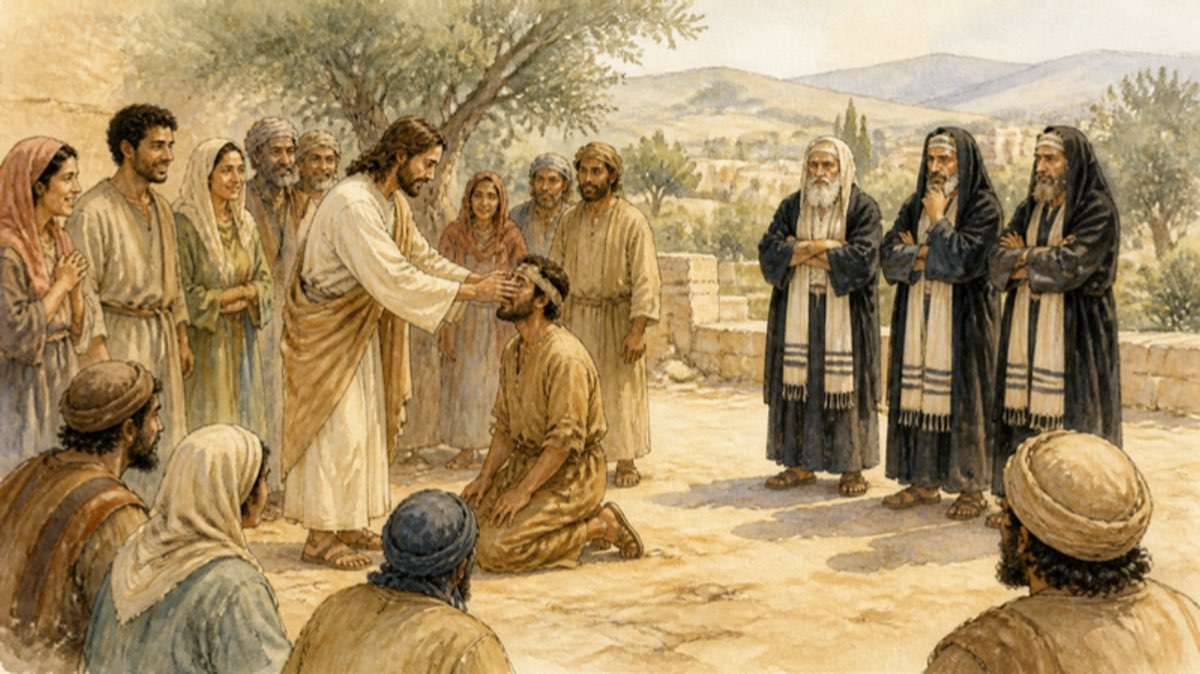
In Matthew 12:22, Jesus heals a man who is demon-possessed, blind, and mute. The crowd is amazed and starts asking whether Jesus could be “the Son of David” — the Messiah. The Pharisees, standing right there, give a different explanation:
But when the Pharisees heard this, they said, “It is only by Beelzebul, the prince of demons, that this fellow drives out demons.” — Matthew 12:24 (NIV)
Jesus answers with a short argument (a kingdom divided against itself can’t stand; why would Satan cast out Satan?) and then says this:
And so I tell you, every kind of sin and slander can be forgiven, but blasphemy against the Spirit will not be forgiven. Anyone who speaks a word against the Son of Man will be forgiven, but anyone who speaks against the Holy Spirit will not be forgiven, either in this age or in the age to come. — Matthew 12:31-32 (NIV)
Mark tells the same story and adds a sentence that, for me, settled what the sin is:
Truly I tell you, people can be forgiven all their sins and every slander they utter, but whoever blasphemes against the Holy Spirit will never be forgiven; they are guilty of an eternal sin.” He said this because they were saying, “He has an impure spirit.” — Mark 3:28-30 (NIV)
“He said this because they were saying…” Mark is telling the reader exactly what triggered the warning. The teachers of the law “who came down from Jerusalem” (Mark 3:22) — experts, not casual bystanders — looked at a healing and called it the work of an impure spirit.
What “blasphemy” means here
The Greek word is blasphēmia (Blue Letter Bible lists it as Strong’s G988): slander, abusive speech, speaking evil of someone. It’s the same word used earlier in the verse for “every slander they utter.” So the sin isn’t a magic phrase. It’s a kind of speech — and, behind the speech, a settled attitude.
GotQuestions’ page on the unpardonable sin describes the Pharisees this way: “They saw Jesus’ wonderful works, and they heard His clear presentation of truth,” and yet they deliberately closed their eyes to it. Enduring Word’s commentary on Matthew 12 reads the chapter as a whole — from the Sabbath arguments to the Beelzebul charge — as Jesus revealing “the hardness of the Pharisees’ hearts through their words.” The sin, on both readings, is not a slip. It’s a settled position.
That’s why Jesus can say that speaking against “the Son of Man” is forgivable. Plenty of people misjudged Jesus. Peter denied knowing him three times and “went outside and wept bitterly” (Luke 22:62), and a few chapters later he’s restored. Paul, by his own account, persecuted the church. Those were sins against Jesus by people who later repented. The Pharisees in Matthew 12 were doing something different: rejecting the only evidence that could ever persuade them.
Why it can’t be forgiven (as the commentaries explain it)
This part surprised me. I assumed “unforgivable” meant God had a limit — one sin so bad he refused to cover it. That isn’t how the commentators read it.
GotQuestions puts the logic in one line: “To reject the only Savior is to be left with no means of salvation; to reject the only pardon is, obviously, unpardonable.” Enduring Word describes the sin as “a settled disposition of life that rejects the testimony of the Holy Spirit regarding Jesus,” and adds something I found reassuring: “Even if someone has intentionally said such things, they can still repent and prevent a settled rejection of Jesus.” In other words, the door isn’t locked from God’s side. The person has decided the door is a trap and walked away from it, and as long as that stance holds there is no path back — not because repentance would be refused, but because it will never be offered.
The image that helped me: if you’re drowning and you push away the one rescuer, you’re not being denied rescue. You’re refusing it.

“Have I committed it?” — what every source says
Here is the part the anxious forum posters needed, and the two sources I checked agree:
The Pharisees were not worried. They walked away from the miracle planning how to stop Jesus (Matthew 12:14). Concern, guilt, and the fear of being cut off from God are the opposite of the hardened, hostile posture the passage describes. Enduring Word quotes Adam Clarke on exactly this: “Many sincere people have been grievously troubled with apprehensions that they had committed the unpardonable sin; but let it be observed that no man who believes the Divine mission of Jesus Christ, ever can commit this sin.”
The specific sin can’t be repeated. GotQuestions argues that the blasphemy in Matthew 12 “cannot be duplicated today,” because no one can personally watch Jesus perform a miracle and credit it to Satan. On its reading, “the only unpardonable sin today is that of continued unbelief” — dying in a lifelong refusal of Christ, which is a different thing from a frightened person’s bad week.
Doubt is not blasphemy. Thomas doubted; Jesus showed him his hands. John the Baptist sent messengers from prison asking whether Jesus was really the one. Neither is treated as unforgivable.
Intrusive thoughts are not blasphemy. Several people in those threads described horrible thoughts about God that popped into their heads uninvited. GotQuestions has a page specifically on scrupulosity, which it calls “religious OCD” and describes as “a psychological illness in modern psychology” that often fixates on blasphemy. A thought you hate and fight is not a settled rejection of God.
Past sins, even severe ones, are not blasphemy. The verse right before the warning says “every kind of sin and slander can be forgiven.” That’s the headline; the exception is narrow.
Later in the New Testament, John writes to Christians:
If we confess our sins, he is faithful and just and will forgive us our sins and purify us from all unrighteousness. — 1 John 1:9 (NIV)
No category of sin is carved out of that sentence.
Who the warning was for
I’m not a Christian, so I read this passage the way I’d read a hard line in any founding document: what was it for? And the answer seems to be: it was for the experts who had decided in advance that nothing Jesus did could be from God. It was a warning to people who were sure of themselves, not a trap for people who are afraid.
What struck me as a mom is that the frightened readers had the whole thing backwards. The verse is addressed to the hard-hearted, and they were reading it as if it were addressed to the soft-hearted. Context fixed that. It usually does.
Sources and further reading
- BibleGateway — Matthew 12:22-32 (NIV) and Mark 3:22-30 (NIV)
- Enduring Word — Matthew 12 commentary and Mark 3 commentary
- GotQuestions — What is the unpardonable sin / unforgivable sin?
- GotQuestions — What is scrupulosity?
- Blue Letter Bible — Matthew 12:31 with study tools and the lexicon entry for blasphēmia (G988)
Questions moms ask
Where does the Bible talk about the unforgivable sin?
Can a Christian accidentally commit the unforgivable sin?
What if I'm afraid I've already committed it?
Scripture references in this article
Each reference opens the full passage on BibleGateway (NIV).



Little helps for everyday faith
Start with a few quiet minutes.

Behind the notes
Hi, I'm Vega.
I'm a curious mom in Taiwan reading the Bible and writing down what I learn. I'm not a Christian — I grew up Buddhist — but after watching my aunt and the moms around me lean on these words through hard years, I wanted to understand why they carry so much weight. Every verse is quoted from the ESV or NIV and every interpretation links to a public commentary. I'm still learning; if you spot an error, tell me.
A little more about me