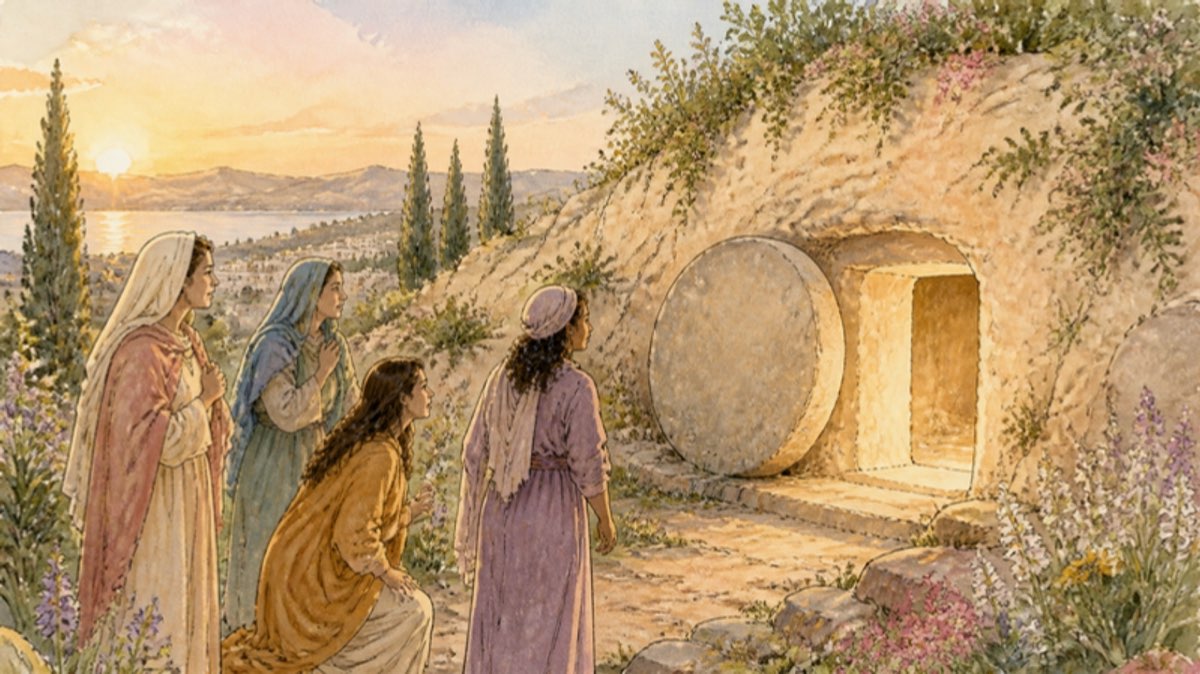
What Happens When You Die? A Biblical Guide to the Afterlife
What the Bible actually says about the moment of death, the time between death and resurrection, heaven, hell, and the new creation — from Luke 23:43 and 2 Corinthians 5:8 to 1 Thessalonians 4 and Revelation 21.
My son asked me where his great-grandmother went. I gave him the Buddhist answer I grew up with, and then I realized I didn’t actually know what his Christian friends’ parents would say — or what their book says, as opposed to what gets said at funerals. So I went and read the passages.
The Bible’s picture has two stages, not one. First, at death: the Christian is “with the Lord.” Then, at the end: a bodily resurrection and a renewed creation where “there will be no more death.” Heaven, as most people picture it, is the first stage. The second is the one the New Testament spends more words on.
The moment of death
Ecclesiastes says it in Old Testament terms:
and the dust returns to the ground it came from, and the spirit returns to God who gave it.
— Ecclesiastes 12:7 (NIV)
Hebrews adds the sequence: “people are destined to die once, and after that to face judgment” (Hebrews 9:27, NIV). No reincarnation, which was the first thing I noticed coming from my background — one life, then an accounting.
For Christians specifically, the texts about where they go are short and consistent. Jesus to the criminal crucified beside him:
Jesus answered him, “Truly I tell you, today you will be with me in paradise.”
— Luke 23:43 (NIV)
Paul, twice:
We are confident, I say, and would prefer to be away from the body and at home with the Lord.
— 2 Corinthians 5:8 (NIV)
I am torn between the two: I desire to depart and be with Christ, which is better by far;
— Philippians 1:23 (NIV)
“Today.” “At home with the Lord.” “Depart and be with Christ.” Enduring Word’s commentary on 2 Corinthians 5 says the passage “refutes the false doctrine of ‘soul sleep’” and describes being “absent from the body” as entering God’s “immediate, glorious presence.” GotQuestions’ page on the intermediate state states it flatly: “The Bible makes it clear that deceased believers are with the Lord (2 Corinthians 5:6-8; Philippians 1:23).” That is the mainstream view across Protestant, Catholic, and Orthodox traditions. (The minority “soul sleep” view — unconsciousness until the resurrection — rests on the “sleep” language below; GotQuestions’ page on it argues the metaphor is about the body, “not the soul.”)
The in-between: what Christians call the intermediate state
Here’s what surprised me. The New Testament doesn’t present “going to heaven” as the end of the story. Paul tells grieving Christians in Thessalonica:
Brothers and sisters, we do not want you to be uninformed about those who sleep in death, so that you do not grieve like the rest of mankind, who have no hope. For we believe that Jesus died and rose again, and so we believe that God will bring with Jesus those who have fallen asleep in him.
— 1 Thessalonians 4:13-14 (NIV)
“Grieve like the rest of mankind, who have no hope” — notice he doesn’t say don’t grieve. Then the future event:
For the Lord himself will come down from heaven, with a loud command, with the voice of the archangel and with the trumpet call of God, and the dead in Christ will rise first. After that, we who are still alive and are left will be caught up together with them in the clouds to meet the Lord in the air. And so we will be with the Lord forever.
— 1 Thessalonians 4:16-17 (NIV)
So the dead are “with the Lord” now, and “the dead in Christ will rise” later. The period between is what theologians call the intermediate state; GotQuestions’ page on it says the Bible “does not give a great amount of detail” about what kind of body, if any, believers have during it. Catholic teaching adds purgatory — a purification during that period — which Protestant sources like GotQuestions reject (“The Bible says nothing about purgatory”); I’ve linked that page so you can see the Catholic definition it quotes and the Protestant objection side by side.
The end: resurrection, not just heaven
The chapter Christians read at funerals is 1 Corinthians 15, and it’s about bodies:
So will it be with the resurrection of the dead. The body that is sown is perishable, it is raised imperishable; it is sown in dishonor, it is raised in glory; it is sown in weakness, it is raised in power; it is sown a natural body, it is raised a spiritual body. If there is a natural body, there is also a spiritual body.
— 1 Corinthians 15:42-44 (NIV)
“Spiritual body” doesn’t mean ghost. Enduring Word’s commentary on the chapter puts it this way: “Our resurrection bodies will be material (like Christ’s), but also transformed” — the risen Jesus of the Gospels ate fish (Luke 24:42-43) and showed his scars (John 20:27). And the setting for those bodies is a renewed world, described in the Bible’s last pages:
‘He will wipe every tear from their eyes. There will be no more death’ or mourning or crying or pain, for the old order of things has passed away.”
— Revelation 21:4 (NIV)
Jesus’ own promise in John 14 fits the same shape: “My Father’s house has many rooms… I will come back and take you to be with me” (John 14:2-3, NIV). Presence now, homecoming later.
Hell
I’m not going to soften this, because the texts don’t. Jesus talks about judgment more than anyone else in the Bible. In his story of the rich man and Lazarus:
“The time came when the beggar died and the angels carried him to Abraham’s side. The rich man also died and was buried. In Hades, where he was in torment, he looked up and saw Abraham far away, with Lazarus by his side.
— Luke 16:22-23 (NIV)
Enduring Word’s commentary on Luke 16 titles this passage “Witness of Hades” and walks through the rich man’s torment as Jesus’ own teaching about the afterlife. Christians differ on how literal the fire imagery is and on whether hell is eternal conscious torment or eventual destruction (the “annihilationist” view), but the mainstream reading is a real, final separation from God for those who refuse him. On people who never heard the gospel, GotQuestions is blunt — “The message of the gospel is exclusive” — and other Christians read Romans 1:19-20 and 2:14-16 more hopefully; it’s a live debate, and I’ve linked the strict version so you can see it stated plainly.
The line that holds it together
Jesus to Martha, whose brother had been dead four days:
Jesus said to her, “I am the resurrection and the life. The one who believes in me will live, even though they die; and whoever lives by believing in me will never die. Do you believe this?”
— John 11:25-26 (NIV)
The whole Christian claim about death is in that sentence, and it’s a claim about a person, not a place. That’s the part I didn’t understand before reading it: for a Christian, “what happens when you die” is answered by “who you’re with,” and everything else — paradise, resurrection, new creation — is downstream of that.
What I told my son
I told him what his friends’ parents would say: that the Bible says their great-grandmothers are with God now and that one day everyone who trusts God will get new bodies and a new world without crying. He asked if that was true. I told him I was still reading. That’s honest, and he was satisfied with it, which is more than I expected.
If you're grieving
These are study notes. If you've lost someone and the questions here are not academic, 1 Thessalonians 4:13 gives Christians explicit permission to grieve — just "not like those who have no hope." A pastor, a grief counselor, or a hospice chaplain is used to exactly this conversation.
For a hard day
These are one curious mom's study notes, not pastoral counsel or medical advice. If today is heavier than a verse can carry, please reach out to your pastor, a licensed counselor, or your doctor — and if you're in crisis in the US, call or text 988.
Questions moms ask
Does the Bible say believers go to heaven immediately when they die?
The verses most often cited say yes: 'today you will be with me in paradise' (Luke 23:43), 'away from the body and at home with the Lord' (2 Corinthians 5:8), 'to depart and be with Christ' (Philippians 1:23). A minority view, 'soul sleep,' reads the 'sleep' language of 1 Thessalonians 4 literally; GotQuestions has pages on both.
Is heaven the final destination?
Not in the New Testament's own framing. The end point is bodily resurrection and a renewed creation — 1 Corinthians 15:42-44, 1 Thessalonians 4:16-17, and Revelation 21:1-4, where God 'will wipe every tear from their eyes.' Christians often call the time between death and that resurrection the 'intermediate state.'
Will we recognize people we love?
The Bible doesn't answer directly. Christians usually point to the disciples recognizing the risen Jesus, to the rich man recognizing Lazarus and Abraham in Luke 16:23, and to Jesus' saying that people will sit with Abraham, Isaac, and Jacob (Matthew 8:11), as reasons to think identity continues. That's an inference, not a verse.
Scripture references in this article
Each reference opens the full passage on BibleGateway (NIV).
I'm a curious mom in Taiwan reading the Bible and writing down what I learn. I'm not a Christian — I grew up Buddhist — but after watching my aunt and the moms around me lean on these words through hard years, I wanted to understand why they carry so much weight. Every verse is quoted from the ESV or NIV and every interpretation links to a public commentary. I'm still learning; if you spot an error, tell me.