
A friend of mine, mid-divorce, told me her church had been kind to her face and chilly behind her back. She wanted to know what the Bible actually said, not what people assumed it said. I didn’t know either, so I read the passages — there are only a handful — and the commentaries on them.
The Bible talks about divorce in five main places: a Mosaic regulation (Deuteronomy 24), a prophet’s rebuke (Malachi 2), two sayings of Jesus (Matthew 5 and 19, with parallels in Mark 10 and Luke 16), and a chapter of Paul’s (1 Corinthians 7). Jesus names one exception; Paul adds a second. Everything else is interpretation.
Deuteronomy 24: the law Jesus was asked about
The Old Testament doesn’t command divorce; it regulates one. Deuteronomy 24:1-4 assumes divorce is happening and sets a procedure:
If a man marries a woman who becomes displeasing to him because he finds something indecent about her, and he writes her a certificate of divorce, gives it to her and sends her from his house, — Deuteronomy 24:1 (NIV)
GotQuestions describes these verses as laws “to protect the rights of divorcées,” and Enduring Word’s commentary on the chapter notes that divorce here is “carefully regulated and requiring a written certificate.” The certificate mattered: it was the woman’s proof that she was free. The phrase “something indecent” became the hinge of a famous rabbinic argument. One school (Shammai) read it as sexual unfaithfulness; the other (Hillel) read it so broadly that a burned dinner qualified. That argument is the background to the question the Pharisees bring to Jesus.
Malachi 2:16: “I hate divorce”?
The older translations render Malachi 2:16 as “I hate divorce,” and it’s often quoted as God’s one-line verdict. The NIV translates the Hebrew differently:
“The man who hates and divorces his wife,” says the Lord, the God of Israel, “does violence to the one he should protect,” says the Lord Almighty. So be on your guard, and do not be unfaithful. — Malachi 2:16 (NIV)
Either way, the context (Malachi 2:10-16) is specific: men in Judah were divorcing “the wife of your youth” to marry foreign women, and the prophet calls it faithlessness and violence. Enduring Word’s commentary says the statement “flows directly from the fact that it destroys what He loves — marriage.” It’s a rebuke of men who walk out, not a label on everyone who has been through a divorce.
Matthew 19: Jesus and the exception clause
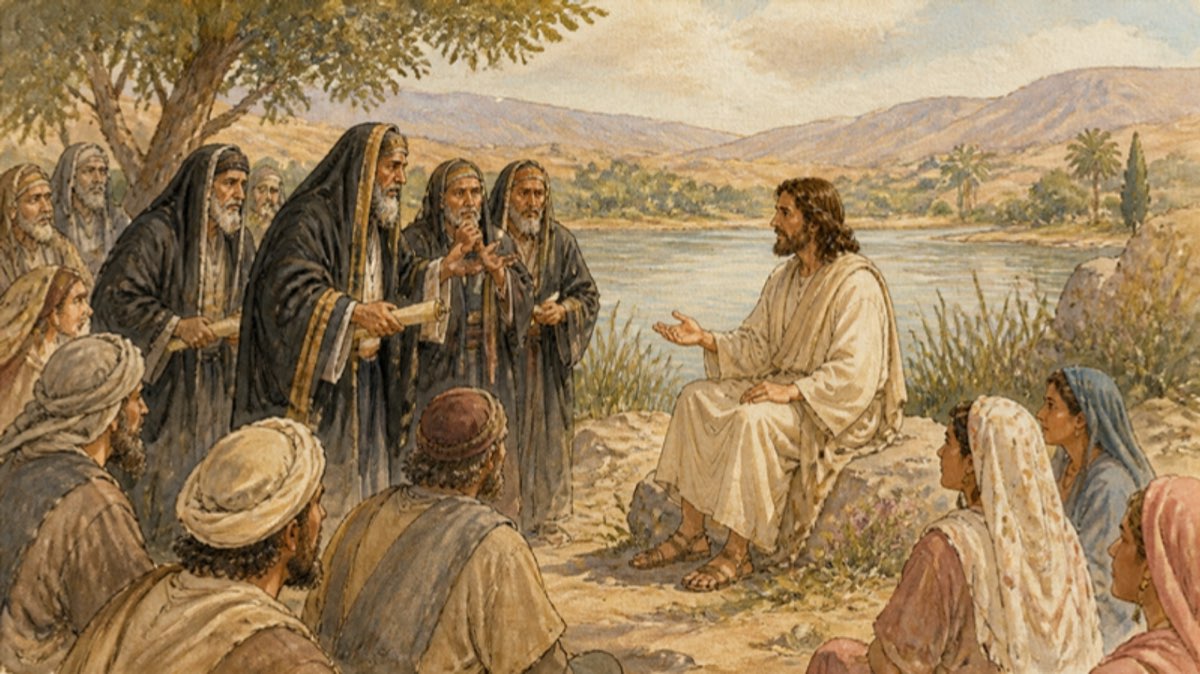
Some Pharisees came to him to test him. They asked, “Is it lawful for a man to divorce his wife for any and every reason?” — Matthew 19:3 (NIV)
“For any and every reason” is the Hillel position. Jesus doesn’t pick a side in the rabbinic debate; he goes back to Genesis:
“Haven’t you read,” he replied, “that at the beginning the Creator ‘made them male and female,’ and said, ‘For this reason a man will leave his father and mother and be united to his wife, and the two will become one flesh’? So they are no longer two, but one flesh. Therefore what God has joined together, let no one separate.” — Matthew 19:4-6 (NIV)
When they press him on Moses’ certificate, he answers:
Jesus replied, “Moses permitted you to divorce your wives because your hearts were hard. But it was not this way from the beginning. I tell you that anyone who divorces his wife, except for sexual immorality, and marries another woman commits adultery.” — Matthew 19:8-9 (NIV)
Two things to notice. First, Jesus says the Mosaic law was a concession (“because your hearts were hard”), not the ideal. Second, “except for sexual immorality” — the Greek word is porneia (Blue Letter Bible, G4202), a broad term for sexual sin — is the one exception he states. Matthew 5:31-32 says the same thing in the Sermon on the Mount.
Mark’s version of the conversation has no exception:
He answered, “Anyone who divorces his wife and marries another woman commits adultery against her. And if she divorces her husband and marries another man, she commits adultery.” — Mark 10:11-12 (NIV)
This is where Christians divide. The majority Protestant reading — the one Enduring Word and GotQuestions both take — is that Matthew records the exception and Mark reports the teaching without it, so the exception stands. GotQuestions’ page on the exception clause says porneia “was used to refer to adultery, fornication, prostitution, incest” — a broad word; Enduring Word says the same, and adds that on this reading “divorce — and the freedom to remarry without sin — is only permitted in the case of sexual immorality” (plus the desertion case below). Catholic teaching, by contrast, does not recognize divorce of a valid marriage at all, and a minority of Protestant readers argue that porneia here means unfaithfulness during a Jewish betrothal; I’ve seen both positions described but couldn’t find them on a page I could verify, so I’m naming them rather than summarizing them. Serious people hold each view and cite the same verses.
1 Corinthians 7: Paul’s two instructions
Paul writes to a church in a city where some members had become Christians after marrying, and their spouses hadn’t. He is careful to say which words are Jesus’ and which are his own judgment.
To the married I give this command (not I, but the Lord): A wife must not separate from her husband. But if she does, she must remain unmarried or else be reconciled to her husband. And a husband must not divorce his wife. — 1 Corinthians 7:10-11 (NIV)
Then, for mixed marriages:
But if the unbeliever leaves, let it be so. The brother or the sister is not bound in such circumstances; God has called us to live in peace. — 1 Corinthians 7:15 (NIV)
“Not bound” is the phrase most Protestant commentators (Enduring Word among them) read as the second biblical ground for divorce: desertion by an unbelieving spouse. Whether “not bound” also means “free to remarry” is debated, but that is the common reading.
Where that leaves the question of abuse
The Bible never says the word. GotQuestions is candid about that: “The Bible is silent on the issue of physical abuse as a reason for divorce,” its page says, and because abuse isn’t one of the two listed grounds, “we are careful to limit our advice to separation.” But the same page is just as clear on safety: “No one should remain in an unsafe environment,” “there is nothing unbiblical about separating from an abuser,” and separation “should occur immediately.” Its page on grounds for divorce lists abuse first among the additional grounds people ask about and says none “can be claimed to be explicitly biblical” — while admitting the stricter reading may be wrong (“While this may very well be the case, it is never wise to presume upon the Word of God”). Many pastors and counselors do go further and treat abuse as covenant-breaking; I couldn’t find that position on a page I could verify, so I’m reporting it as something you’ll hear rather than something I can link. What every source I read has in common: nobody tells you to stay in a dangerous house. Get safe first, then sort out the theology.

Remarriage
Three positions, roughly:
- Permitted after a biblical divorce. If the divorce was for porneia or desertion, the innocent party may remarry. GotQuestions states the rule as “no divorce and, if a divorce does occur, no remarriage,” then names the two exceptions and concludes that in those cases “it is reasonable to assume that remarriage is allowed.” Enduring Word reads Matthew 19:9 the same way.
- Forgiveness before divorce. GotQuestions also stresses that the exception “is an allowance for divorce, not a requirement for it,” and that even after adultery “a couple can, through God’s grace, learn to forgive and begin rebuilding their marriage.” Several pastors I’ve heard extend that logic to remarriage after a divorce that shouldn’t have happened — forgivable like any other sin — though that’s a view I’m reporting, not one I can link.
- Not permitted while the former spouse lives. Based on Mark 10, Luke 16:18, and 1 Corinthians 7:11 (“remain unmarried or else be reconciled”). This is the Catholic position and that of some Protestant churches.
If you’re a Christian, which of these your own church holds matters more than my summary. Ask.
Where the texts surprised me
Jesus is harder on divorce than the culture around him, and softer on divorced people than the religious leaders were. He talks with a Samaritan woman who has had five husbands (John 4) without lecturing her. Paul’s chapter is full of pastoral hedging — “I say this as a concession, not as a command” — which reads to me like someone who knows real marriages are complicated. And the one unambiguous villain in these passages is the man in Malachi who walks out on the wife of his youth.
My friend, by the way, found a different church. The theology there wasn’t more lenient. The people were just warmer.
Sources and further reading
- BibleGateway — Matthew 19:1-12 (NIV), 1 Corinthians 7 (NIV), Malachi 2:10-16 (NIV)
- Enduring Word — Matthew 19 commentary, 1 Corinthians 7, Deuteronomy 24, Malachi 2
- GotQuestions — What does the Bible say about divorce and remarriage?
- GotQuestions — What is the exception clause? and What are the biblical grounds for divorce?
- GotQuestions — Is abuse an acceptable reason for divorce?
- Blue Letter Bible — Matthew 19:9 with study tools and the lexicon entry for porneia (G4202)
Questions moms ask
Does the Bible allow divorce at all?
Can a divorced Christian remarry?
Is abuse a biblical reason for divorce?
Scripture references in this article
Each reference opens the full passage on BibleGateway (NIV).



Little helps for everyday faith
Start with a few quiet minutes.

Behind the notes
Hi, I'm Vega.
I'm a curious mom in Taiwan reading the Bible and writing down what I learn. I'm not a Christian — I grew up Buddhist — but after watching my aunt and the moms around me lean on these words through hard years, I wanted to understand why they carry so much weight. Every verse is quoted from the ESV or NIV and every interpretation links to a public commentary. I'm still learning; if you spot an error, tell me.
A little more about me