
“Finally, be strong in the Lord and in the strength of his might.”
My kids have a picture Bible with a cartoon soldier labeled “the armor of God,” and I assumed for years that the passage was a children’s thing. Then I read it in context. It is the last big section of a dense letter, written by a prisoner, and nearly every piece of the armor is borrowed from the book of Isaiah. These are my notes, as a curious non-Christian mom trying to read it the way its first readers would have.
The passage
Finally, be strong in the Lord and in his mighty power. Put on the full armor of God, so that you can take your stand against the devil’s schemes. For our struggle is not against flesh and blood, but against the rulers, against the authorities, against the powers of this dark world and against the spiritual forces of evil in the heavenly realms. — Ephesians 6:10–12 (NIV)
The list of pieces follows in verses 14–17, and verse 18 adds prayer. I’ll quote each piece as we get to it.
Who wrote it, and from where
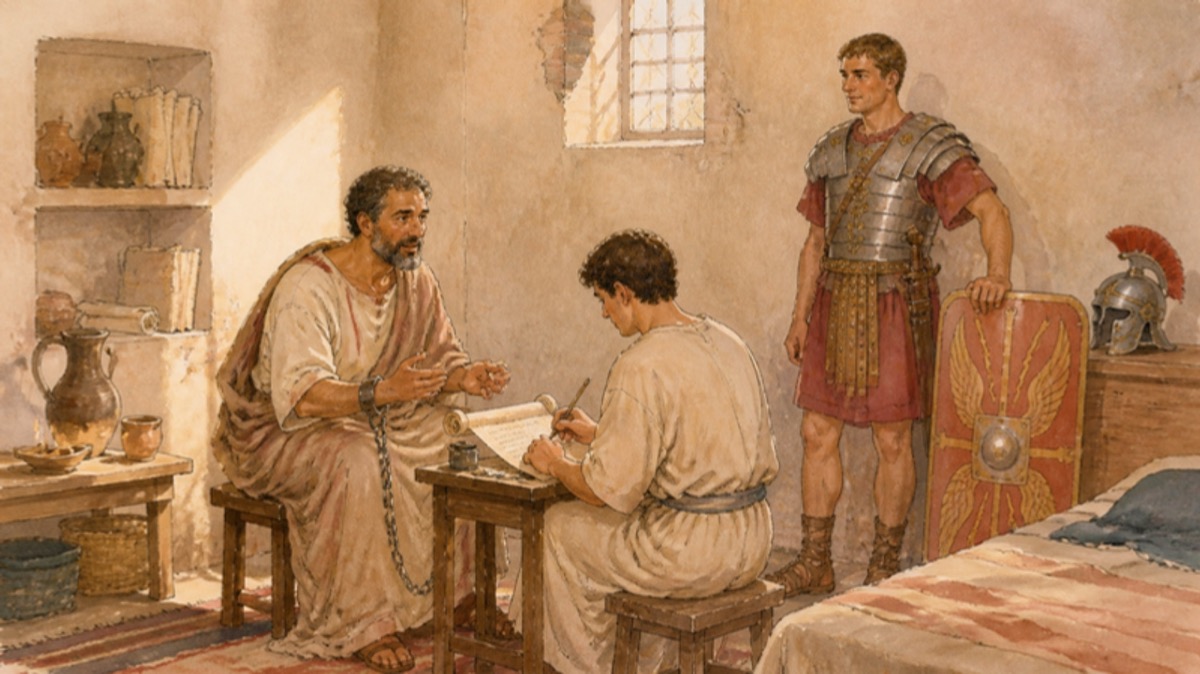
Ephesians is a letter from Paul, written during his imprisonment in Rome; Enduring Word notes he wrote Colossians from the same imprisonment, which is why the two letters overlap. Paul says so himself inside this passage, asking for prayer “for which I am an ambassador in chains” (Ephesians 6:20, NIV). Some scholars think Ephesians was a circular letter meant to be passed among several churches in the region around Ephesus (in modern western Turkey), since the earliest manuscripts leave the city name blank.
That setting matters for the imagery. Enduring Word’s note on verse 14: “Paul wrote this while in the custody of Roman soldiers. It was easy for him to look at the equipment of his guards and see how God has equipped the believer.” The armor is not a fantasy; it was standing in the room.
Why “Finally” matters
The passage opens with “Finally.” Paul has spent chapters 1–3 on what he says God has done for believers and chapters 4–6 on how to live, including the famous household instructions to wives, husbands, children, parents, slaves, and masters. Enduring Word reads “finally” as “in light of all he has previously said,” and lists the lights: in light of God’s work, of the believer’s standing, of the plan, of the Spirit. Only after all that does Paul say there is a battle. The order is deliberate: you are told who you are before you are told what you are up against.
The first instruction is not about armor at all: “be strong in the Lord.” The commentary says the Greek is literally “strengthen yourselves in the Lord,” probably echoing 1 Samuel 30:6, where David “strengthened himself in the LORD his God.” Its illustration stuck with me: give the best armor to a man who can barely stand, and he will still be beaten. Strength first, then equipment.
The key word is “stand”
Read verses 11–14 and count: “take your stand,” “stand your ground,” “to stand,” “stand firm.” Four times. The goal of the whole passage is not to conquer anything. It is to not be moved. Enduring Word: “It is plain that this is Paul’s emphasis in Ephesians 6:11 and 6:13.” The armor is defensive by design; five of the six pieces protect, and only one, the sword, can strike.
The Greek word for “full armor” is πανοπλία (panoplia), which Blue Letter Bible defines as “full armour, complete armour.” It is where English gets panoply. Paul’s point is “all of it,” not a favorite piece.
The enemy is not people
Verse 12 is the sentence the passage turns on: “our struggle is not against flesh and blood.” Enduring Word reads the stack of titles (rulers, authorities, powers, spiritual forces) as different ranks with one goal, “to knock the Christian down from their place of standing.”
Whatever you believe about the spiritual side of that, the practical implication is plain and, I think, wise: the difficult coworker, the ex, the relative who texts in all caps, none of them are “the enemy” in this passage. Reading people as the enemy is exactly what the verse rules out.
Where the armor comes from: Isaiah
This was the biggest surprise for me. Paul did not invent the pieces. In the Old Testament, the armor belongs to God:
- “He put on righteousness as his breastplate, and the helmet of salvation on his head” (Isaiah 59:17, NIV). Enduring Word: “In the Old Testament, it is the LORD who wears the armor. He now shares that armor with us.”
- “Righteousness will be his belt and faithfulness the sash around his waist” (Isaiah 11:5, NIV), describing the promised king.
- “How beautiful on the mountains are the feet of those who bring good news, who proclaim peace” (Isaiah 52:7, NIV). Enduring Word says Paul “had Isaiah 52:7 in mind” for the shoes.
So a first-century Jewish reader would have heard Ephesians 6 as “the armor God wears in Isaiah, now handed to you.”
Each piece, in the order a soldier put them on
Enduring Word notes the pieces are listed “in the order in which the soldier would normally put them on.” The first three are worn constantly (“stand firm then, with …”), the last three are picked up (“take up,” “take”).
The belt of truth (v. 14). “Stand firm then, with the belt of truth buckled around your waist” (NIV). Strictly speaking the belt is not armor; it gathered the tunic so a man could move. The commentary quotes Salmond: it was “of especial use in keeping other parts in place.” A relaxed man took his belt off; putting it on meant action. “Truth” here is read as the basic content of what Christians believe, the thing everything else hangs from.
The breastplate of righteousness (v. 14). It covers the heart. Enduring Word is specific that this is “not our own earned righteousness, not a feeling of righteousness, but a righteousness received by faith in Jesus,” and quotes Martyn Lloyd-Jones: “You do not put on the ‘breastplate of experiences,’ you put on the breastplate of ‘righteousness.’” The point is that a standing which was given cannot be argued away on a bad day.
Feet fitted with the readiness of the gospel of peace (v. 15). Roman military sandals were serious equipment; the commentary cites Josephus describing them as “shoes thickly studded with sharp nails” for grip, and credits the speed of Alexander’s and Caesar’s armies to good footwear. The Greek word rendered “readiness” means a prepared foundation. The idea is footing: being settled enough in the “good news” to not slip.
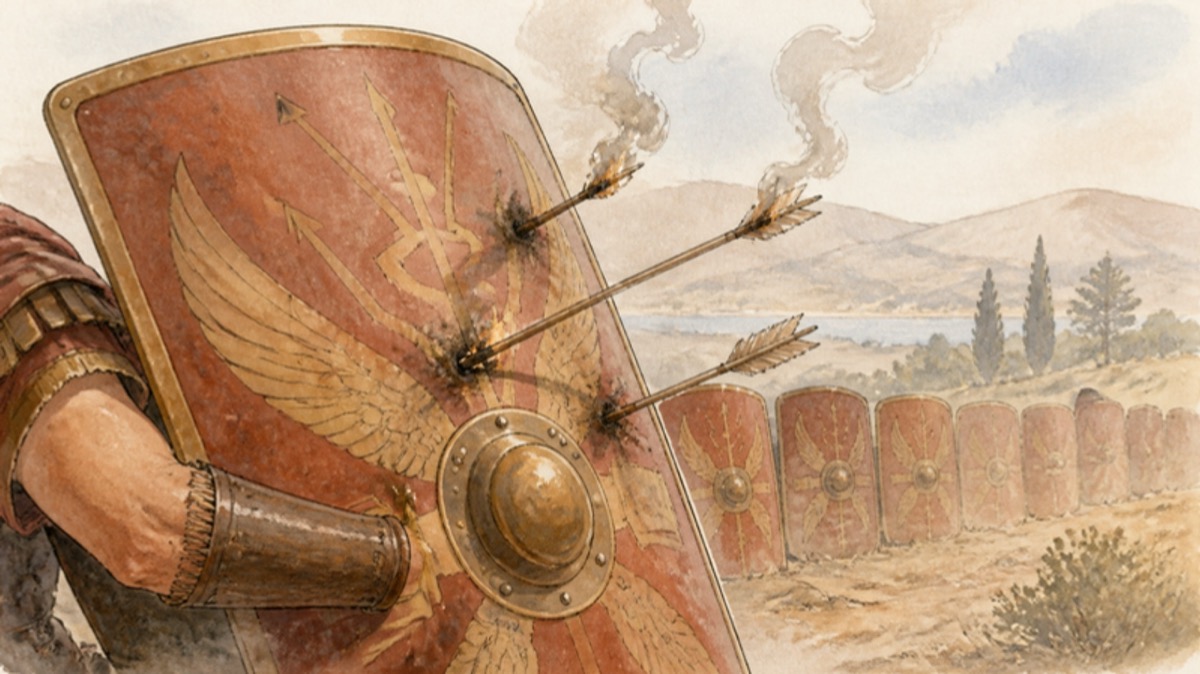
The shield of faith (v. 16). “Take up the shield of faith, with which you can extinguish all the flaming arrows of the evil one” (NIV). The shield Paul names is the large oblong one that covered the whole body, not the small round one. Enduring Word explains the “flaming arrows”: they were fired in volleys at the start of an attack, “not only to injure the enemy, but to shoot at him at all sides with a massive number of arrows, and thus to confuse and panic.” The commentary quotes the Roman historian Livy on the real danger: even a caught arrow kept burning, tempting the soldier to throw the shield away and expose himself. Faith here is pictured as the thing you keep holding while it is on fire.
The helmet of salvation (v. 17). Protects the head, which the commentary connects to 1 Thessalonians 5:8, where the helmet is “the hope of salvation.” Its reading: the helmet “protects us against discouragement, against the desire to give up.”
The sword of the Spirit, which is the word of God (v. 17). The only weapon. Enduring Word warns against treating the Bible “as a book of magic charms” and says using the sword “takes practice,” with Jesus in the wilderness as the example of answering each temptation with a specific scripture.
Prayer (v. 18). “And pray in the Spirit on all occasions with all kinds of prayers and requests” (NIV). Not called armor, but the commentary’s phrase is that “it is through prayer that spiritual strength and the armor of God go to work.” A fully armored soldier who never goes into the field accomplishes nothing.
What Ephesians 6 is not telling you to do
It is not a magic morning ritual. You can pray through the list (plenty of Christians do), but the text gives no formula, and Enduring Word says strength in the Lord “is not an incantation or a spell.”
It does not tell you to attack anyone. Four “stands,” one sword, and a verse that says the struggle is not against people.
It does not promise the battle ends. “Stand your ground … after you have done everything, to stand” (v. 13). The outcome described is still being upright at the end of the day.
The shield is supposed to be hot
The Livy detail is the one I keep. The arrow is on fire, and the temptation is to drop the shield because holding it hurts. Christian moms I know use that image for the days when the thing that would make everything easier is to stop trusting that the day has any meaning. Hold the shield; it is supposed to be hot.
And the order: strength before armor, identity before battle. Whatever your faith, telling a child who she is before telling her what she is up against is good parenting. Paul did it with a whole church.
I still think the cartoon soldier in my kids’ Bible is fine. I just wish it came with the chain and the Isaiah footnotes.
Sources
- Ephesians 6:10–18 (NIV) — BibleGateway
- Enduring Word — Ephesians 6 commentary (David Guzik)
- Enduring Word — Ephesians 1 commentary, with the letter’s setting in Paul’s Roman imprisonment
- Blue Letter Bible — Ephesians 6:10 with interlinear tools
- Blue Letter Bible — Strong’s G3833 πανοπλία (panoplia)
- GotQuestions — What is the full armor of God?
- GotQuestions — What is the shield of faith?
- GotQuestions — Summary of the Book of Ephesians
In different seasons
The passage keeps its original setting, but the questions we bring to it can change. A tired afternoon and a grateful morning may lead us to notice different parts of the same verse.
Choose a season below for a short reflection. These are gentle applications drawn from public commentaries, not additional words from the verse.
When your thoughts won't settle
Anxiety is a battle. The verse says the strength for it isn't yours to generate.
A question to carry: Whose strength am I relying on today?
Questions moms ask
Is the armor of God a prayer you say every morning?
What are the six pieces of the armor of God?
Where did Paul get the armor imagery?
Why does Paul say 'stand' instead of 'fight'?
Scripture references in this article
Each reference opens the full passage on BibleGateway (NIV).



Little helps for everyday faith
Start with a few quiet minutes.

Behind the notes
Hi, I'm Vega.
I'm a curious mom in Taiwan reading the Bible and writing down what I learn. I'm not a Christian — I grew up Buddhist — but after watching my aunt and the moms around me lean on these words through hard years, I wanted to understand why they carry so much weight. Every verse is quoted from the ESV or NIV and every interpretation links to a public commentary. I'm still learning; if you spot an error, tell me.
A little more about me