
“Prayers that aren’t fake.” That was the request, from someone whose mother was in hospice and who knew I’m not religious, so she trusted me to check rather than to comfort. She meant prayers that didn’t promise what the Bible doesn’t. I went through the passages Christians actually pray for healing, read what the commentaries say each one promises, and matched a short prayer to each. This is a resource page; the prayers are the kind many Christians pray. The notes on the texts are mine.
The Bible’s healing passages are of two kinds: ones where God heals, and ones where he doesn’t and says why. Honest healing prayer, as the commentaries describe it, holds both.
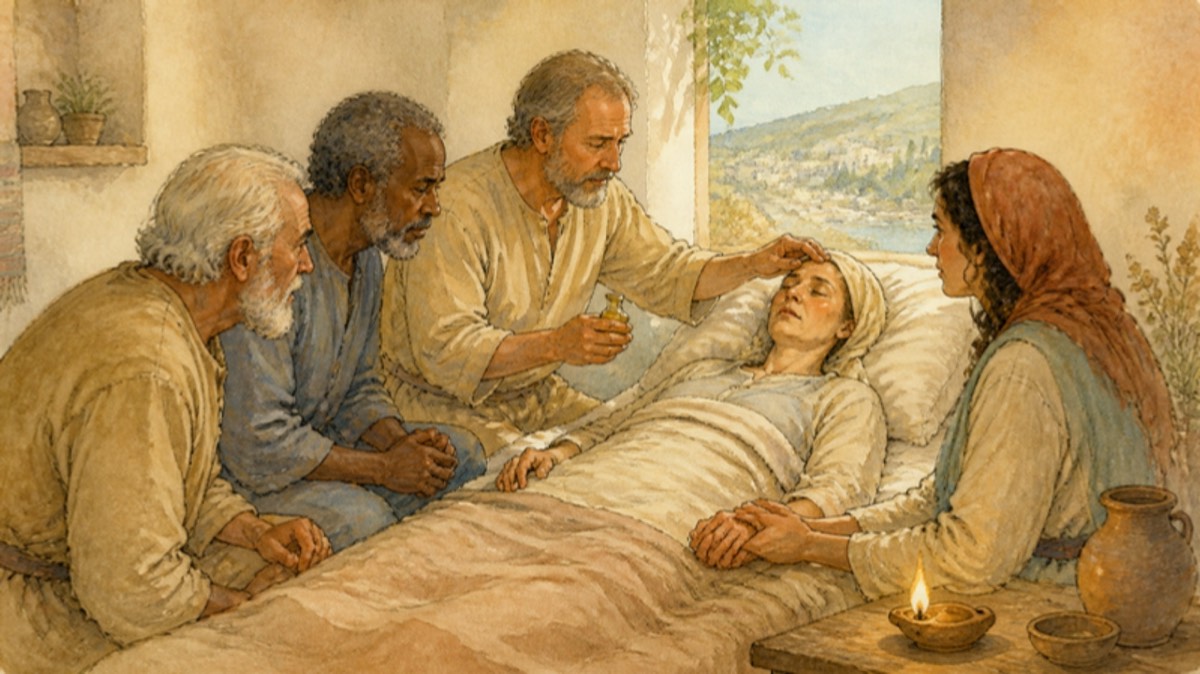
The instruction: James 5:14-16
Is anyone among you sick? Let them call the elders of the church to pray over them and anoint them with oil in the name of the Lord. And the prayer offered in faith will make the sick person well; the Lord will raise them up. If they have sinned, they will be forgiven. Therefore confess your sins to each other and pray for each other so that you may be healed. The prayer of a righteous person is powerful and effective. — James 5:14-16 (NIV)
This is the only place the New Testament gives a procedure for praying over the sick: call the elders, anoint with oil, pray in faith. Enduring Word’s commentary on James 5 says the anointing “has been interpreted as either seeking the best medical attention possible for the afflicted (oil massages were considered medicinal), or as an emblem of the Holy Spirit’s presence and power,” and points to Luke 10:34, where the Good Samaritan pours oil on wounds. GotQuestions’ page on anointing oil notes that “oil is often used as a symbol for the Holy Spirit in the Bible.” On the promise itself, GotQuestions’ page on “the prayer of faith” is honest that Christians read it two ways: some “believe this verse means that, if only one prays with enough faith, healing for the sick person is guaranteed”; others take “save” to include “the spiritual and emotional comfort of God, rather than physical healing.” Either way, the instruction assumes community — the sick person asks, and others come.
Lord, I’m asking the way James said to: out loud, with other people. Raise [name] up. Forgive what needs forgiving. Let this prayer be the effective kind. Amen.
The oldest healing prayer: Jeremiah 17:14
Heal me, Lord, and I will be healed; save me and I will be saved, for you are the one I praise. — Jeremiah 17:14 (NIV)
One verse, said by a prophet about himself. Many Christians use it as-is.
Heal me, Lord, and I will be healed. I’m not asking anyone else. Amen.
The prayer of praise: Psalm 103:2-3
Praise the Lord, my soul, and forget not all his benefits— who forgives all your sins and heals all your diseases, — Psalm 103:2-3 (NIV)
Enduring Word’s commentary on Psalm 103 is careful here: God “brings healing to us in this life through both natural and miraculous ways” and “promises ultimate healing for all His people in the age to come,” and “many commentators understand these diseases as spiritual in nature.” The same psalm says human life is like grass (verses 15-16). It is praise, not a guarantee of outcome.
You forgive and you heal — that’s who you are. I’m bringing [name]‘s body to the God who heals, and I’m praising you before I know the result. Amen.
The leper’s prayer: Matthew 8:2-3
A man with leprosy came and knelt before him and said, “Lord, if you are willing, you can make me clean.” Jesus reached out his hand and touched the man. “I am willing,” he said. “Be clean!” Immediately he was cleansed of his leprosy. — Matthew 8:2-3 (NIV)
The leper’s wording — “if you are willing” — is the one several of my Christian friends said they use, because it asks without presuming.
Lord, if you are willing, you can make [name] well. I believe you can. I’m asking whether you will. Amen.
The prayer with no words: Mark 5:34
A woman who has bled for twelve years touches Jesus’ cloak in a crowd and says nothing. He turns:
He said to her, “Daughter, your faith has healed you. Go in peace and be freed from your suffering.” — Mark 5:34 (NIV)
I don’t have words today. I’m reaching for the edge of your cloak. Amen.
The prayer for the brokenhearted: Psalm 147:3
He heals the brokenhearted and binds up their wounds. — Psalm 147:3 (NIV)
Not every sickness is physical. This is the verse my friend chose for herself, not for her mother.
Bind up what’s broken in me while I’m busy taking care of someone else. Amen.
The prayer for the one caring: Psalm 41:3
The Lord sustains them on their sickbed and restores them from their bed of illness. — Psalm 41:3 (NIV)
Sustain [name] on the bed. And sustain me in the chair beside it. Amen.
The prayer when the answer is no: 2 Corinthians 12:8-9
Three times I pleaded with the Lord to take it away from me. But he said to me, “My grace is sufficient for you, for my power is made perfect in weakness.” Therefore I will boast all the more gladly about my weaknesses, so that Christ’s power may rest on me. — 2 Corinthians 12:8-9 (NIV)
This is the passage my friend most needed. Paul — the apostle — asks for a “thorn in the flesh” to be removed, three times, and is told no. Paul never says what the thorn was, which lets every reader put their own there; Enduring Word’s commentary on 2 Corinthians 12 reads the whole chapter as “how God’s grace is sufficient” through “the thorn in the flesh that kept him humble.” The Christian claim is not that prayer always heals; it’s that grace is sufficient when it doesn’t. Jesus’ own prayer in Gethsemane ends the same way: “Yet not as I will, but as you will” (Matthew 26:39, NIV).
I’ve asked three times. If the answer is no, let your grace be enough — for [name] and for me. Not as I will, but as you will. Amen.

About Isaiah 53:5 and “by his wounds we are healed”
But he was pierced for our transgressions, he was crushed for our iniquities; the punishment that brought us peace was on him, and by his wounds we are healed. — Isaiah 53:5 (NIV)
This line is on a lot of healing-prayer cards, so a note. When Peter quotes it (1 Peter 2:24), he applies it to sin — “that we might die to sins and live for righteousness.” GotQuestions’ page on what the Bible says about healing calls Isaiah 53:5 “often misunderstood and misapplied”: “The verse is talking about sin and righteousness, not sickness and disease,” though it adds that “sometimes people are physically healed when they place their faith in Christ, but this is not always the case.” Other Christians read it as a present physical promise. I’m reporting the disagreement, not settling it. If you pray this verse, know which reading you’re praying.
What Exodus 15:26 does and doesn’t say
He said, “If you listen carefully to the Lord your God and do what is right in his eyes, if you pay attention to his commands and keep all his decrees, I will not bring on you any of the diseases I brought on the Egyptians, for I am the Lord, who heals you.” — Exodus 15:26 (NIV)
“The Lord who heals you” — Jehovah Rapha on the prayer cards — is spoken to Israel right after the Red Sea, and the verse itself attaches an “if”: listen, do what is right, keep the decrees. Christians pray the name; the sentence it comes from was a promise to a nation in a specific moment, with conditions, not a blanket health guarantee.
How Christian families actually use these
- Pray the text, then the prayer. Reading the verse first is what keeps the prayer honest about what it’s asking.
- Involve the church. James 5 is the one instruction; several moms told me asking the elders to come was harder than any of the praying and mattered more.
- Keep the medicine. 3 John 1:2 — “I pray that you may enjoy good health” — sits comfortably beside a doctor’s visit; none of the sources treat prayer and treatment as rivals.
- Pray the “no” prayer early. The women who’d been through a long illness said praying 2 Corinthians 12 before the outcome, not after, kept them from feeling betrayed.
My friend’s mother died six weeks later. The prayer she ended up using most was the Mark 5 one — the one with no words. She said it was the only one that didn’t ask her to pretend.
Sources and further reading
- BibleGateway — James 5:13-18 (NIV), 2 Corinthians 12:1-10 (NIV), Psalm 103 (NIV)
- Enduring Word — James 5 commentary, 2 Corinthians 12, Psalm 103
- GotQuestions — What does the Bible say about healing? and What is divine healing?
- GotQuestions — What is the significance of anointing oil? and What is the prayer of faith?
- Blue Letter Bible — James 5:14 with study tools
Questions moms ask
What does James 5:14-15 actually instruct?
Does 'by his wounds we are healed' (Isaiah 53:5) promise physical healing?
What if I pray and the person isn't healed?
Scripture references in this article
Each reference opens the full passage on BibleGateway (NIV).



Little helps for everyday faith
Start with a few quiet minutes.

Behind the notes
Hi, I'm Vega.
I'm a curious mom in Taiwan reading the Bible and writing down what I learn. I'm not a Christian — I grew up Buddhist — but after watching my aunt and the moms around me lean on these words through hard years, I wanted to understand why they carry so much weight. Every verse is quoted from the ESV or NIV and every interpretation links to a public commentary. I'm still learning; if you spot an error, tell me.
A little more about me