
Psalm 46:10 is the verse on the mug, the wall print, the yoga studio sign. I wanted to know what it meant in the psalm it comes from, so this devotion walks through all eleven verses rather than lifting out the famous one. It is written as a resource — many Christian moms read a passage like this before the house wakes up — and the prayer at the end is offered in that spirit, not as my own.
Today’s Scripture
He says, “Be still, and know that I am God; I will be exalted among the nations, I will be exalted in the earth.” — Psalm 46:10 (NIV)
The psalm around the verse
Psalm 46 was written by the Sons of Korah, a family of Levite musicians, and it is built in three stanzas marked off by the word Selah. It does not open with a crisis. It opens with God:
God is our refuge and strength, an ever-present help in trouble. Therefore we will not fear, though the earth give way and the mountains fall into the heart of the sea, though its waters roar and foam and the mountains quake with their surging. — Psalm 46:1-3 (NIV)
Enduring Word notes that most psalms begin with the writer’s trouble, and this one begins with God’s provision. The trouble comes in the next breath — earth giving way, mountains sliding into the sea — described as the worst case and then dismissed: “therefore we will not fear.” Martin Luther based his hymn “A Mighty Fortress Is Our God” on this stanza, and Enduring Word records that when he was in distress he would say, “Let us sing the forty-sixth psalm.”
The second stanza moves from the shaking earth to a city with a river:
There is a river whose streams make glad the city of God, the holy place where the Most High dwells. God is within her, she will not fall; God will help her at break of day. Nations are in uproar, kingdoms fall; he lifts his voice, the earth melts. The Lord Almighty is with us; the God of Jacob is our fortress. — Psalm 46:4-7 (NIV)
Jerusalem has no river; commentators read the river as a picture of God’s presence, the thing that keeps the city steady while “nations are in uproar.” Then comes the refrain, which the psalm will repeat as its last line: “The Lord Almighty is with us; the God of Jacob is our fortress.” The Hebrew behind “Lord Almighty” is Yahweh of hosts — the God of armies.
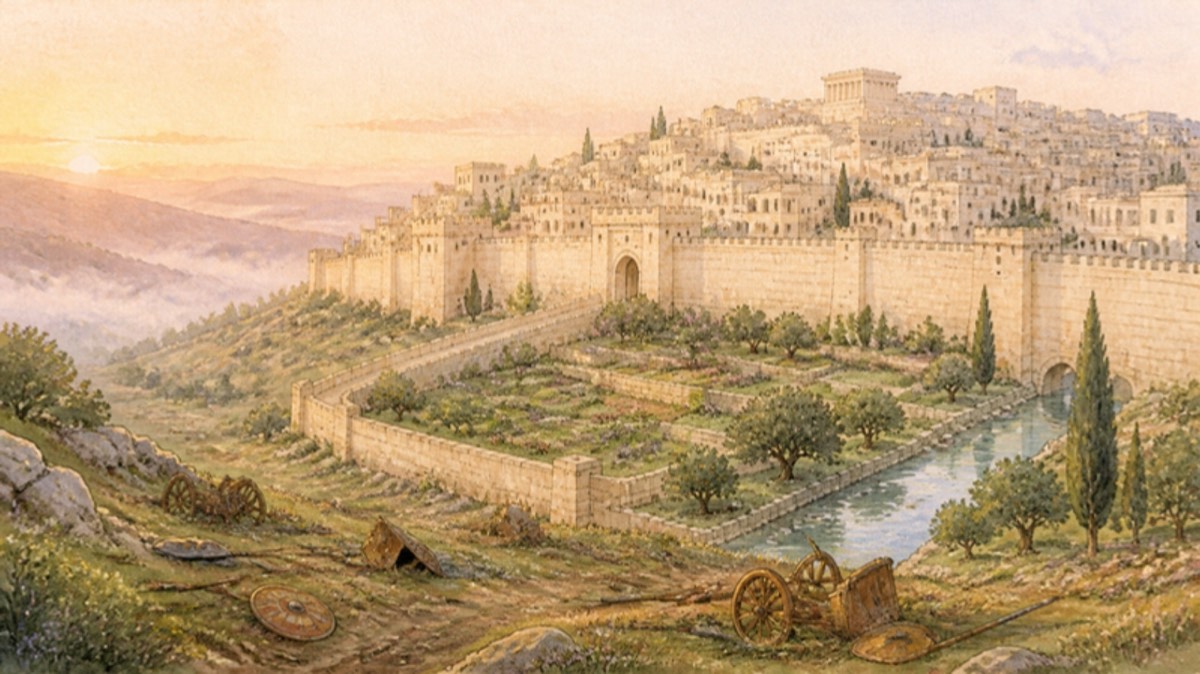
The third stanza invites the reader to look at a battlefield after the fighting has stopped — bows broken, spears shattered, shields burned (46:8-9). And then God himself speaks, for the first time in the psalm, with verse 10.
What “be still” means
The Hebrew verb is raphah — to let drop, to let go, to relax your grip. Addressed to nations that have just been described at war, Enduring Word takes the sense as “argument and opposition should stop,” and quotes two commentators to the same effect: Kidner, for whom the line is “a rebuke to a restless and turbulent world: ‘Quiet!’ — in fact, ‘Leave off!’,” and Boice, who paraphrases it “Lay down your arms. Surrender, and acknowledge that I am the one and only victorious God.” The second half of the verse fits that reading: “I will be exalted among the nations.”
So the verse on the mug is, in its first meaning, a ceasefire order. That doesn’t make the devotional use wrong. The psalm’s own logic is that the one who can tell armies to stop is “an ever-present help in trouble,” and the refrain is “with us.” A mom reading it at 5:40 a.m. is being told the same thing the nations were told: drop your hands, this is not yours to hold up. The uncertainty is real; the verse does not deny that. It says who is in charge of it.
What the psalm does not promise
It is worth being precise, because the mug version can slide into “everything will be fine.” Psalm 46 never says the earth won’t give way; it says “though” it does, “we will not fear.” It never says the nations won’t rage; it says they do, and that God’s voice is louder. The city in the psalm is kept, but the valley outside it is littered with broken weapons — something happened out there. Enduring Word’s reading of verses 8-9 is that the people are invited to look over the battlefield “after God has completely routed His enemies.” The peace the psalm offers is the peace of someone standing inside the walls after the siege, not someone to whom nothing ever happened.
That matters for a mother in an uncertain season. The text doesn’t ask her to pretend the diagnosis, the layoff, or the custody hearing is small. It asks her to locate herself — inside the city, with the river, with the God who is “within her” (46:5) — and then to drop her hands.
Two more passages that say the same thing differently
This is what the Sovereign Lord, the Holy One of Israel, says: “In repentance and rest is your salvation, in quietness and trust is your strength, but you would have none of it. — Isaiah 30:15 (NIV)
Isaiah’s context is Judah running to Egypt for military help against Assyria instead of trusting God. The verse ends with the line the mugs leave off: “but you would have none of it.” Quietness and trust were offered as strength, and refused. It is the same choice Psalm 46 describes from the other side.
Do not be anxious about anything, but in every situation, by prayer and petition, with thanksgiving, present your requests to God. And the peace of God, which transcends all understanding, will guard your hearts and your minds in Christ Jesus. — Philippians 4:6-7 (NIV)
Paul, writing from prison, gives the New Testament version: the route out of anxiety is specific prayer with thanksgiving, and the result is a peace that “guards” — Enduring Word points out that the word is military, a sentry on duty. Psalm 46 ends with a fortress; Philippians 4 ends with a guard at the gate.
Reading it with kids
Psalm 46 is one of the easier psalms to read aloud to children because it is made of pictures: mountains falling into the sea, a river in a city, bows snapped in half. Several Christian moms I’ve read use the refrain as a call-and-response at bedtime — the parent says “The Lord Almighty is with us,” the child answers “the God of Jacob is our fortress” — and explain “be still” with the hand motion the Hebrew suggests: fists, then open palms. Luther’s hymn, if the family sings, carries the first stanza nearly word for word: “a bulwark never failing.”
A short practice many Christian moms use
- Read all of Psalm 46 once, slowly, before anything else — it takes two minutes.
- Name the specific uncertainty out loud. Not “everything,” the actual thing: the test result, the job, the bill.
- Say the refrain — “The Lord Almighty is with us; the God of Jacob is our fortress” — once for that thing.
- Open your hands, literally. The verb in verse 10 is about letting go of a grip.
- Write one line in a journal about what you let go of. The site’s prayer journal tool is built for exactly this.
A prayer many use
God, the ground feels like it’s moving. I can’t make it stop and I’ve been trying. The psalm says you are the one who makes wars cease, so I’m dropping my hands. You are with me today — in the appointment, in the waiting, in the thing I can’t fix. Be exalted in it. Amen.
For a hard day
If the uncertainty has become constant dread, sleeplessness, or panic, that is a doctor’s conversation; a psalm can sit beside treatment but isn’t a substitute for it. In the US, 988 is available any hour.
Sources
- Psalm 46 (NIV) on BibleGateway
- Enduring Word — Psalm 46 commentary
- Enduring Word — Isaiah 30 commentary
- Enduring Word — Philippians 4 commentary
- Blue Letter Bible — Psalm 46:10 with lexicon tools
- GotQuestions — What does it mean to be still and know that I am God?
- GotQuestions — What is the peace of God?
Questions moms ask
What does “Be still, and know that I am God” mean in Psalm 46:10?
Who wrote Psalm 46?
Is Psalm 46:10 a verse about relaxing?
Scripture references in this article
Each reference opens the full passage on BibleGateway (NIV).


Little helps for everyday faith
Start with a few quiet minutes.

Behind the notes
Hi, I'm Vega.
I'm a curious mom in Taiwan reading the Bible and writing down what I learn. I'm not a Christian — I grew up Buddhist — but after watching my aunt and the moms around me lean on these words through hard years, I wanted to understand why they carry so much weight. Every verse is quoted from the ESV or NIV and every interpretation links to a public commentary. I'm still learning; if you spot an error, tell me.
A little more about me