
This devotion is on one sentence that Christian moms quote constantly — “My grace is sufficient for you” — and I wanted to see the sentence in the letter it came from. It turns out to be God’s reply to a prayer he turned down, in the middle of an argument Paul was having with a church that thought he wasn’t impressive enough. That setting makes the line much tougher and much kinder than the needlepoint version.
Written as a resource: the practice and prayer at the end are the kind many Christian mothers use with this passage, not a claim about my own faith.
Today’s Scripture
But he said to me, “My grace is sufficient for you, for my power is made perfect in weakness.” Therefore I will boast all the more gladly about my weaknesses, so that Christ’s power may rest on me. — 2 Corinthians 12:9 (NIV)
The argument Paul was losing
By 2 Corinthians 10, Paul is defending himself. Rival teachers — he calls them, with sarcasm, “super-apostles” (11:5) — have told the Corinthians that Paul is unimpressive in person and a weak speaker (10:10). So Paul does something he says he hates: he boasts. First about his sufferings (11:23-28). Then, in chapter 12, about a vision.
I know a man in Christ who fourteen years ago was caught up to the third heaven. Whether it was in the body or out of the body I do not know—God knows. — 2 Corinthians 12:2 (NIV)
“A man in Christ” is Paul himself, writing in the third person because he’s embarrassed to be doing this at all. The vision happened fourteen years earlier and he had apparently never spoken of it. GotQuestions notes that he tells it only to explain what came next.
The thorn
or because of these surpassingly great revelations. Therefore, in order to keep me from becoming conceited, I was given a thorn in my flesh, a messenger of Satan, to torment me. — 2 Corinthians 12:7 (NIV)
Three things in one verse. The thorn had a purpose — “to keep me from becoming conceited.” It had an origin on two levels — “given” (Paul doesn’t say by whom, but the passive implies God) and yet “a messenger of Satan.” And it hurt: “to torment me” is literally to beat with fists. Enduring Word adds that the Greek word for thorn (skolops) “describes a tent stake, not a thumbtack.”
What was it? Paul never says. The commentaries list the guesses: an eye problem (Galatians 4:15 says the Galatians would have torn out their own eyes for him, and 6:11 mentions his “large letters”); recurring malaria (William Ramsay’s theory); a headache or earache (Tertullian’s, the earliest recorded guess); a speech impediment; his enemies. Enduring Word quotes Spurgeon’s dry observation that “each expositor has selected that particular thorn which had pierced his own bosom.” Both Enduring Word and GotQuestions conclude the vagueness is on purpose — if we knew it was, say, migraines, everyone without migraines could decide the passage wasn’t for them.
The prayer God refused
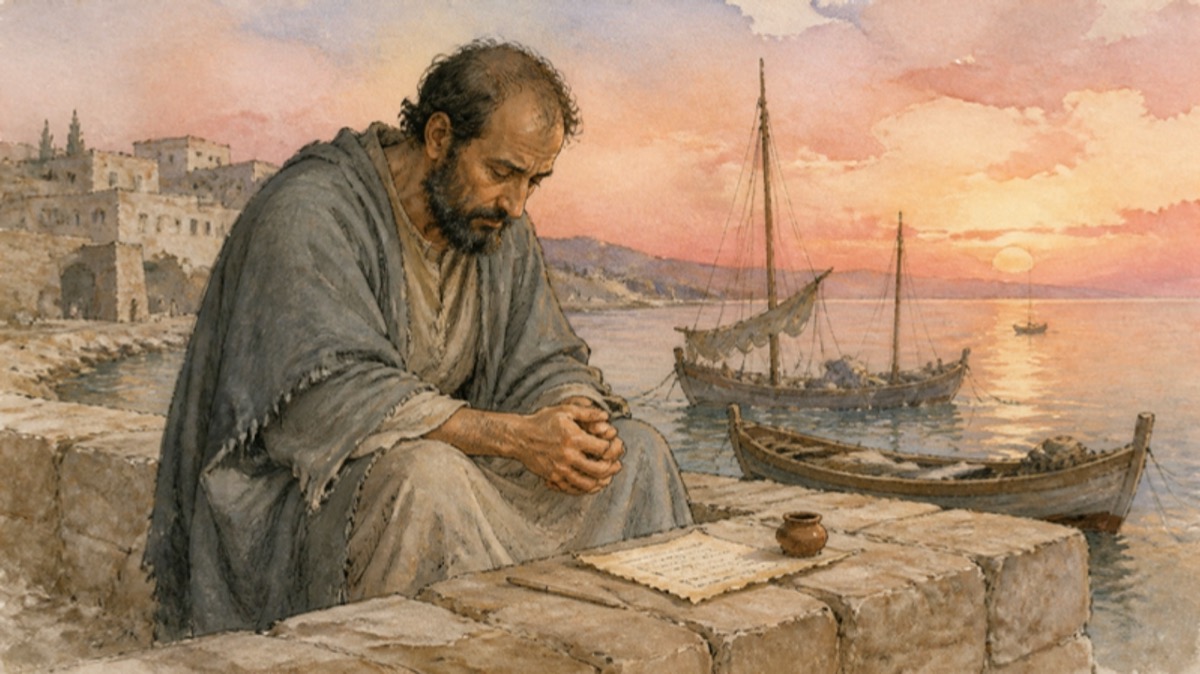
Three times I pleaded with the Lord to take it away from me. — 2 Corinthians 12:8 (NIV)
Three times. Enduring Word suggests the number may be a Hebrew figure of speech for “over and over again,” and points out that Paul “was no masochist” — his first instinct was to ask for the suffering to stop, like anyone’s. Jesus also prayed three times in Gethsemane for the cup to pass (Matthew 26:44), and in both cases the answer was no.
That is the setting of the famous sentence. “My grace is sufficient for you” was not said to someone at peace. It was said to someone who had asked repeatedly and been refused.
What “sufficient” and “made perfect” mean
Sufficient — the Greek is arkeō, to be enough. Not abundant, not overflowing: enough. “Made perfect” is teleioō, to reach its goal or be completed. Enduring Word’s image is the clearest I found: “there are two ways of relief. It can come by removing the load or by strengthening the shoulder that bears the load.” God did the second. And the commentary adds a line that stuck with me: “We really don’t believe God’s grace is sufficient until we believe we are insufficient.”
Paul’s response is the strangest part of the passage:
That is why, for Christ’s sake, I delight in weaknesses, in insults, in hardships, in persecutions, in difficulties. For when I am weak, then I am strong. — 2 Corinthians 12:10 (NIV)
He doesn’t say he learned to tolerate the thorn. He says he will boast about weaknesses, because that is where the power shows up. GotQuestions connects this to Philippians 4:11-13, where the same man says he has learned to be content in plenty and in want — the strength “is not Paul’s experiences or abilities, nor was it the absence of difficulty.”
The same lesson, three times in one letter
2 Corinthians 12:9 is not an isolated line; it is the third time in the letter Paul has said the same thing from a different angle. In chapter 1 he describes a crisis in the province of Asia so severe that “we despaired of life itself,” and says it happened “that we might not rely on ourselves but on God” (1:8-9). In chapter 4 he calls believers “jars of clay” carrying a treasure, “to show that this all-surpassing power is from God and not from us” (4:7). And in chapter 11 he lists the shipwrecks, beatings, sleepless nights, and hunger (11:23-27), then says that if he must boast, he will “boast of the things that show my weakness” (11:30). By the time the thorn appears in chapter 12, the reader has been told three ways that weakness is where the power is located. The famous sentence is the summary, not a surprise.
Mercy, grace, and the word Paul chose
The Greek word is charis, and in Paul’s letters it almost always means God’s favor given to people who have not earned it. GotQuestions draws the standard line: mercy is not receiving what you do deserve, grace is receiving what you don’t. What is unusual in 2 Corinthians 12 is the direction of the gift. Elsewhere Paul uses charis for forgiveness and salvation (Ephesians 2:8). Here it is a sustaining grace — the strength to go on living with something unresolved — and it is given to a man who has done nothing wrong and asked for something reasonable. That is why the verse lands differently for people in long seasons of difficulty than the word “grace” usually does.
What grace means here
Christians distinguish mercy (not getting what you deserve) from grace (getting what you don’t). In this passage grace is not forgiveness — Paul isn’t confessing anything. It is supply: the daily provision to keep going with the thorn still in. Jesus taught his followers to ask for “daily bread,” and the grace in 2 Corinthians 12 works the same way, measured out for the day, not stockpiled.
For a mother that is a different promise from the one she might want. It is not “the hard thing will be removed.” It is “you will be given what you need to carry the hard thing today.” Several Christian moms I’ve read say that the first reading of this passage made them angry and the fifth made them steadier, for exactly that reason.
A short practice many Christian moms use with this passage
- Name your thorn — the thing you have asked more than three times to have removed.
- Read 2 Corinthians 12:7-10 straight through, including the refusal.
- Replace the question “When will this go?” with “What do I need to carry it today?” and write the answer down.
- Say the sentence as if it were addressed to you — because in the text, it was addressed to one specific person who had asked and been told no.
A prayer many use
God, I’ve asked for this to be taken away, and it’s still here. Paul got a no and a promise. If the answer for me is also no, then I’m asking for the promise: enough for today. Not for next month. Today. And if your strength shows up best in my weak places, then here they are. Amen.
Sources
- 2 Corinthians 12 (NIV) on BibleGateway
- Enduring Word — 2 Corinthians 12 commentary
- GotQuestions — What was Paul’s thorn in the flesh?
- GotQuestions — What does it mean that God’s grace is sufficient?
- Blue Letter Bible — 2 Corinthians 12:9 with lexicon tools
- Enduring Word — Galatians 4 commentary
Questions moms ask
What was Paul's thorn in the flesh?
What does “my grace is sufficient for you” mean?
Does 2 Corinthians 12:9 mean God won't heal?
Scripture references in this article
Each reference opens the full passage on BibleGateway (NIV).



Little helps for everyday faith
Start with a few quiet minutes.

Behind the notes
Hi, I'm Vega.
I'm a curious mom in Taiwan reading the Bible and writing down what I learn. I'm not a Christian — I grew up Buddhist — but after watching my aunt and the moms around me lean on these words through hard years, I wanted to understand why they carry so much weight. Every verse is quoted from the ESV or NIV and every interpretation links to a public commentary. I'm still learning; if you spot an error, tell me.
A little more about me