
““For God so loved the world, that he gave his only Son, that whoever believes in him should not perish but have eternal life.”
I grew up Buddhist in Taiwan, so the first place I saw “John 3:16” was on a sign at a sports game, not in a church. For a long time I assumed it was a slogan. It turns out to be the last line of a late-night conversation, and the conversation is what makes the line make sense.
The verse itself
For God so loved the world that he gave his one and only Son, that whoever believes in him shall not perish but have eternal life. — John 3:16 (NIV)
Enduring Word’s commentary calls it possibly “the most popular single verse used in evangelism” out of the Bible’s 31,102 verses. That popularity is exactly why it is worth slowing down on.
Who wrote it and where it comes from
John’s Gospel is traditionally attributed to the apostle John, and the book states its own purpose near the end: “these are written that you may believe that Jesus is the Messiah, the Son of God, and that by believing you may have life in his name” (John 20:31, NIV). So the whole book is written to persuade, and John 3:16 is its thesis in one sentence.
The scene is chapter 3. “Now there was a Pharisee, a man named Nicodemus who was a member of the Jewish ruling council. He came to Jesus at night” (John 3:1–2, NIV). Enduring Word notes he was a member of the Sanhedrin, religious and educated, and that he came “by night,” which commentators read as either caution or a desire for a long, uninterrupted talk. Nicodemus opens with a compliment. Jesus cuts straight past it: “Very truly I tell you, no one can see the kingdom of God unless they are born again” (John 3:3, NIV).
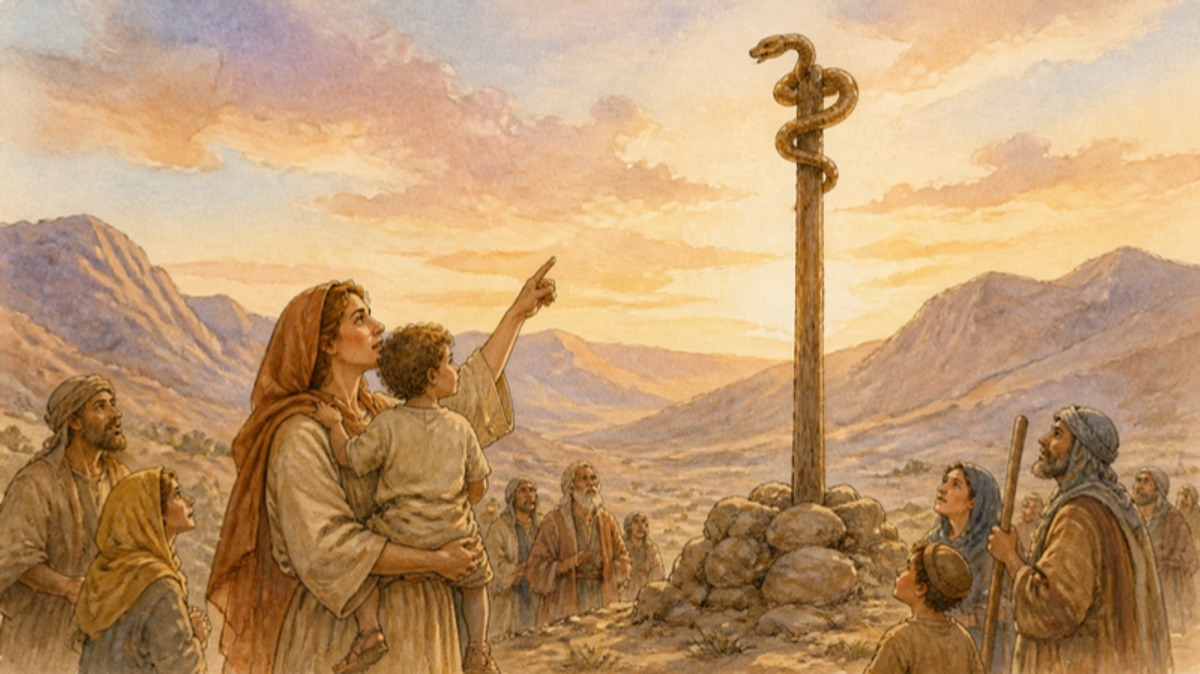
Nicodemus is confused (How can an old man be born?), and Jesus explains with two images. First, wind: you cannot see it, but you see what it does. Second, a story Nicodemus would have known since childhood: “Just as Moses lifted up the snake in the wilderness, so the Son of Man must be lifted up, that everyone who believes may have eternal life in him” (John 3:14–15, NIV). That refers to Numbers 21:8–9, where people bitten by snakes lived if they looked at a bronze snake on a pole. Enduring Word quotes the scholar F. F. Bruce on why this matters: Nicodemus had missed the point when it was framed in the prophets’ language, so Jesus gives him “an object-lesson, from a story with which he had been familiar since childhood.”
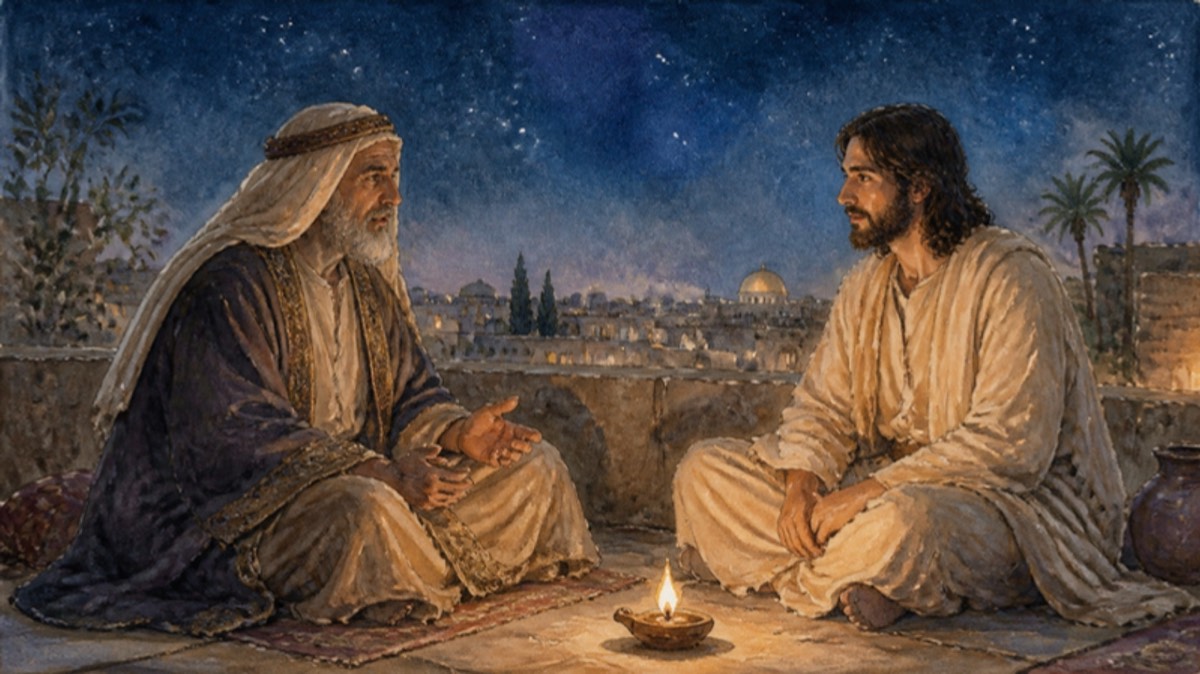
Then comes verse 16. One detail I didn’t know: the NIV closes the quotation marks at the end of verse 15. In that reading, verses 16–21 are John stepping in to explain what the conversation meant. Other editions keep Jesus talking. Either way, 3:16 is the summary of the Nicodemus story, not a free-floating promise.
Word by word
“For God so loved the world.” The “so” is the Greek οὕτως (houtōs). Blue Letter Bible’s lexicon gives “in this way, thus, so.” It is a word about manner, not amount. The verse is less “God loved the world sooo much” and more “this is how God loved the world: he gave.” The amount is enormous, but the grammar points at the method.
“The world.” Greek kosmos. Enduring Word says the Jewish readers of that day “rarely thought that God loved the world” and quotes Leon Morris: “no passage appears to be cited in which any Jewish writer maintains that God loved the world.” So the scope here was startling to its first audience, not a cliché.
“He gave.” The commentary’s point is that the love “didn’t just feel for the plight of a fallen world. God did something about it.” Enduring Word also quotes Henry Alford’s suggestion that the wording would have reminded Nicodemus of Abraham offering Isaac, the one story in his scriptures of a father giving up an only son.
“His one and only Son.” Greek μονογενής (monogenēs). Blue Letter Bible: “single of its kind, only.” Older Bibles render it “only begotten.” The point is uniqueness: not one son among many.
“Whoever believes in him.” Enduring Word is careful here: “believes in means much more than intellectual awareness or agreement. It means to trust in, to rely on, and to cling to.” Agreeing that a bridge exists is not the same as walking across it.
“Shall not perish but have eternal life.” The verse sets two outcomes side by side. Verse 17 immediately adds that the purpose was rescue, not condemnation: “For God did not send his Son into the world to condemn the world, but to save the world through him” (John 3:17, NIV). And verse 19 names the problem bluntly: “people loved darkness instead of light.”
Three misreadings of John 3:16
It does not say “God loves you, so everything will be fine.” The verse is about rescue from perishing, which assumes the situation was serious. Verse 17’s “not … to condemn” only makes sense if condemnation was on the table.
“So” does not mean “so much.” This is the single most common misreading, and the Greek is clear. The love is shown by an action.
“Believes” is not the same as “agrees.” The commentary’s trust-rely-cling definition is stronger than the English word suggests.
It is not a verse Jesus said to a crowd. It came out of a one-on-one conversation with a skeptical, educated insider. That matters for tone: it is an explanation to a thinker, not a chant.
Why it is everywhere
John 20:31 explains it. The author wrote the whole book so readers “may believe,” and 3:16 compresses the book: God’s love, the gift, belief, life. Enduring Word quotes Bruce again: “If there is one sentence more than another which sums up the message of the Fourth Gospel, it is this.” That is why Christians put it on signs. It is the shortest honest summary they have.
The word a parent notices
What stopped me was the phrase “he gave his one and only Son.” I have children. Reading the verse as a parent, the word “gave” lands differently than it did on the stadium sign. Christians read this as the measure of how far God went; I read it as a sentence that only a parent can fully feel the weight of. Enduring Word’s Isaac observation makes the same point from the other direction: the first readers would have felt it as a parent story too.
For your own kids, the simplest true version I can manage is: this verse says God’s love is a doing kind of love, and it is for “whoever,” which includes small people who are not sure yet.
That is as far as a stadium sign ever got me, and quite a bit further than I expected.
Sources
- John 3:16–17 (NIV) — BibleGateway
- Enduring Word — John 3 commentary (David Guzik)
- Blue Letter Bible — John 3:16 with interlinear tools
- Blue Letter Bible — Strong’s G3779 οὕτως (houtōs)
- Blue Letter Bible — Strong’s G3439 μονογενής (monogenēs)
- GotQuestions — What does John 3:16 mean?
- GotQuestions — What does it mean that Jesus is God’s only begotten son?
- GotQuestions — Summary of the Gospel of John
In different seasons
The passage keeps its original setting, but the questions we bring to it can change. A tired afternoon and a grateful morning may lead us to notice different parts of the same verse.
Choose a season below for a short reflection. These are gentle applications drawn from public commentaries, not additional words from the verse.
When your thoughts won't settle
Anxiety about whether you're loved by God meets the plainest statement of it in Scripture, addressed to the whole world without exception.
A question to carry: Do I believe "the world" in this verse includes me specifically?
Questions moms ask
What does 'so loved' mean in John 3:16?
What does 'one and only Son' (or 'only begotten Son') mean?
Is John 3:16 something Jesus said, or something John wrote?
Who was Nicodemus?
Scripture references in this article
Each reference opens the full passage on BibleGateway (NIV).



Little helps for everyday faith
Start with a few quiet minutes.

Behind the notes
Hi, I'm Vega.
I'm a curious mom in Taiwan reading the Bible and writing down what I learn. I'm not a Christian — I grew up Buddhist — but after watching my aunt and the moms around me lean on these words through hard years, I wanted to understand why they carry so much weight. Every verse is quoted from the ESV or NIV and every interpretation links to a public commentary. I'm still learning; if you spot an error, tell me.
A little more about me