David and Goliath: The Bible Story for Kids (With Questions to Talk About)
David and Goliath retold for ages 3–8 — the original passage in 1 Samuel 17, a bedtime-length version, three questions to talk about, and what the story means in the Bible.
By Vega Lin··Updated October 26, 2026·8 min read-aloud
Where it is in the Bible: 1 Samuel 17. Read the whole chapter on BibleGateway (NIV).
Age range for this retelling: about 3–8. About six minutes aloud.
The story (for ages 3–8)
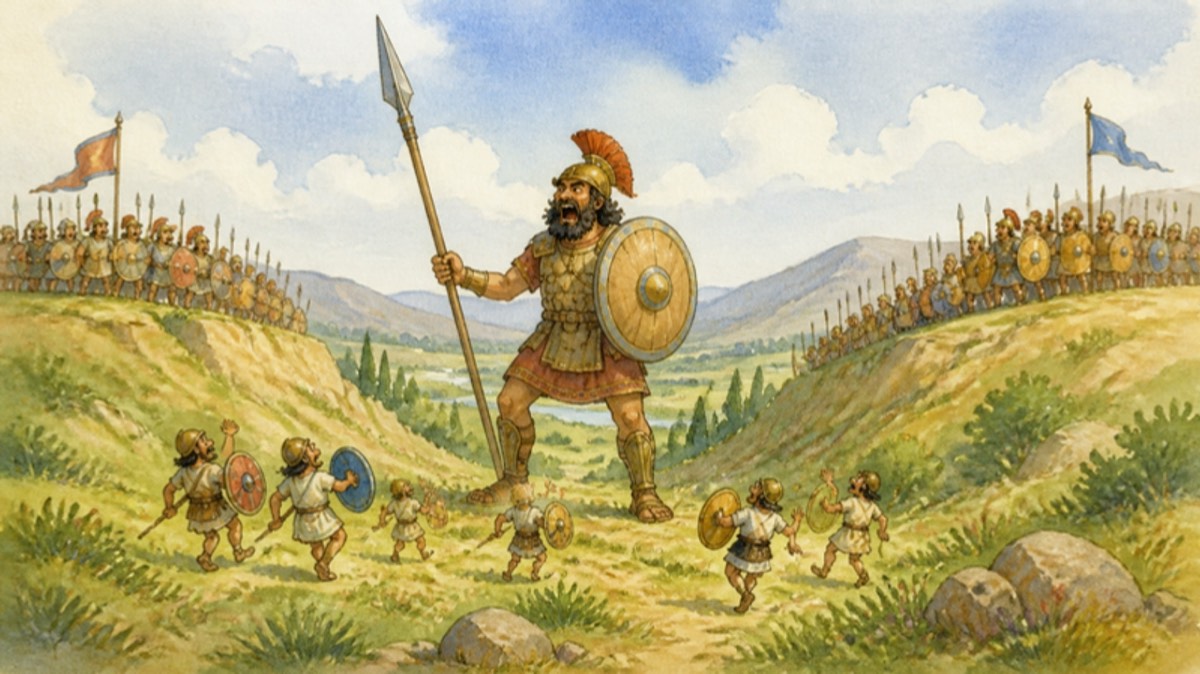
Long ago, the people of Israel had an enemy called the Philistines. One day the two armies lined up on two hills with a valley in between. The Israelites stood on one hill. The Philistines stood on the other. And nobody moved.
Why not? Because of Goliath.
Goliath was the biggest soldier anyone had ever seen. He was taller than a door. Taller than a basketball hoop. He wore heavy bronze armor that clanked when he walked, and his spear was as thick as a fence post. Every morning and every evening, Goliath stomped into the valley and shouted up at the Israelites:
“Send someone to fight me! If he wins, we’ll be your servants. If I win, you’ll be ours!”
For forty days he shouted. And for forty days, every soldier in Israel’s army was too afraid to go.
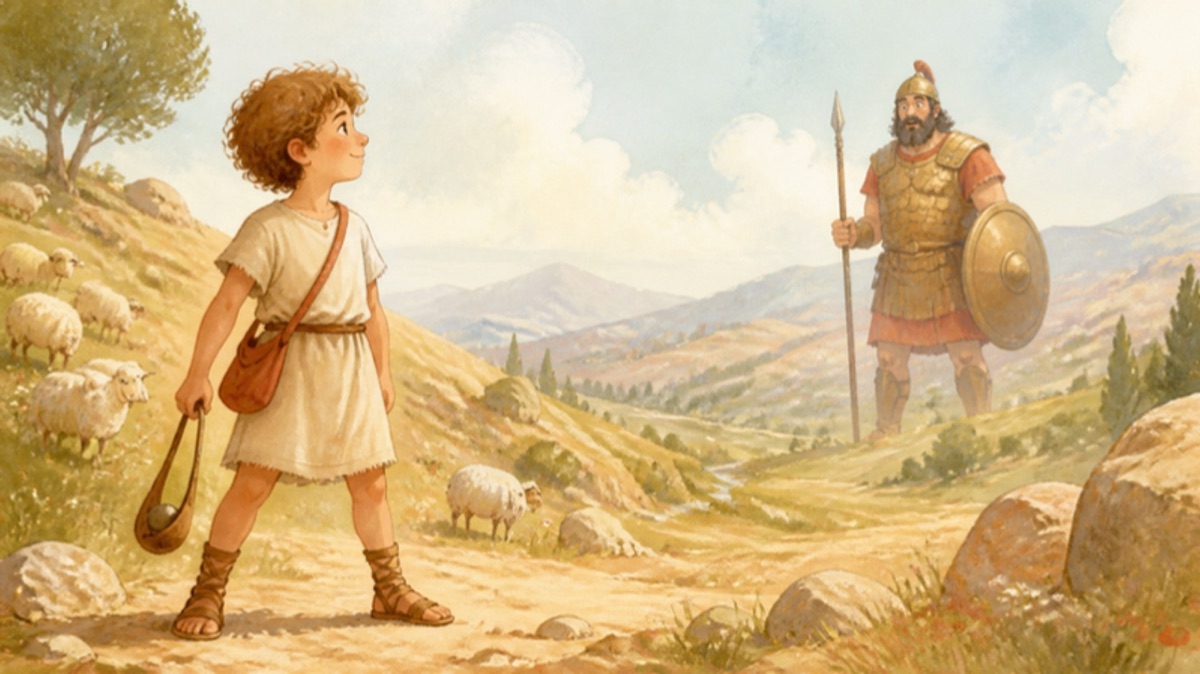
Now, far away from the battle, there was a boy named David. David was the youngest of eight brothers, and his job was to take care of the family’s sheep. He wasn’t a soldier. He was a shepherd. But out in the fields, David had learned two things: how to use a sling to throw stones hard and straight, and how to trust God — because when a lion and a bear had come to steal his sheep, God had helped him chase them away.
One day David’s father said, “Take this bread and cheese to your big brothers at the army camp, and see how they’re doing.” So David went.
He got there just as Goliath stomped out and started shouting. David looked around. The soldiers were backing away, pale and scared. David was puzzled. “Who is this man,” he asked, “to shout at the army of the living God?”
His oldest brother was annoyed. “Go home and watch your sheep,” he said. But the king, whose name was Saul, heard about the shepherd boy who wasn’t afraid, and he sent for him.
“You can’t fight Goliath,” King Saul said. “You’re only a boy.”
“I’ve fought a lion and a bear,” said David. “God saved me from them, and God will save me from this giant too.”
So Saul agreed. He put his own armor on David — a big bronze helmet, a heavy coat, a sword. David tried to walk and nearly fell over. “I can’t wear this,” he said. “I’m not used to it.” He took it all off.
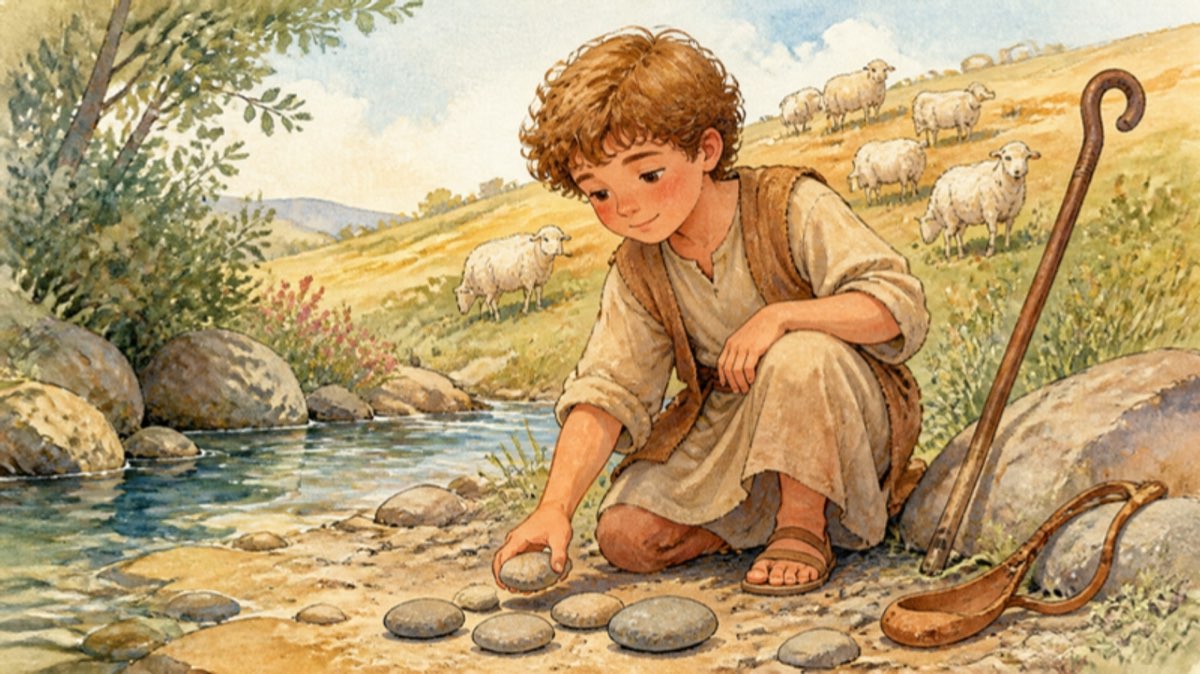
Instead, David picked up his shepherd’s staff, walked down to the stream, and chose five smooth stones. He put them in his bag, held his sling in his hand, and walked out into the valley to meet the giant.
Goliath looked down at the boy with the stick and laughed. “Am I a dog, that you come at me with sticks?” he roared.
David looked up at the giant and said, “You come with a sword and a spear. But I come in the name of the Lord. Today everyone will know that it isn’t swords that save people — the battle belongs to God.”
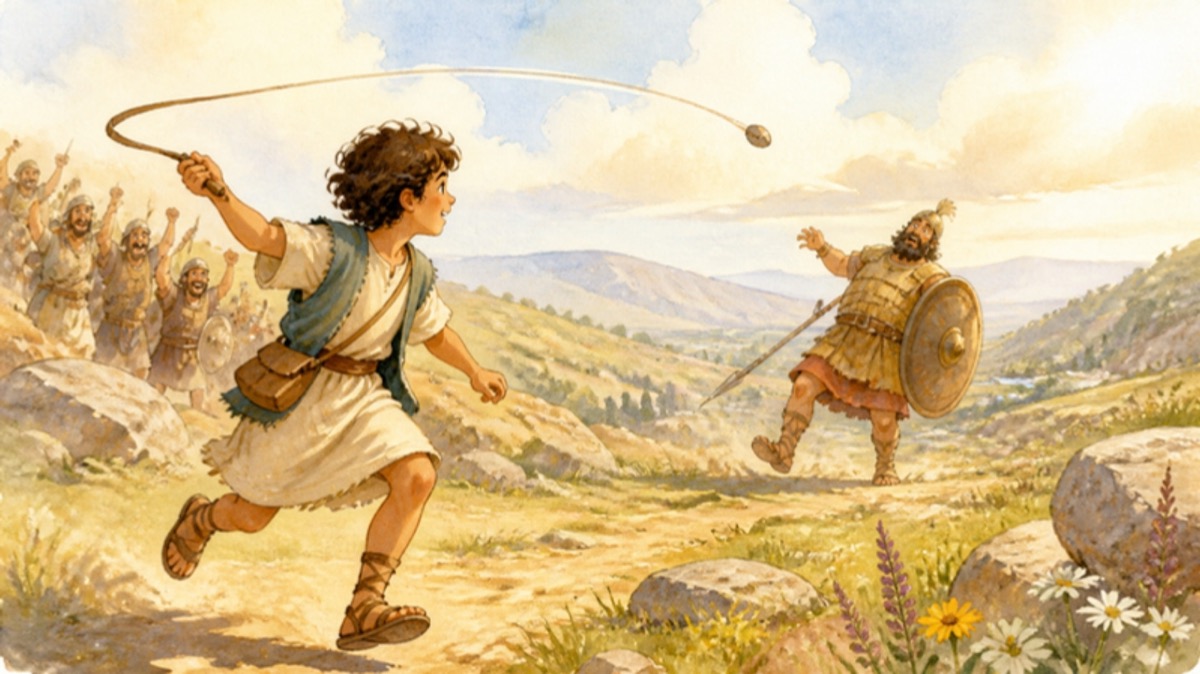
Goliath started forward. David ran toward him. He reached into his bag, took out one stone, put it in his sling, and whirled it around and around. Whoosh — he let it fly.
The stone flew straight and true and hit Goliath right in the forehead. The giant stopped. He wobbled. And then — CRASH — he fell face-first onto the ground.
The Philistine army turned and ran. The Israelite army cheered and chased them. And the shepherd boy with five smooth stones walked home with the whole army shouting his name.
David didn’t win because he was big. He won because he trusted God — and because he used the small, ordinary things he already knew how to do.
Three questions to talk about
Everyone else saw a giant. David saw a chance to trust God. When something feels too big for you — a new school, a scary dentist visit — what helps you feel brave?
David didn’t wear the king’s armor; he used his own sling. What is something you are already good at that could help someone?
David said “the battle belongs to the Lord.” What do you think he meant? Was he saying he didn’t need to try?
What this story means in the Bible
David and Goliath is probably the most famous “underdog” story in the world, but in the Bible it isn’t mainly about size.
It’s about who the battle belongs to. David’s speech in 1 Samuel 17:45–47 is the center of the chapter: “You come against me with sword and spear and javelin, but I come against you in the name of the Lord Almighty … the battle is the Lord’s” (NIV). GotQuestions’ summary of the story makes the same point: David’s confidence came from his history with God, not from his aim. The forty days of fear before David arrives show what happens when an army forgets that.
It’s about God choosing the unlikely person. In the chapter just before (1 Samuel 16), God sends the prophet Samuel to anoint David as Israel’s future king and tells him, “People look at the outward appearance, but the Lord looks at the heart” (1 Samuel 16:7, NIV). Goliath is the ultimate outward appearance; David is the heart. Enduring Word’s commentary on 1 Samuel 17 draws the line from this story to David’s later life as king.
Christians also read it as a preview. Many Christian teachers see David — the unexpected shepherd-king who wins a victory the people couldn’t win for themselves — as a picture pointing forward to Jesus, who the New Testament calls the “Son of David” (Matthew 1:1). That’s an interpretation rather than something the chapter says outright, and not every tradition emphasizes it; the sources below show how different commentators handle it.
For kids, the simplest honest version is the one David gives: the ordinary things you have are enough when God is with you.
For a hard day
These are one curious mom's study notes, not pastoral counsel or medical advice. If today is heavier than a verse can carry, please reach out to your pastor, a licensed counselor, or your doctor — and if you're in crisis in the US, call or text 988.
Questions moms ask
Where is David and Goliath in the Bible?
1 Samuel 17, in the Old Testament. David's earlier anointing as future king is in 1 Samuel 16, and the story continues with Saul's jealousy in 1 Samuel 18.
How tall was Goliath?
1 Samuel 17:4 gives his height as "six cubits and a span" — about nine feet nine inches (roughly 3 meters) in the traditional Hebrew text. Some ancient manuscripts say four cubits and a span, about six feet nine. Either way, he towered over everyone.
Is the point of the story that small people can beat big people?
That's the popular version, but David himself says the battle belongs to the Lord (1 Samuel 17:47). In the Bible the story is about trusting God rather than size or armor. The questions below help kids get to that point.
Scripture references in this article
Each reference opens the full passage on BibleGateway (NIV).
I'm a curious mom in Taiwan reading the Bible and writing down what I learn. I'm not a Christian — I grew up Buddhist — but after watching my aunt and the moms around me lean on these words through hard years, I wanted to understand why they carry so much weight. Every verse is quoted from the ESV or NIV and every interpretation links to a public commentary. I'm still learning; if you spot an error, tell me.