Is Halloween a Sin for Christians? How Believers Can Navigate the Holiday
There is no Halloween verse. What Christians actually argue about is Deuteronomy 18, Romans 14, 1 Corinthians 10, and Philippians 4:8 — plus the holiday's tangled history from Samhain to All Hallows' Eve.
Every October my American neighbors’ yards fill with skeletons, and every October someone in my Christian moms’ group asks whether they’re allowed to join in. The answers range from “of course” to “absolutely not,” and both sides quote the Bible. I wanted to know what they were quoting.
There is no Halloween verse. What Christians are really debating is a handful of passages about pagan practice, personal conscience, and what you let into your head — applied to a holiday with a genuinely mixed history. The honest summary is that faithful Christians land in different places, and the Bible itself says that’s okay on questions like this.
First, the history (because the argument depends on it)
GotQuestions has a page on the origins, and its account goes like this. The Celts marked the turn of the year with a festival called Samhain, “a time when the barriers between the natural world and the supernatural were broken” and the dead were believed to walk among the living. “In the 800s A.D., the church established All Saints’ Day on November 1” — All Hallows’ Day, which made the night before All Hallows’ Eve — and “many of the old pagan customs” were folded into the Christian holy day. Irish and Scottish immigrants brought their Halloween traditions to the United States in the 1800s, and American commerce did the rest. GotQuestions’ All Saints’ Day page adds that the ghosts and witches came from “the supposition that the dark forces were especially active just before All Saints’ Day.”
Two Christian details often get left out. October 31 is also Reformation Day: GotQuestions’ page on it dates the holiday to Martin Luther nailing his 95 Theses to the Wittenberg church door in 1517, which is why some Protestant churches hold Reformation parties instead. And the “pagan roots” problem isn’t unique to Halloween; Christmas trees and Easter eggs have the same kind of backstory, which is why many Christians don’t treat origins alone as decisive — though, as you’ll see, GotQuestions weighs origins more heavily than that.
The passage against the occult: Deuteronomy 18
If someone says Halloween is sinful, this is usually the text behind it:
Let no one be found among you who sacrifices their son or daughter in the fire, who practices divination or sorcery, interprets omens, engages in witchcraft, or casts spells, or who is a medium or spiritist or who consults the dead. Anyone who does these things is detestable to the Lord; because of these same detestable practices the Lord your God will drive out those nations before you.
— Deuteronomy 18:10-12 (NIV)
Enduring Word’s commentary on Deuteronomy 18 reads this as a list of actual practices — fortune-telling, spell-casting, trying to contact the dead — that Israel was forbidden to copy from the Canaanites. The question for Halloween is whether a six-year-old in a pumpkin costume is doing any of those things. The “abstain” side says the holiday normalizes a fascination with darkness; the “participate” side says candy and costumes are not divination. Both are reading the same verse.
The passage about disagreement: Romans 14
Paul wrote Romans 14 to a church arguing about food and holy days. His answer is the one Christians most often apply to Halloween:
One person considers one day more sacred than another; another considers every day alike. Each of them should be fully convinced in their own mind. Whoever regards one day as special does so to the Lord. Whoever eats meat does so to the Lord, for they give thanks to God; and whoever abstains does so to the Lord and gives thanks to God.
— Romans 14:5-6 (NIV)
GotQuestions’ page on disputable matters defines them as “non-essential issues in the Christian life, or ‘gray areas’ in which the Bible does not spell out clear guidelines,” and its Halloween page says the decision “is ultimately ours to make in the spirit of Christian freedom,” with “the principles of Romans 14” applied. The chapter has two instructions that cut in opposite directions. Verse 13: “let us stop passing judgment on one another” and don’t “put any stumbling block” in a weaker believer’s way. Verse 22: “whatever you believe about these things keep between yourself and God.” Translated into October: don’t shame the family that trick-or-treats, and don’t shame the family that doesn’t. Colossians 2:16 says something similar about festivals and special days.
The passage about limits: 1 Corinthians 10
The Corinthians’ version of the question was meat that had been offered to idols. Paul’s answer:
“I have the right to do anything,” you say—but not everything is beneficial. “I have the right to do anything”—but not everything is constructive.
— 1 Corinthians 10:23 (NIV)
And the line that becomes the test:
So whether you eat or drink or whatever you do, do it all for the glory of God.
— 1 Corinthians 10:31 (NIV)
Enduring Word’s commentary on the chapter sums up Paul’s position as freedom with two limits: the good of other people, and the glory of God. That gives a Christian parent a practical question that’s better than “is it a sin?” — namely, “can I do this version of it with a clear conscience, and does it help or hurt the people around me?”
The passage about what you dwell on: Philippians 4:8
Finally, brothers and sisters, whatever is true, whatever is noble, whatever is right, whatever is pure, whatever is lovely, whatever is admirable—if anything is excellent or praiseworthy—think about such things.
— Philippians 4:8 (NIV)
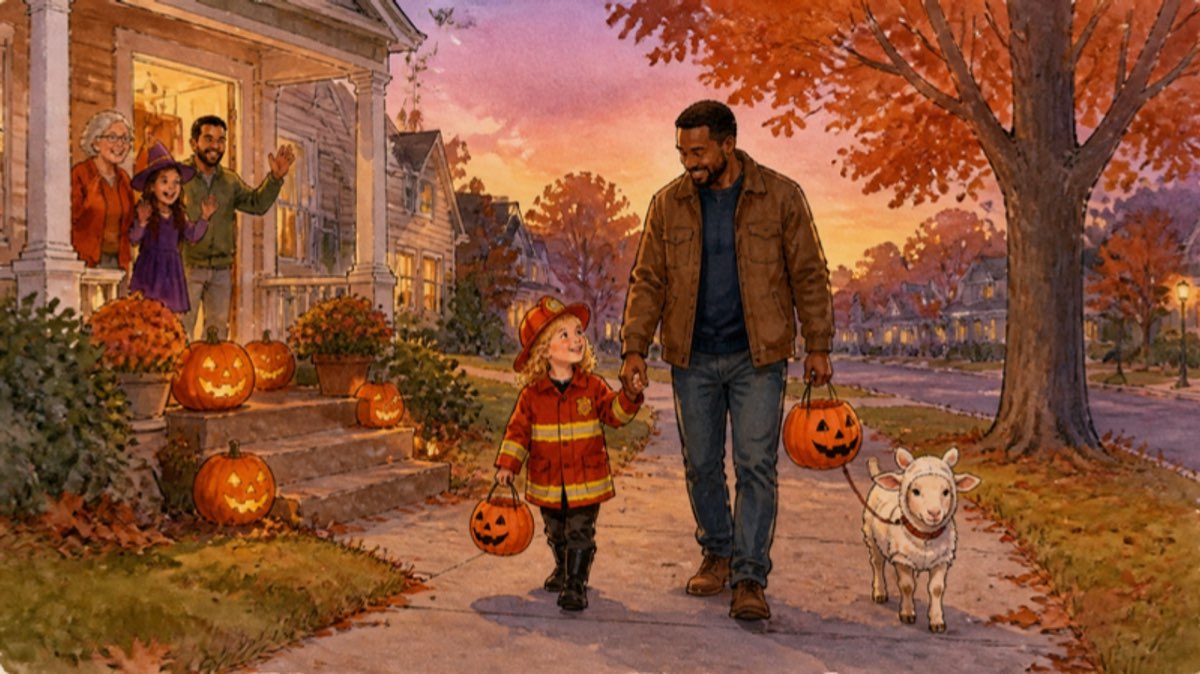
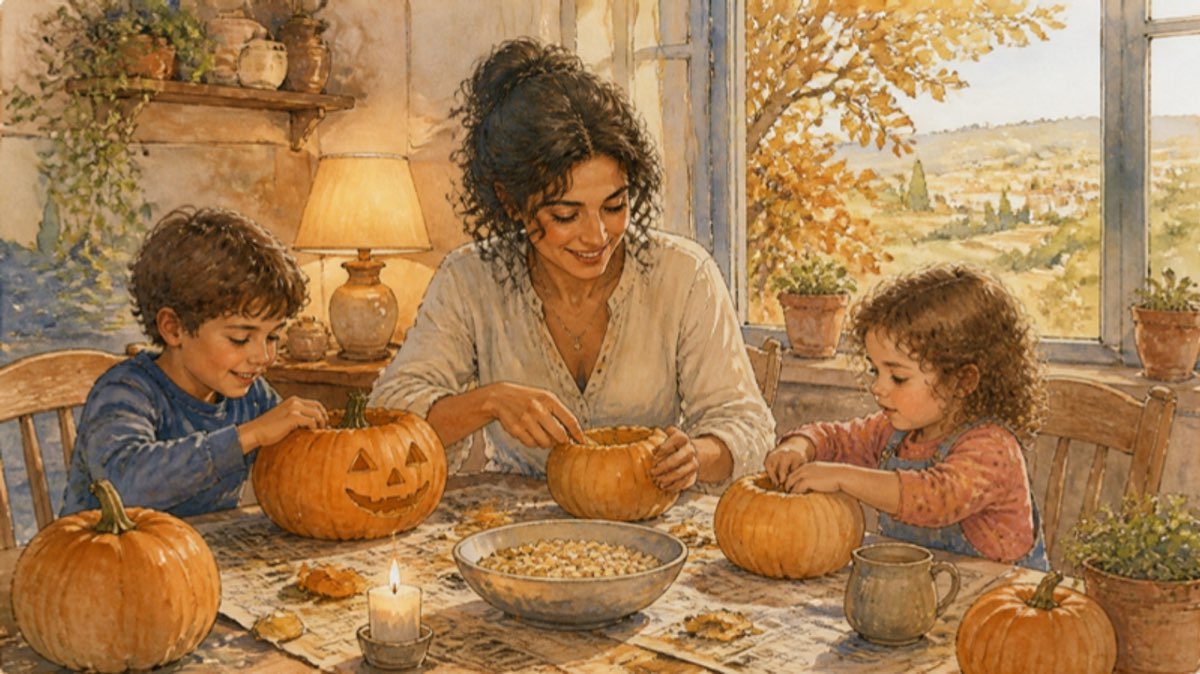
This is the verse people use to sort the holiday into pieces. Pumpkin carving, a kid dressed as a firefighter, neighbors talking on porches: easy. A yard display built around gore, or a party that treats the occult as entertainment: harder to square with “whatever is pure.” Many Christian families draw the line here rather than at the holiday as a whole.
How Christians actually handle it
From what I’ve seen and read, three patterns:
Abstain. Skip it, or hold a harvest festival or “trunk-or-treat” at church. The reasoning is Deuteronomy 18 (and Leviticus 19:31, Exodus 22:18, and the occult confrontations in Acts 8, 13, 16, and 19, which GotQuestions lists) plus caution. GotQuestions’ own headline answer is on this side: “Due to its decidedly pagan origins, the answer to the question as to whether Christians should celebrate Halloween is a resounding no.”
Participate. Trick-or-treat, hand out full-size candy bars, talk to neighbors you never otherwise see. The reasoning is Romans 14 freedom plus the chance to be a visibly warm household.
Participate selectively. Costumes and candy yes; horror and occult themes no. This is where GotQuestions actually ends up despite its headline: “Is there anything evil about a Christian dressing up in an innocent costume and going around the block asking for candy? No, there is not,” followed by “Are there things about Halloween that are anti-Christian and should be completely avoided? Absolutely!” It mentions churches with harvest festivals and Christians who hand out gospel tracts with the candy. This also seems to be the most common choice among the moms I know.
One more verse gets quoted by the participate side, and I think it’s the most interesting one. John writes, “the one who is in you is greater than the one who is in the world” (1 John 4:4, NIV). The argument is that Christians, of all people, don’t need to be afraid of a plastic skeleton.
Ghost Month and jack-o’-lanterns
I grew up Buddhist in Taiwan, where the seventh lunar month is Ghost Month and the dead are very much part of the calendar, so the American anxiety about Halloween was new to me. What I appreciate in the Christian discussion is that the Bible itself gives them a rule for disagreeing: be convinced in your own mind, don’t judge your neighbor, and keep your eye on what you’re feeding your kids’ imaginations. That’s a better frame than most holiday arguments get.
If your family abstains, Romans 14 says do it without contempt for the house next door. If your family participates, it says do it without contempt for the family that stays home. Either way, the candy is not the point.
For a hard day
These are one curious mom's study notes, not pastoral counsel or medical advice. If today is heavier than a verse can carry, please reach out to your pastor, a licensed counselor, or your doctor — and if you're in crisis in the US, call or text 988.
Questions moms ask
Does the Bible mention Halloween?
No. The holiday didn't exist in biblical times. The passages Christians apply to it are Deuteronomy 18:10-12 (against divination and consulting the dead), Romans 14 (disputable matters), 1 Corinthians 10:23-31 (freedom with limits), and Philippians 4:8 (what to dwell on).
Where did Halloween come from?
GotQuestions' page on Halloween's origins traces it to the Celtic festival Samhain, then to the church's All Saints' Day on November 1 (established, it says, in the 800s), which made October 31 'All Hallows' Eve,' and then to Irish and Scottish immigrants who brought the customs to America in the 1800s. October 31 is also Reformation Day, the date Luther nailed his 95 Theses to the Wittenberg church door in 1517.
So can Christians trick-or-treat?
GotQuestions says Christians shouldn't 'celebrate' Halloween because of its pagan origins, but asks whether a child 'dressing up in an innocent costume and going around the block asking for candy' is evil and answers, 'No, there is not' — while the darker aspects 'should be completely avoided.' Romans 14 ('each of them should be fully convinced in their own mind') and 1 Corinthians 10:31 are the two passages it says govern the decision.
Scripture references in this article
Each reference opens the full passage on BibleGateway (NIV).
I'm a curious mom in Taiwan reading the Bible and writing down what I learn. I'm not a Christian — I grew up Buddhist — but after watching my aunt and the moms around me lean on these words through hard years, I wanted to understand why they carry so much weight. Every verse is quoted from the ESV or NIV and every interpretation links to a public commentary. I'm still learning; if you spot an error, tell me.