
I don’t pray, so I had no idea how Christians learn to. I assumed there was a technique. What I found when I went to the passages is that Jesus’ own disciples didn’t know either — “Lord, teach us to pray,” one of them asks in Luke 11:1 — and that his answer is about ninety words long. This is a resource for readers who want to begin; I’ve written the notes, and the prayer at the end is the kind many Christians pray.
Jesus taught prayer mostly in one place, Matthew 6:5-13, and it comes in three parts: where to do it, what not to do, and a short model prayer. Everything else in the New Testament about prayer builds on that.
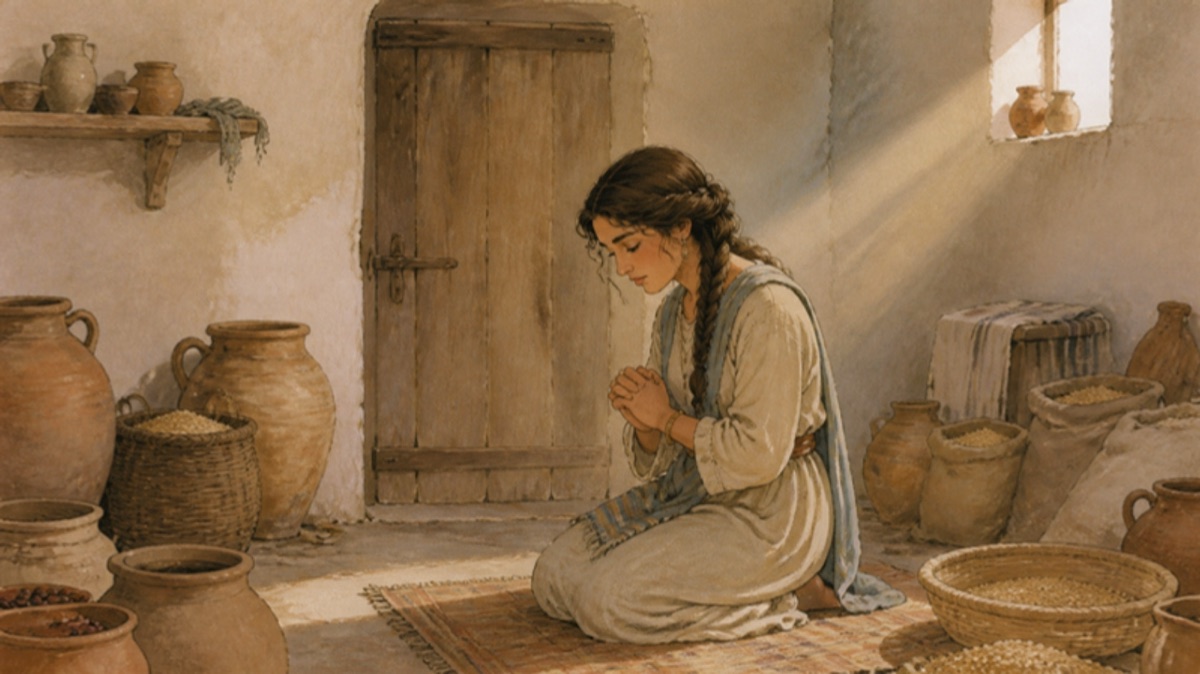
First, where: the closed door
But when you pray, go into your room, close the door and pray to your Father, who is unseen. Then your Father, who sees what is done in secret, will reward you. — Matthew 6:6 (NIV)
The verse before this one is about people who prayed on street corners to be seen. Enduring Word’s commentary on Matthew 6 notes that the “room” here would have been a storeroom — the one space in a first-century house with a door. The instruction is less about architecture than about audience: pray to be heard by God, not watched by people. For a mom, the closed door might be the car in the driveway before going in.
Then, what not to do: babbling
And when you pray, do not keep on babbling like pagans, for they think they will be heard because of their many words. Do not be like them, for your Father knows what you need before you ask him. — Matthew 6:7-8 (NIV)
This surprised me. The one thing Jesus explicitly rules out is volume — the idea that more words, or the right formula, earns a hearing. “Your Father knows what you need before you ask him” takes the pressure off getting the wording right. It also raises the obvious question (if he already knows, why ask?). GotQuestions’ page on why Christians pray gives several answers: because God commands it (Philippians 4:6-7), because Jesus and the early church did it (Mark 1:35), because God “intends prayer to be the means of obtaining His solutions” in specific situations, and because it’s “a means of discerning His will.” Its summary line is that prayer is “not… our means of getting God to do our will on earth, but rather… a means of getting God’s will done on earth.”
The model: the Lord’s Prayer
“This, then, is how you should pray: “‘Our Father in heaven, hallowed be your name, your kingdom come, your will be done, on earth as it is in heaven. Give us today our daily bread. And forgive us our debts, as we also have forgiven our debtors. And lead us not into temptation, but deliver us from the evil one.’ — Matthew 6:9-13 (NIV)
Read as a shape rather than a script (which is how GotQuestions and Enduring Word both treat it), the prayer has six moves:
- Address: “Our Father in heaven.” Not “O great unknowable one.” A family word.
- God first: “hallowed be your name, your kingdom come, your will be done.” Three requests about God before any about the person praying.
- Daily need: “Give us today our daily bread.” Today’s bread, not the year’s. This is the line Christian moms I know pray most, and the one I understand best.
- Forgiveness, both directions: “forgive us our debts, as we also have forgiven our debtors.” The only line Jesus comments on afterward (Matthew 6:14-15).
- Protection: “lead us not into temptation, but deliver us from the evil one.”
- (In many churches) a closing doxology — “for yours is the kingdom…” — which Enduring Word notes is disputed: “whether this doxology is in the original manuscript Matthew wrote or was added in later.” That’s why some Bibles print it in the text and others in a footnote.
Christians have built a lot of beginner frameworks on this — ACTS (adoration, confession, thanksgiving, supplication) is the most common, and GotQuestions’ page on it says the model is “loosely based on the Lord’s Prayer” while warning that formulas “do not necessarily make our prayers more effective.” They’re all attempts to keep the same proportions: God’s concerns first, your needs second, forgiveness in the middle.
The seven-word prayer
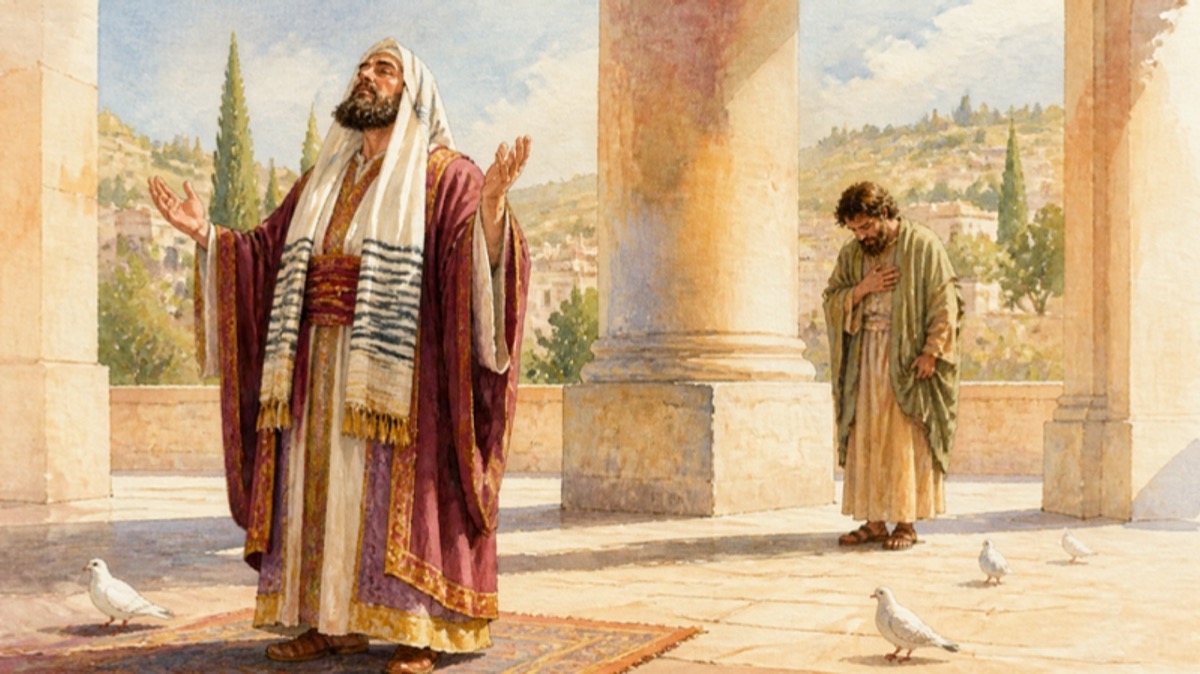
In case the model prayer feels like a lot, Jesus also told a story about two men praying in the temple. The Pharisee’s prayer is a list of his accomplishments. The other man:
“But the tax collector stood at a distance. He would not even look up to heaven, but beat his breast and said, ‘God, have mercy on me, a sinner.’ — Luke 18:13 (NIV)
Jesus says that’s the man who “went home justified.” Seven words. I keep this verse in my notes because it is the clearest evidence that, in this tradition, prayer is graded on honesty rather than length.
When there are no words
In the same way, the Spirit helps us in our weakness. We do not know what we ought to pray for, but the Spirit himself intercedes for us through wordless groans. — Romans 8:26 (NIV)
This is the verse Christian moms quoted to me most when I asked about praying while exhausted. Enduring Word reads “wordless groans” as the Spirit praying on behalf of someone who can’t — which means, in their understanding, that an incoherent 3 a.m. prayer counts. Psalm 62:8, “pour out your hearts to him,” is the Old Testament version: the instruction is to empty, not to compose.
Keeping going
Two more passages the beginner guides lean on:
Then Jesus told his disciples a parable to show them that they should always pray and not give up. — Luke 18:1 (NIV)
That’s the lead-in to the persistent widow, who wears down an unjust judge by showing up every day. The point (Enduring Word is careful here) isn’t that God is reluctant; it’s that if persistence works on a bad judge, it’s not wasted on a good Father.
Do not be anxious about anything, but in every situation, by prayer and petition, with thanksgiving, present your requests to God. And the peace of God, which transcends all understanding, will guard your hearts and your minds in Christ Jesus. — Philippians 4:6-7 (NIV)
Note the “with thanksgiving” tucked into the middle. And 1 Thessalonians 5:17, the shortest instruction of all: “pray continually.” Christians read that as an attitude running under the day, not a nonstop monologue.
One caution the Bible itself adds: James 4:3 says some prayers go unanswered because they “ask with wrong motives.” Prayer, on this account, isn’t a vending machine. GotQuestions’ page on unanswered prayer puts the Christian position in a sentence: God “will respond, but He will do so in His timing.”
A way to start, as the sources describe it
If you’re a beginner, here’s the sequence the beginner guides and the women I spoke with converge on. I’m reporting it, not prescribing it:
- Pick a door. A room, a car, a walk. Matthew 6:6.
- Say who you’re talking to. “Father” is Jesus’ word.
- Three sentences about God, then yours. The Lord’s Prayer’s proportions.
- Ask for today’s bread. The actual thing you need today, named plainly.
- Forgive someone, out loud, in the prayer. The line Jesus singled out.
- Stop when you’re done. Matthew 6:7. Seven words is enough.
A beginner’s prayer many Christians use
Father, I don’t know how to do this. You already know what I need. Thank you for today. Give me what today takes. Forgive me, and help me forgive. Keep me out of trouble. Amen.
Every line of that comes from Matthew 6. That’s the whole guide, really — the rest is practice.
Sources and further reading
- BibleGateway — Matthew 6:5-15 (NIV), Luke 11:1-13 (NIV), Luke 18:1-14 (NIV)
- Enduring Word — Matthew 6 commentary, Luke 11, Luke 18, Romans 8
- GotQuestions — What is the proper way to pray? and What is the Lord’s Prayer and should we pray it?
- GotQuestions — Why pray?, What is the ACTS method of prayer?, Why does God not answer my prayers?
- Blue Letter Bible — Matthew 6:9 with study tools
Questions moms ask
Is there a right way to pray?
What's the shortest prayer in the Bible?
What if I don't feel anything when I pray?
Scripture references in this article
Each reference opens the full passage on BibleGateway (NIV).



Little helps for everyday faith
Start with a few quiet minutes.

Behind the notes
Hi, I'm Vega.
I'm a curious mom in Taiwan reading the Bible and writing down what I learn. I'm not a Christian — I grew up Buddhist — but after watching my aunt and the moms around me lean on these words through hard years, I wanted to understand why they carry so much weight. Every verse is quoted from the ESV or NIV and every interpretation links to a public commentary. I'm still learning; if you spot an error, tell me.
A little more about me