
A friend’s daughter asked her this the week their old dog died, and my friend — who goes to church — admitted she didn’t know what the Bible said. So I looked. The honest answer is that there is no verse about it, and the Christian sources I trust say so up front. But the Bible has far more to say about animals than I expected, and some of it is directly relevant.
Here is what the texts say, what the main commentaries conclude, and where it leaves a grieving kid.
Start with the honest part
GotQuestions, which is about as mainstream-evangelical as it gets, opens its answer this way: “The Bible does not give any explicit teaching on whether animals have souls or whether our pets will be in heaven.” It then says the best anyone can do is “an educated guess” from general principles. I found no serious commentary that claims more than that. Anyone who tells you the Bible promises your dog is in heaven — or promises it isn’t — is going beyond the text.
What the Bible says about animals
And God said, “Let the land produce living creatures according to their kinds: the livestock, the creatures that move along the ground, and the wild animals, each according to its kind.” And it was so. God made the wild animals according to their kinds, the livestock according to their kinds, and all the creatures that move along the ground according to their kinds. And God saw that it was good. — Genesis 1:24-25 (NIV)
Animals are created on the same day as humans, and God calls them good before people exist. Then comes a phrase that matters for this question:
And to all the beasts of the earth and all the birds in the sky and all the creatures that move along the ground—everything that has the breath of life in it—I give every green plant for food.” And it was so. — Genesis 1:30 (NIV)
“The breath of life” — the same phrase Genesis uses for the first man in 2:7. GotQuestions points out that both humans and animals have this breath and both are “living beings”; the difference the text draws is elsewhere, in Genesis 1:26-27, where only humans are made “in the image of God.” That is the hinge of the whole question: the Bible gives animals life from God but reserves the image of God for people, and it doesn’t say what follows from that after death.
After the flood, God makes a covenant — and names the animals in it:
“I now establish my covenant with you and with your descendants after you and with every living creature that was with you—the birds, the livestock and all the wild animals, all those that came out of the ark with you—every living creature on earth. — Genesis 9:9-10 (NIV)
Noah brought the animals onto the ark on God’s instruction, and the covenant afterward is explicitly “with every living creature.” GotQuestions’s comment: this doesn’t put pets in heaven, “but it does show that God cares about animals and that a world without animals is contrary to His plan.”
The Psalms keep the theme. “You, Lord, preserve both people and animals” (Psalm 36:6). Lions “seek their food from God” (Psalm 104:21), and the whole chapter is a catalog of creatures God feeds. Proverbs 12:10 makes care for animals a mark of a righteous person. The book of Jonah ends with God defending his concern for Nineveh partly on the grounds that it contains “many animals” (Jonah 4:11). And Jesus says not one sparrow “is forgotten by God” (Luke 12:6).
The one verse that asks the question out loud
Who knows if the human spirit rises upward and if the spirit of the animal goes down into the earth?” — Ecclesiastes 3:21 (NIV)
This is the closest the Bible comes to the question, and it is a question. The Teacher has just said that people and animals “all go to the same place; all come from dust, and to dust all return” (3:20). Enduring Word reads verse 21 as the writer hoping for a different destiny for people than for animals while admitting that from an “under the sun” viewpoint he has no way to know — “so, ‘Who knows?’” It is not a verse against animals in the afterlife; it’s a verse that refuses to settle it.
Animals in the world to come
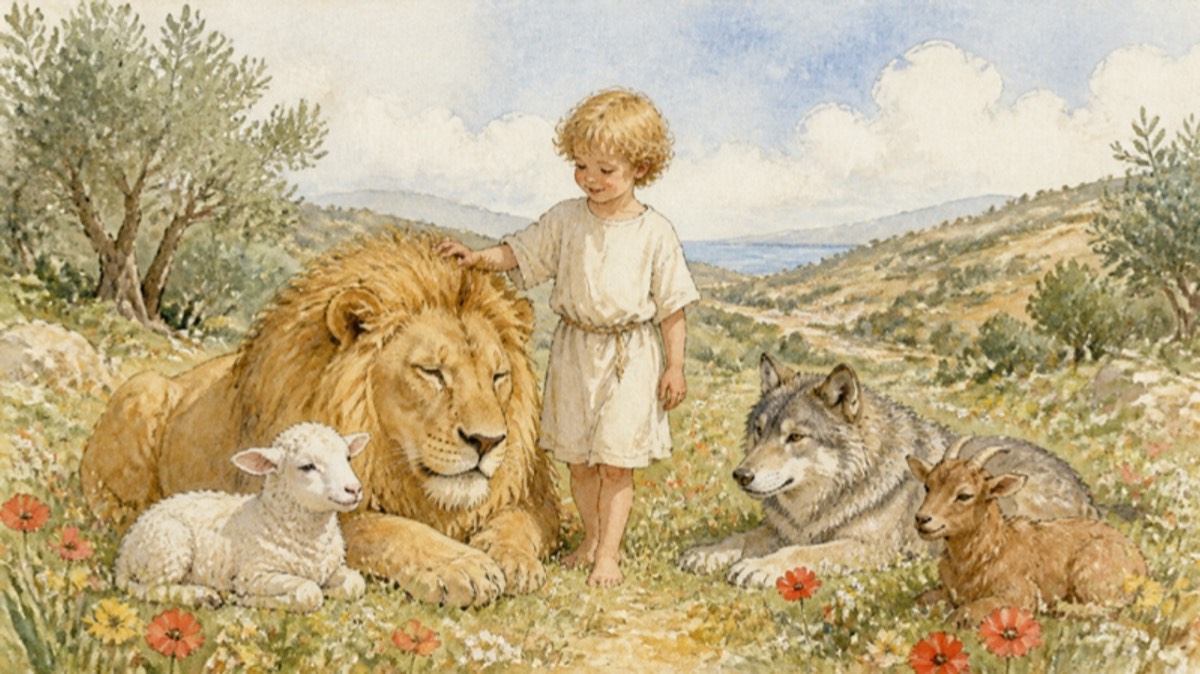
The wolf will live with the lamb, the leopard will lie down with the goat, the calf and the lion and the yearling together; and a little child will lead them. — Isaiah 11:6 (NIV)
Isaiah’s picture of the restored world is full of animals — wolf, lamb, leopard, goat, calf, lion — and a child leading them. Isaiah 65:25 repeats it: “The wolf and the lamb will feed together.” GotQuestions is confident that “there will definitely be animals” in the coming kingdom and sees “no reason why there could not be pets or animals on the new earth, too.”
that the creation itself will be liberated from its bondage to decay and brought into the freedom and glory of the children of God. — Romans 8:21 (NIV)
Paul says creation itself — not just people — “will be liberated from its bondage to decay.” Does that mean animals that have died are raised? GotQuestions answers carefully: “Possibly, but the passage does not explicitly say that.” That is the right amount of caution.
Then I heard every creature in heaven and on earth and under the earth and on the sea, and all that is in them, saying: “To him who sits on the throne and to the Lamb be praise and honor and glory and power, for ever and ever!” — Revelation 5:13 (NIV)
“Every creature in heaven and on earth” joins the song. It is a vision, and visions are not zoology, but the Bible’s last book does not picture a creature-free eternity.
What Christian thinkers have said
The most-quoted non-biblical source is C. S. Lewis, who in The Problem of Pain (1940) devoted a chapter to animal pain and speculated that tame animals might share in their owners’ immortality — that a pet could be raised “in” the person who loved it, as a part of their life. He was explicit that this was a guess. On the other side, plenty of theologians argue that without the image of God there is no basis for individual animal survival, and that the Bible’s promises are addressed to people.
Both camps end up at the same text: the Bible describes a renewed creation with animals in it and says nothing about which animals.
For the grieving child (or adult)
Grief over a pet is not a theological error. The attachment is real and daily — the animal was fed by your hands, slept at your feet, and greeted you without conditions. Several Christian moms I’ve read handle their kids’ question with three honest statements: God made the animal and called it good (Genesis 1:25), God cares about animals (Jonah 4:11, Luke 12:6), and God’s new world has animals in it (Isaiah 11:6). Then they say they don’t know the rest, which is true, and which kids can handle better than adults expect.
Practical things that help: a small burial or memorial, a photo on the fridge, letting the child say what they’ll miss. If the family feels ready later, a rescue animal is not a replacement but is a way to use the care the first animal taught.
Five verses to read with a child who has lost a pet
If you want something short to read together, these are the ones that fit, in the order the story runs:
- Genesis 1:25 — God made the animals “and God saw that it was good.”
- Psalm 36:6 — “You, Lord, preserve both people and animals.”
- Luke 12:6 — not one sparrow “is forgotten by God.”
- Isaiah 11:6 — the wolf, the lamb, and “a little child will lead them.”
- Revelation 21:4 — “no more death or mourning or crying or pain.”
None of them says the dog is in heaven. All of them say the animal mattered to the one who made it, which is usually the thing a child is really asking.
Where I land
I came to this expecting a shrug and found something more specific. The Bible gives animals God’s breath, God’s covenant, God’s feeding, and a place in its last vision of the world. It does not give them the image of God, and it does not say what happens to the individual creature. That is where every careful reader stops, and it’s a more respectful place to stop than either a promise or a dismissal.
Sources
- Genesis 1 (NIV) on BibleGateway
- GotQuestions — Do pets / animals go to heaven?
- Enduring Word — Genesis 1 commentary
- Enduring Word — Genesis 9 commentary
- Enduring Word — Ecclesiastes 3 commentary
- Enduring Word — Isaiah 11 commentary
- Enduring Word — Romans 8 commentary
- Blue Letter Bible — Ecclesiastes 3:21 with study tools
- Blue Letter Bible — Psalm 36:6 with study tools
Questions moms ask
Does the Bible say pets go to heaven?
Do animals have souls according to the Bible?
Will there be animals in heaven?
Scripture references in this article
Each reference opens the full passage on BibleGateway (NIV).



Little helps for everyday faith
Start with a few quiet minutes.

Behind the notes
Hi, I'm Vega.
I'm a curious mom in Taiwan reading the Bible and writing down what I learn. I'm not a Christian — I grew up Buddhist — but after watching my aunt and the moms around me lean on these words through hard years, I wanted to understand why they carry so much weight. Every verse is quoted from the ESV or NIV and every interpretation links to a public commentary. I'm still learning; if you spot an error, tell me.
A little more about me