
When I started reading the Bible I assumed it would be against alcohol, because the Christians I knew growing up in Taiwan mostly didn’t drink. Then I hit Psalm 104, where wine is listed with bread and oil as something God gives to make people glad, and the wedding at Cana, where the first miracle in John’s Gospel is making more of it. The actual position is more specific than “for” or “against,” and it’s worth laying out passage by passage.
Wine as a gift
He makes grass grow for the cattle, and plants for people to cultivate— bringing forth food from the earth: wine that gladdens human hearts, oil to make their faces shine, and bread that sustains their hearts. — Psalm 104:14-15 (NIV)
This is a creation psalm, and wine sits in the middle of a list of ordinary good things — grass for cattle, bread, oil for the face. GotQuestions adds Ecclesiastes 9:7 (“drink your wine with a joyful heart”) and Amos 9:14, where drinking wine from your own vineyard is a sign of God’s blessing.
and said, “Everyone brings out the choice wine first and then the cheaper wine after the guests have had too much to drink; but you have saved the best till now.” — John 2:10 (NIV)
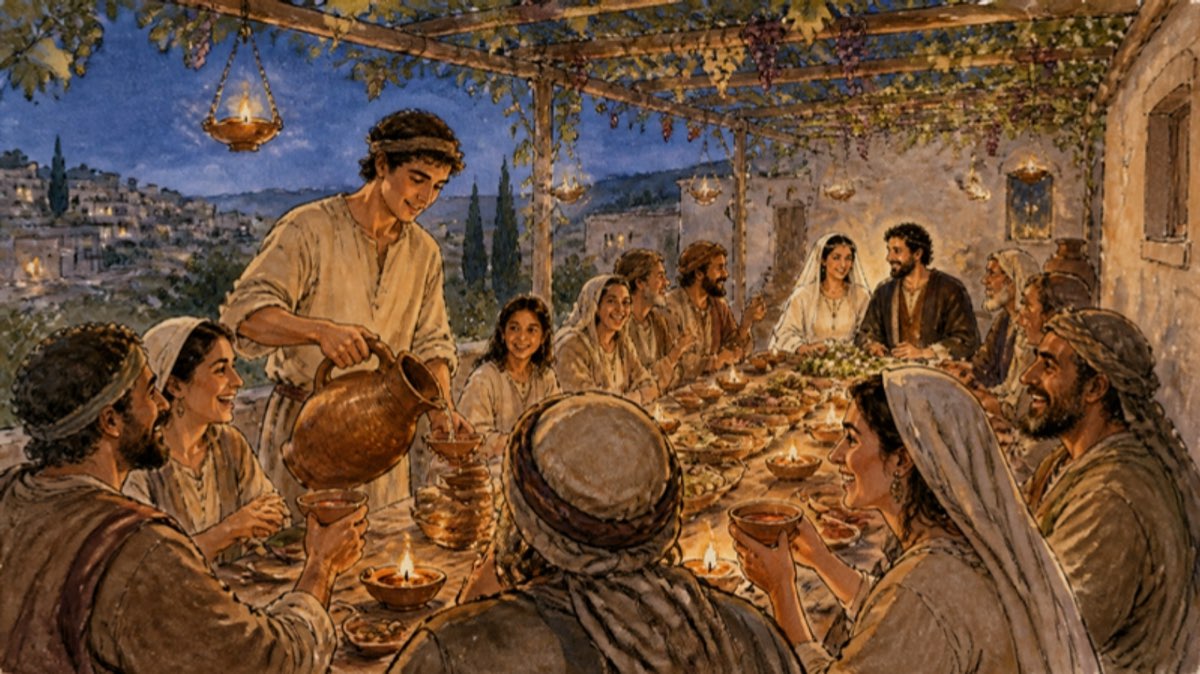
At Cana, Jesus turns something like 120 gallons of water into wine, and the master of the banquet’s complaint is that the good wine has been saved for last — when guests “have had too much.” The story treats wine at a wedding as normal and the quality of it as something worth commenting on.
For John the Baptist came neither eating bread nor drinking wine, and you say, ‘He has a demon.’ The Son of Man came eating and drinking, and you say, ‘Here is a glutton and a drunkard, a friend of tax collectors and sinners.’ — Luke 7:33-34 (NIV)
Jesus’s critics called him “a glutton and a drunkard.” The charge was false, but it would have been absurd if he had been a teetotaler like John the Baptist, whom they accused of the opposite. Jesus himself draws the contrast.
Stop drinking only water, and use a little wine because of your stomach and your frequent illnesses. — 1 Timothy 5:23 (NIV)
Paul tells his younger colleague to stop drinking only water and use a little wine for his stomach. GotQuestions notes that in that world the water was often unsafe, and wine — fermented, so alcoholic, though not necessarily as strong as modern wine — was the safer drink.
The warnings, which are just as clear
Wine is a mocker and beer a brawler; whoever is led astray by them is not wise. — Proverbs 20:1 (NIV)
Who has woe? Who has sorrow? Who has strife? Who has complaints? Who has needless bruises? Who has bloodshot eyes? Those who linger over wine, who go to sample bowls of mixed wine. Do not gaze at wine when it is red, when it sparkles in the cup, when it goes down smoothly! In the end it bites like a snake and poisons like a viper. — Proverbs 23:29-32 (NIV)
Proverbs is not vague here. The passage continues with the drinker seeing strange sights, feeling nothing when hit, and waking up asking when he can drink again (23:33-35). It is one of the oldest descriptions of addiction in any literature.
Do not get drunk on wine, which leads to debauchery. Instead, be filled with the Spirit, — Ephesians 5:18 (NIV)
This is the verse that settles the question for most Christians: the command is “do not get drunk,” and the contrast is being “filled with the Spirit.” Enduring Word’s commentary on the chapter takes the two halves together — drunkenness as being under the control of something, Spirit-filling as the alternative control.
The acts of the flesh are obvious: sexual immorality, impurity and debauchery; idolatry and witchcraft; hatred, discord, jealousy, fits of rage, selfish ambition, dissensions, factions and envy; drunkenness, orgies, and the like. I warn you, as I did before, that those who live like this will not inherit the kingdom of God. — Galatians 5:19-21 (NIV)
Drunkenness appears in Paul’s list of “acts of the flesh,” next to jealousy and fits of rage. Not drinking — drunkenness. The distinction holds across every warning passage.
“I have the right to do anything,” you say—but not everything is beneficial. “I have the right to do anything”—but I will not be mastered by anything. — 1 Corinthians 6:12 (NIV)
Paul’s broader principle: “I will not be mastered by anything.” GotQuestions applies this directly — “drinking alcohol in excess is undeniably addictive,” and a Christian is warned against being mastered by it.
Abstaining as devotion
they must abstain from wine and other fermented drink and must not drink vinegar made from wine or other fermented drink. They must not drink grape juice or eat grapes or raisins. — Numbers 6:3 (NIV)
The Nazirite vow — taken by Samson’s mother, by Samson, and (according to Luke 1:15) required of John the Baptist — included giving up wine and even grapes for the length of the vow. Priests were forbidden wine while on duty (Leviticus 10:9), and church leaders are told not to be “given to drunkenness” or “indulging in much wine” (1 Timothy 3:3, 3:8). The Bible has a long tradition of people giving up alcohol as an act of devotion, which is a different thing from saying everyone must.
The verse about other people: Romans 14
It is better not to eat meat or drink wine or to do anything else that will cause your brother or sister to fall. — Romans 14:21 (NIV)
Romans 14 is about Christians who disagree over food and days, and Paul’s rule is that freedom bends to love. If drinking in front of someone would cause them to stumble — a recovering alcoholic, a new believer with a strict conscience — the text says don’t. Enduring Word’s commentary on the chapter reads this as a limit on liberty, not a ban: the stronger conscience gives way for the weaker one’s sake.
So whether you eat or drink or whatever you do, do it all for the glory of God. — 1 Corinthians 10:31 (NIV)
And the summary principle, which GotQuestions puts bluntly: it is impossible for a Christian to drink to excess “to the glory of God.”
Why Christians still disagree
Most of global Christianity — Catholic, Orthodox, Anglican, Lutheran, and many Reformed churches — has always used wine in communion and treated moderate drinking as permissible. Martin Luther’s fondness for beer is well documented. The strong abstinence position in American Protestantism is more recent: it grew out of the 19th-century temperance movement, which responded to real devastation from cheap spirits in industrial cities and shaped Baptist, Methodist, Pentecostal, and Adventist practice. Some of those churches switched to grape juice for communion in that period, and many still teach total abstinence.
Both sides can point to the Bible: one to Psalm 104 and Cana, the other to Proverbs 23 and the Nazirites. What neither side can point to is a verse that makes the other’s position a sin. GotQuestions, which is conservative, lands on “a matter of Christian freedom.”
Where the practical lines fall
From the texts and the commentaries, the lines Christians actually draw are these:
- Drunkenness is out. Ephesians 5:18 and Galatians 5:21 are not ambiguous.
- Being mastered is out. 1 Corinthians 6:12. If alcohol is doing a job in your life — coping, numbing, sleeping — that is the “mastered” the verse means.
- Other people’s weakness counts. Romans 14:21. Many Christians don’t drink around someone in recovery, or at church events, for this reason.
- Abstaining is honorable but not required. Numbers 6; 1 Timothy 5:23.
- Family history is a reason to abstain. Not a verse — a wisdom call that most pastors make and that Proverbs 23 supports.
If drinking has become a problem
The Bible’s description of addiction in Proverbs 23:35 — “When will I wake up so I can find another drink?” — is two and a half thousand years old and still accurate. Alcohol use disorder is a medical condition, and churches with recovery ministries (Celebrate Recovery is the largest) treat it as one. In the US, the SAMHSA National Helpline is 1-800-662-4357, free and confidential, any hour. Asking is not a failure of faith; Paul told Timothy to take care of his body in the same letter where he told him to fight the good fight.
Sources
- Ephesians 5 (NIV) on BibleGateway
- Enduring Word — Ephesians 5 commentary
- Enduring Word — Romans 14 commentary
- Enduring Word — Proverbs 23 commentary
- Enduring Word — 1 Timothy 5 commentary
- Blue Letter Bible — Ephesians 5:18 with study tools
- GotQuestions — What does the Bible say about drinking alcohol?
- GotQuestions — Did Jesus drink wine?
Questions moms ask
Does the Bible say drinking alcohol is a sin?
Did Jesus drink wine?
Why do some Christians never drink?
Scripture references in this article
Each reference opens the full passage on BibleGateway (NIV).



Little helps for everyday faith
Start with a few quiet minutes.

Behind the notes
Hi, I'm Vega.
I'm a curious mom in Taiwan reading the Bible and writing down what I learn. I'm not a Christian — I grew up Buddhist — but after watching my aunt and the moms around me lean on these words through hard years, I wanted to understand why they carry so much weight. Every verse is quoted from the ESV or NIV and every interpretation links to a public commentary. I'm still learning; if you spot an error, tell me.
A little more about me