
This question gets asked constantly on Christian forums, and the answers range from “absolutely not” to “it depends,” usually with the same two or three verses attached. I’m not a Christian, so I have no stake in the outcome — I just wanted to know what the texts actually say, where they come from, and what the commentaries do with them. That turned out to be more interesting than the forum fights.
Short version: the Bible never discusses dating, because dating as we know it didn’t exist. It discusses marriage, and on marriage between a believer and an unbeliever it is fairly consistent, for reasons it states plainly.
The verse everyone quotes: 2 Corinthians 6:14
Do not be yoked together with unbelievers. For what do righteousness and wickedness have in common? Or what fellowship can light have with darkness? What harmony is there between Christ and Belial? Or what does a believer have in common with an unbeliever? — 2 Corinthians 6:14-15 (NIV)
Paul is writing to the church in Corinth, a port city full of temples. The verses right after this one make the actual concern explicit: “What agreement is there between the temple of God and idols?” (6:16). Enduring Word’s reading is that the Corinthian Christians were still entangled with the city’s idol worship and with people who pulled them back toward it — the same problem Paul addressed in 1 Corinthians 8-10.
The “yoke” image comes from farming. Deuteronomy 22:10 forbids plowing “with an ox and a donkey yoked together”: two animals of different strength and stride pull a plow in circles. GotQuestions uses the same picture — a mismatched team “cannot perform the task set before them.”
So is the verse about marriage? Both commentaries say marriage is the most common application, and Enduring Word quotes the old commentator Adam Clarke on it at length. But both also say Paul means something broader — any partnership or influence where an unbeliever’s worldview ends up steering the believer. Enduring Word adds that Paul is not telling Christians to avoid unbelievers altogether, since he says the opposite in 1 Corinthians 5:9-13. The principle is about who sets the direction.
The verse that is actually about marriage: 1 Corinthians 7:39
A woman is bound to her husband as long as he lives. But if her husband dies, she is free to marry anyone she wishes, but he must belong to the Lord. — 1 Corinthians 7:39 (NIV)
This is the clearest line in the New Testament on the question, and it is often overlooked because it is addressed to widows. A widow is free to remarry anyone she wishes — “but he must belong to the Lord.” GotQuestions calls this “a clear directive to marry a Christian.” It’s a narrower, plainer statement than 2 Corinthians 6:14 and doesn’t need the yoke metaphor to work.
Why the Old Testament forbade it, in its own words
Do not intermarry with them. Do not give your daughters to their sons or take their daughters for your sons, for they will turn your children away from following me to serve other gods, and the Lord ’s anger will burn against you and will quickly destroy you. — Deuteronomy 7:3-4 (NIV)
Israel was told not to intermarry with the nations in Canaan, and the reason given is not ethnic — it is spiritual and specifically about children: “they will turn your children away from following me.” The clearest case study is Solomon:
As Solomon grew old, his wives turned his heart after other gods, and his heart was not fully devoted to the Lord his God, as the heart of David his father had been. — 1 Kings 11:4 (NIV)
Solomon had every advantage — wisdom, wealth, a temple he built himself — and his foreign wives still pulled him toward their gods. Centuries later, when Nehemiah found Jews in Jerusalem marrying women from Ashdod, Ammon, and Moab, he cited Solomon by name as the warning (Nehemiah 13:26). Ezra 9-10 records the same crisis a generation earlier.
The exception that explains the rule: Ruth
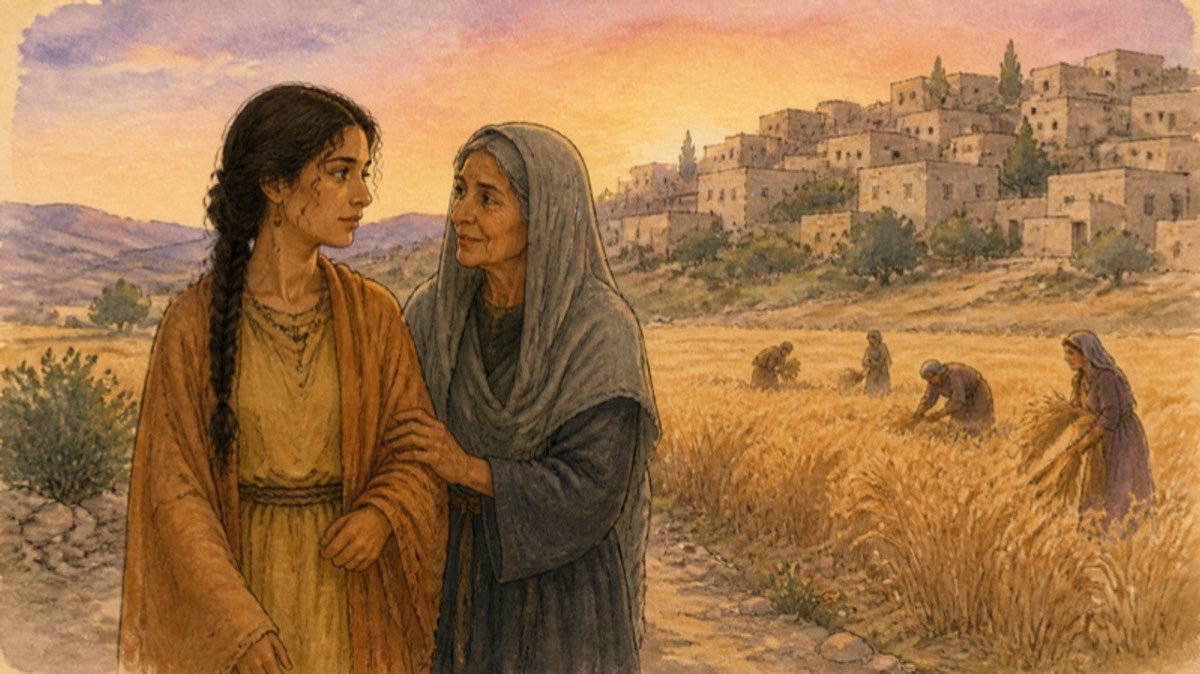
The Bible’s most celebrated cross-cultural marriage is Boaz, an Israelite, marrying Ruth, a Moabite — one of the exact nations Nehemiah named. The book treats the marriage as a blessing and ends by naming Ruth as King David’s great-grandmother (Ruth 4:17). What makes the difference is the order of events. Before she ever met Boaz, Ruth had said to her mother-in-law:
But Ruth replied, “Don’t urge me to leave you or to turn back from you. Where you go I will go, and where you stay I will stay. Your people will be my people and your God my God. — Ruth 1:16 (NIV)
The line the Old Testament draws is faith, not ethnicity. Rahab of Jericho and Ruth of Moab both married into Israel after committing to Israel’s God, and both appear in the genealogy of Jesus (Matthew 1:5). Deuteronomy’s concern was about where the children would end up, and Ruth’s children ended up in the line of David.
Already married to an unbeliever: Paul’s instruction
To the rest I say this (I, not the Lord): If any brother has a wife who is not a believer and she is willing to live with him, he must not divorce her. And if a woman has a husband who is not a believer and he is willing to live with her, she must not divorce him. For the unbelieving husband has been sanctified through his wife, and the unbelieving wife has been sanctified through her believing husband. Otherwise your children would be unclean, but as it is, they are holy. — 1 Corinthians 7:12-14 (NIV)
Some Corinthian Christians apparently thought the spiritual move was to divorce a non-Christian spouse. Paul says the opposite: stay, if the spouse is willing. Enduring Word is careful about “sanctified” here — it does not mean the unbelieving spouse is saved by the marriage, but that they are “set apart for a special working” of God’s Spirit through living next to a believer. And Paul ends the section hopefully: “How do you know, wife, whether you will save your husband?” (7:16).
Peter gives the believing wife a method:
Wives, in the same way submit yourselves to your own husbands so that, if any of them do not believe the word, they may be won over without words by the behavior of their wives, when they see the purity and reverence of your lives. — 1 Peter 3:1-2 (NIV)
“Without words.” Whatever the modern application, nagging a spouse toward faith is not in the text.
What about dating?
Here is the honest gap: the Bible has no category for dating. GotQuestions says it directly — “dating of any type was not widely practiced in biblical times. Most marriages were arranged.” So every answer to the question in the title is an inference. The usual inference runs: dating is the road to marriage; the marriage texts say marry a believer; therefore don’t start down a road you shouldn’t finish.
“Missionary dating” — dating a non-Christian in the hope of converting them — is the common objection, and GotQuestions addresses it by name. Its answer: God can use anything, but the cases where the non-Christian comes to faith don’t prove the practice wise, and there are “far more cases” where the Christian’s faith is the thing that changes. The verse often paired with this is Amos 3:3 (“Do two walk together unless they have agreed to do so?”), though in Amos it is about prophecy and cause-and-effect, not courtship; it’s a proverb being borrowed.
Where Christian traditions actually land
- Most evangelical teaching: don’t date a non-Christian at all, on the reasoning above. This is the position of GotQuestions and of Enduring Word’s comments on 2 Corinthians 6.
- A softer version, common in practice: friendship is fine, romantic commitment waits until faith is shared.
- Catholic and some mainline churches: interfaith marriage is permitted with a dispensation and conditions (for Catholics, a promise to raise the children in the faith) — which, notice, is the exact concern of Deuteronomy 7:4 handled by rule rather than prohibition.
None of these traditions reads the texts as neutral on the question. The disagreement is about whether the answer is “never” or “carefully.”
What I take from it as an outsider
The texts care less about the label on the spouse than about who shapes the household — and especially the children. That is the explicit reason in Deuteronomy 7:4, the failure in 1 Kings 11:4, the hope in 1 Corinthians 7:14, and the point of the Ruth story. For a mom reading this from outside the faith, that’s a surprisingly practical standard: not “is this person acceptable,” but “where will this person pull the family.”
Sources
- 2 Corinthians 6 (NIV) on BibleGateway
- Enduring Word — 2 Corinthians 6 commentary
- Enduring Word — 1 Corinthians 7 commentary
- Enduring Word — 1 Kings 11 commentary
- Enduring Word — Deuteronomy 7 commentary
- Blue Letter Bible — 2 Corinthians 6:14 with study tools
- GotQuestions — What does it mean to be unequally yoked?
- GotQuestions — Is missionary dating a good idea?
Questions moms ask
What does “unequally yoked” mean?
Is it a sin for a Christian to date a non-Christian?
What if I'm already married to someone who isn't a Christian?
Scripture references in this article
Each reference opens the full passage on BibleGateway (NIV).



Little helps for everyday faith
Start with a few quiet minutes.

Behind the notes
Hi, I'm Vega.
I'm a curious mom in Taiwan reading the Bible and writing down what I learn. I'm not a Christian — I grew up Buddhist — but after watching my aunt and the moms around me lean on these words through hard years, I wanted to understand why they carry so much weight. Every verse is quoted from the ESV or NIV and every interpretation links to a public commentary. I'm still learning; if you spot an error, tell me.
A little more about me