
I started this list for a neighbor who was going through chemotherapy and whose church kept sending her verses — some of which, she told me, made her feel worse, because they seemed to promise what wasn’t happening. So I went and read where each of the common healing verses comes from. Some are personal prayers from sick people. Some are national promises to Israel. One is the record of a request God said no to. Knowing which is which matters.
Twenty verses in the NIV, in three groups: prayers for healing in the Bible, verses that describe God as healer, and what happens around Jesus. Then a plain section on the questions Christians disagree about. None of this is medical advice.
Prayers for healing in the Bible
1. Jeremiah 17:14
Heal me, Lord, and I will be healed; save me and I will be saved, for you are the one I praise. — Jeremiah 17:14 (NIV)
This is Jeremiah’s own prayer, dropped into a chapter about how deceitful the human heart is (17:9). The prophet who delivered hard messages to everyone else asks for healing for himself, and adds “for you are the one I praise” — the request and the praise are the same sentence.
2. Psalm 6:2
Have mercy on me, Lord, for I am faint; heal me, Lord, for my bones are in agony. — Psalm 6:2 (NIV)
David, faint and in pain (“my bones are in agony”), later says he floods his bed with weeping every night (6:6). The first of the psalms Christians call penitential. It gives permission to pray without composure.
3. Psalm 30:2
Lord my God, I called to you for help, and you healed me. — Psalm 30:2 (NIV)
A thanksgiving written after recovery: “I called to you for help, and you healed me.” The next verse says God “spared me from going down to the pit.” It is a before-and-after psalm by someone who had been close to dying.
4. Psalm 41:3
The Lord sustains them on their sickbed and restores them from their bed of illness. — Psalm 41:3 (NIV)
David is sick and his enemies are visiting his bedside to gloat (41:5-8). The verse says God “sustains them on their sickbed” — the picture is of God tending the bed itself, the work of a nurse. Sustaining is promised before restoring.
5. James 5:14-15
Is anyone among you sick? Let them call the elders of the church to pray over them and anoint them with oil in the name of the Lord. And the prayer offered in faith will make the sick person well; the Lord will raise them up. If they have sinned, they will be forgiven. — James 5:14-15 (NIV)
The most direct instruction about sick people in the New Testament: call the elders, have them pray and anoint with oil. Oil was also ordinary first aid in that world (the Samaritan pours oil and wine on wounds in Luke 10:34). Whether “make the sick person well” means physical recovery, spiritual restoration, or both is debated. Enduring Word notes that “many have wondered if James guarantees healing here,” that some read it as the final resurrection, and that the mention of sins being forgiven suggests “a spiritual work and healing, not necessarily a physical healing.”
6. James 5:16
Therefore confess your sins to each other and pray for each other so that you may be healed. The prayer of a righteous person is powerful and effective. — James 5:16 (NIV)
Confession and prayer for one another, with the example of Elijah’s prayer for rain (5:17-18). “Powerful and effective” — the Greek is a single word for energy at work. It is set in a community, not a solo practice.
God described as healer
7. Exodus 15:26
He said, “If you listen carefully to the Lord your God and do what is right in his eyes, if you pay attention to his commands and keep all his decrees, I will not bring on you any of the diseases I brought on the Egyptians, for I am the Lord, who heals you.” — Exodus 15:26 (NIV)
Three days after the Red Sea, at a spring called Marah whose water was too bitter to drink. God makes the water sweet and then says “I am the Lord, who heals you.” The promise is tied to listening and obeying, inside a covenant with one nation — commentators are careful not to lift it out as a blanket guarantee.
8. Psalm 103:2-4
Praise the Lord, my soul, and forget not all his benefits— who forgives all your sins and heals all your diseases, who redeems your life from the pit and crowns you with love and compassion, — Psalm 103:2-4 (NIV)
David pairs “forgives all your sins” with “heals all your diseases” in one breath. The same psalm admits a few verses later that human life is like grass that the wind blows over (103:15-16). Most commentators read verse 3 as a description of God’s character and his ultimate work, not a promise that no believer is ever sick.
9. Psalm 147:3
He heals the brokenhearted and binds up their wounds. — Psalm 147:3 (NIV)
Written as Jerusalem was being rebuilt after exile (147:2). The healing in view is of broken hearts and wounds — emotional and national — by the God who in the next verse counts the stars.
10. Jeremiah 30:17
But I will restore you to health and heal your wounds,’ declares the Lord, ‘because you are called an outcast, Zion for whom no one cares.’ — Jeremiah 30:17 (NIV)
Said to Judah, which God calls “an outcast… Zion for whom no one cares.” The promise to “restore you to health and heal your wounds” is a promise to a nation in exile, and the chapter is about its return home.
11. Malachi 4:2
But for you who revere my name, the sun of righteousness will rise with healing in its rays. And you will go out and frolic like well-fed calves. — Malachi 4:2 (NIV)
The last chapter of the Old Testament. “The sun of righteousness will rise with healing in its rays” — and then a picture of released calves leaping. Christians have long read the verse about Jesus; the line turns up in the carol “Hark! the Herald Angels Sing.”
12. Isaiah 53:5
But he was pierced for our transgressions, he was crushed for our iniquities; the punishment that brought us peace was on him, and by his wounds we are healed. — Isaiah 53:5 (NIV)
The Suffering Servant chapter, which Christians read as a description of Jesus written seven centuries early. “By his wounds we are healed” is quoted twice in the New Testament — about sin in 1 Peter 2:24, and about physical sickness in Matthew 8:17 (quoting the previous verse, 53:4). Both readings are in the Bible, which is why Christians argue about it.
13. 1 Peter 2:24
“He himself bore our sins” in his body on the cross, so that we might die to sins and live for righteousness; “by his wounds you have been healed.” — 1 Peter 2:24 (NIV)
Peter’s use of Isaiah 53:5. The healing he names is explicit: “so that we might die to sins and live for righteousness.” Enduring Word’s comment: Isaiah 53:5 “primarily refers to spiritual healing but also includes physical healing,” and the physical part “is received in part now, but only completely with our resurrection.”
Jesus, bodies, and the end of pain
14. Matthew 9:35
Jesus went through all the towns and villages, teaching in their synagogues, proclaiming the good news of the kingdom and healing every disease and sickness. — Matthew 9:35 (NIV)
Matthew’s summary sentence: Jesus went through the towns teaching and “healing every disease and sickness.” Healing is not a side activity in the Gospels; it sits in the same sentence as teaching and preaching.
15. Mark 5:34
He said to her, “Daughter, your faith has healed you. Go in peace and be freed from your suffering.” — Mark 5:34 (NIV)
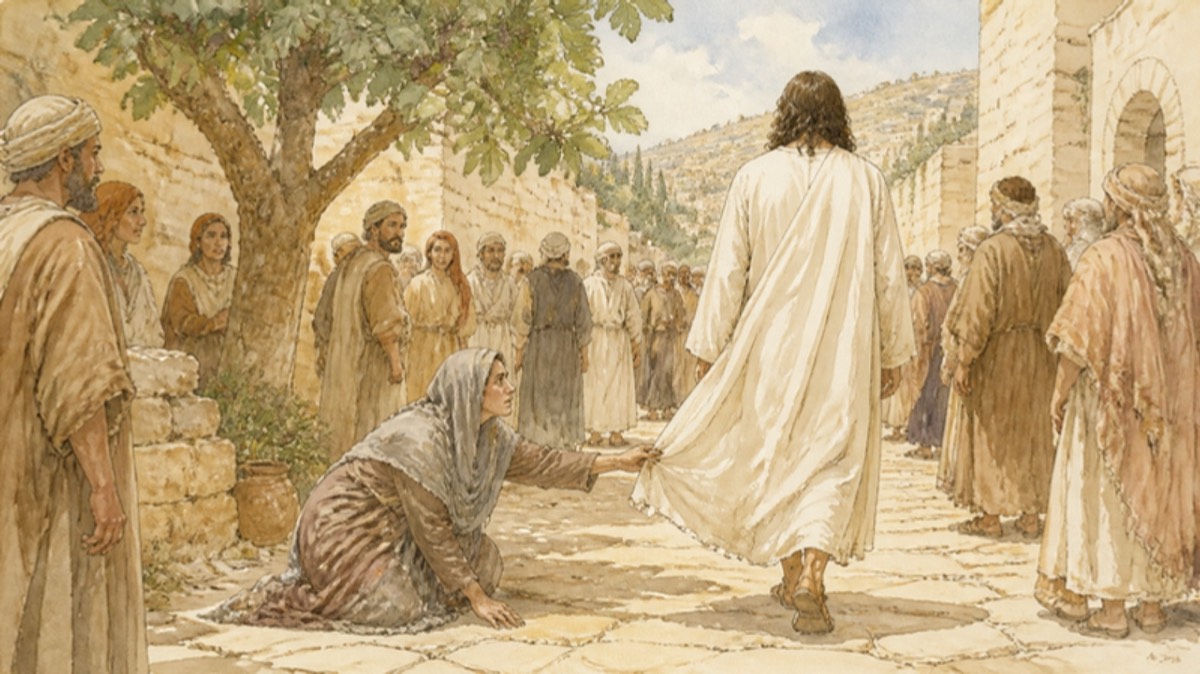
The woman had bled for twelve years, spent everything on doctors, and gotten worse (5:26). She touches his cloak in a crowd. “Daughter” — the only person in the Gospels Jesus addresses that way. “Go in peace and be freed from your suffering” names both the illness and what it had cost her.
16. Proverbs 17:22
A cheerful heart is good medicine, but a crushed spirit dries up the bones. — Proverbs 17:22 (NIV)
A one-line observation that a cheerful heart is good medicine and a crushed spirit “dries up the bones.” The writers of Proverbs noticed the link between mind and body long before anyone had a word for it.
17. Proverbs 4:20-22
My son, pay attention to what I say; turn your ear to my words. Do not let them out of your sight, keep them within your heart; for they are life to those who find them and health to one’s whole body. — Proverbs 4:20-22 (NIV)
A father’s words to his son, which he says bring “health to one’s whole body.” The Hebrew word is marpe — healing, cure. It describes what attention to wisdom does over a lifetime, not a technique for a diagnosis.
18. 3 John 1:2
Dear friend, I pray that you may enjoy good health and that all may go well with you, even as your soul is getting along well. — 3 John 1:2 (NIV)
John’s greeting to his friend Gaius: a wish for good health “even as your soul is getting along well.” It was a standard way to open a letter in that era. Commentators warn against reading a doctrine of guaranteed health into a greeting.
19. 2 Corinthians 12:9
But he said to me, “My grace is sufficient for you, for my power is made perfect in weakness.” Therefore I will boast all the more gladly about my weaknesses, so that Christ’s power may rest on me. — 2 Corinthians 12:9 (NIV)
Paul asked three times for the “thorn in my flesh” to be removed (12:7-8) and was told no. “My grace is sufficient for you” is the answer to a healing prayer that was not granted. It belongs on any honest list of healing verses.
20. Revelation 21:4
‘He will wipe every tear from their eyes. There will be no more death’ or mourning or crying or pain, for the old order of things has passed away.” — Revelation 21:4 (NIV)
The last healing in the Bible: no more death, mourning, crying, or pain. Every Christian tradition agrees this is where the story ends; the disagreements are about how much of it arrives before then.
What Christians disagree about
Does God still heal miraculously today? Cessationists hold that the miraculous gifts, including healing, belonged to the apostles’ generation. Continuationists hold that they continue. Nearly everyone in both camps agrees that God can heal, that praying for the sick is right (James 5:14), and that God sometimes does things doctors can’t explain. They differ on whether to expect it.
Is healing “in the atonement”? Some Pentecostal and Word of Faith teachers read Isaiah 53:5 and Matthew 8:17 as a guarantee of physical healing for believers now. Most other traditions read 1 Peter 2:24 as the controlling text and place full physical healing at the resurrection. The commentaries this article leans on (Enduring Word, GotQuestions) take the second view.
When healing does not come
The Bible records it plainly. Paul’s thorn stayed (2 Corinthians 12:7-9). He left his coworker Trophimus “sick in Miletus” (2 Timothy 4:20) and told Timothy to treat his frequent stomach illnesses with wine (1 Timothy 5:23) rather than promising a miracle. Job was healed only after a long argument in which his friends insisted his suffering must be his fault — and God rebuked the friends (Job 42:7). Nothing in these texts supports telling a sick person they lack faith.
Medicine and prayer together
Luke, who wrote a Gospel and Acts, was a physician (Colossians 4:14). Isaiah had a poultice of figs put on Hezekiah’s boil (Isaiah 38:21). The Christian moms I’ve read who are dealing with chronic illness mostly describe doing both — the oncologist and the elders — and treating the verses above as company rather than as a prescription. If you are sick, see your doctor; if you want prayer, James 5:14 says exactly whom to ask.
Sources
- James 5 (NIV) on BibleGateway
- Enduring Word — James 5 commentary
- Enduring Word — Isaiah 53 commentary
- Enduring Word — Psalm 103 commentary
- Enduring Word — 1 Peter 2 commentary
- Enduring Word — Mark 5 commentary
- Blue Letter Bible — James 5:14 with study tools
- Blue Letter Bible — Isaiah 53:5 with study tools
Questions moms ask
What is the most well-known Bible verse about healing?
Does “by his wounds we are healed” promise physical healing?
Does the Bible say anything about using doctors and medicine?
Scripture references in this article
Each reference opens the full passage on BibleGateway (NIV).
- Jeremiah 17:14
- Psalm 6:2
- Psalm 30:2
- Psalm 41:3
- James 5:14-15
- Luke 10:34
- James 5:16
- Exodus 15:26
- Psalm 103:2-4
- Psalm 147:3
- Jeremiah 30:17
- Malachi 4:2
- Isaiah 53:5
- 1 Peter 2:24
- Matthew 8:17
- Matthew 9:35
- Mark 5:34
- Proverbs 17:22
- Proverbs 4:20-22
- 3 John 1:2
- 2 Corinthians 12:9
- Revelation 21:4
- James 5:14
- 2 Corinthians 12:7-9
- 2 Timothy 4:20
- 1 Timothy 5:23
- Job 42:7
- Colossians 4:14
- Isaiah 38:21



Little helps for everyday faith
Start with a few quiet minutes.

Behind the notes
Hi, I'm Vega.
I'm a curious mom in Taiwan reading the Bible and writing down what I learn. I'm not a Christian — I grew up Buddhist — but after watching my aunt and the moms around me lean on these words through hard years, I wanted to understand why they carry so much weight. Every verse is quoted from the ESV or NIV and every interpretation links to a public commentary. I'm still learning; if you spot an error, tell me.
A little more about me